You know the feeling. There’s a word that means exactly what you want — the precise one — but it’s stuck just out of reach. Or you’re naming a company and you need a word that captures a feeling: something that sounds fast, or calm, or rare. A normal dictionary is no help, because you don’t know the word yet. You only know what it means.
That’s what a reverse dictionary is for. A regular dictionary goes word → meaning. A reverse dictionary goes the other way: meaning → word. Describe the concept, and it finds the words that fit.
We built one, and wired it straight into domain search. It’s live at Reverse Dictionary.
Meaning in, words out
Type a concept using a few words and you’ll get a ranked grid of related English words, streaming in as you type. Start broad: mountain, fast, big house.
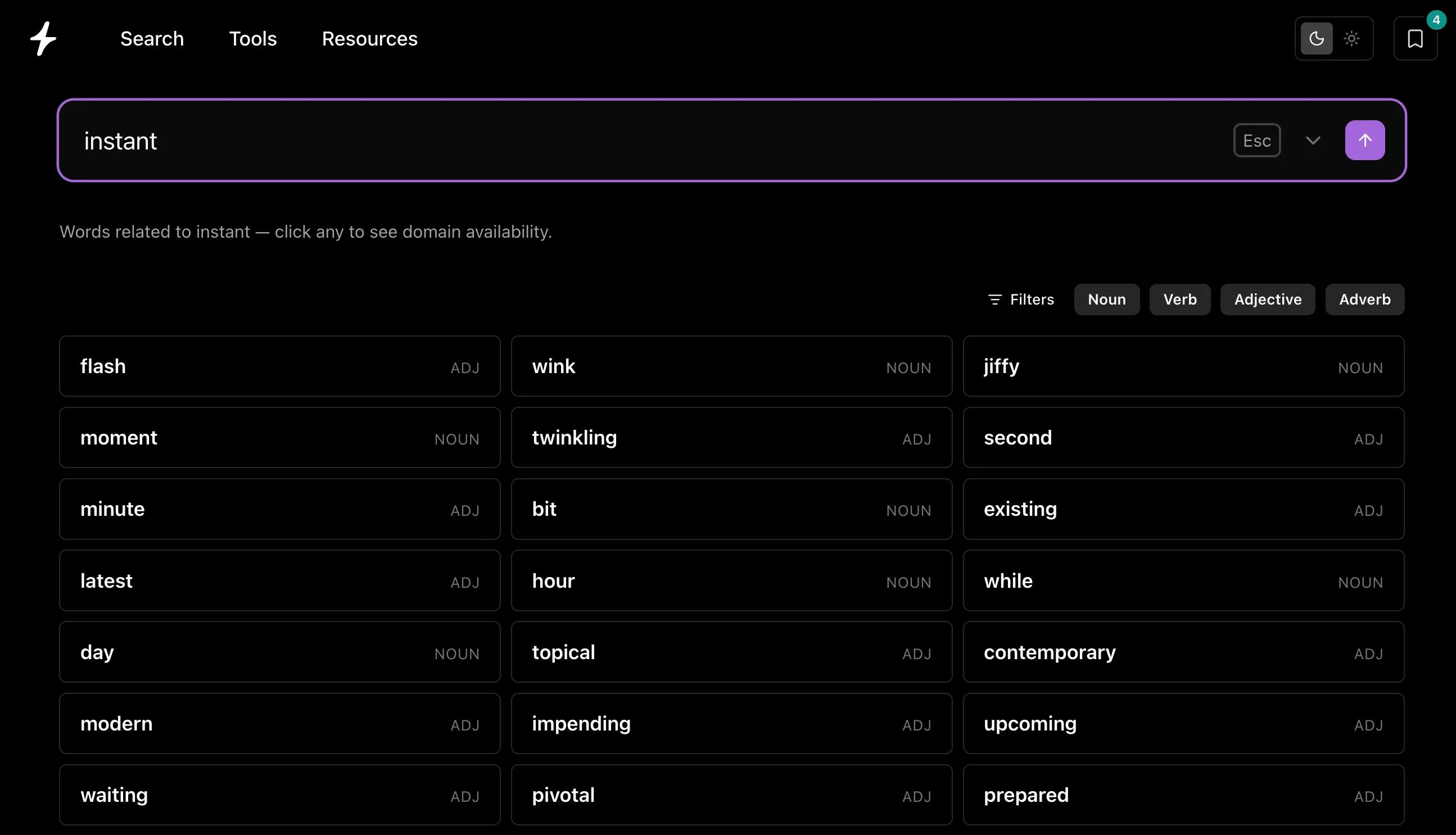
Here’s the fun part. Search a word like “instant” and you don’t just get the obvious synonyms, you’ll see words like jiffy and trice. Right away these might not click, but then you realize: a jiffy is an instant, and something done in a trice happens instantly. That little “oh, nice” moment is the whole point. It nudges you toward names you’d never reach from a synonym list.
Each result carries its part of speech and a short definition, so you can tell swift the adjective from swift the bird at a glance. Want only nouns for a brand name, or only verbs for an action-driven product? Filter the grid to nouns, verbs, adjectives, or adverbs.
How it works
So why does it surface jiffy for instant? Instead of matching synonyms, the reverse dictionary scans the definitions of every word in the dictionary and surfaces the ones whose meaning is associated with your concept, ranked by how strongly they relate. Working from meanings rather than a synonym list is exactly what turns up those adjacent, evocative words. It’s built on a structured lexical database (WordNet) and the same fast Rust search service behind the rest of Instant Domain Search. This means results stream in as you type, the way a domain search does.
It’s the latest in a line of language tooling we’ve built and written about: a blazing-fast word segmenter in Rust, real-time translation with word vectors, and the embedding models that keep our search under 10ms. Reverse Dictionary sits on top of that foundation.
From a word to a domain, in one click
This is where it stops being a vocabulary toy and becomes a naming tool. Click any word in the results and, right there in the grid, you’ll see:
- TLD competitiveness — how many extensions for that word are already registered versus still open.
- Available extensions — the open TLDs you can register right now (
.com,.io,.ai,.co, and more), color-coded by status and price. - Generator alternatives — domain generator-style suggestions built around the word, with exact-match extensions pinned to the top.
So the path runs concept → the right word → an available domain, without ever leaving the page. When something looks promising, open it in Check domain availability for the full report — ownership, pricing across registrars, and alternatives.
Why this helps with naming
The best one-word domains went years ago — but the language is enormous, and most of it never gets considered, simply because you don’t think of it. A reverse dictionary widens the net.
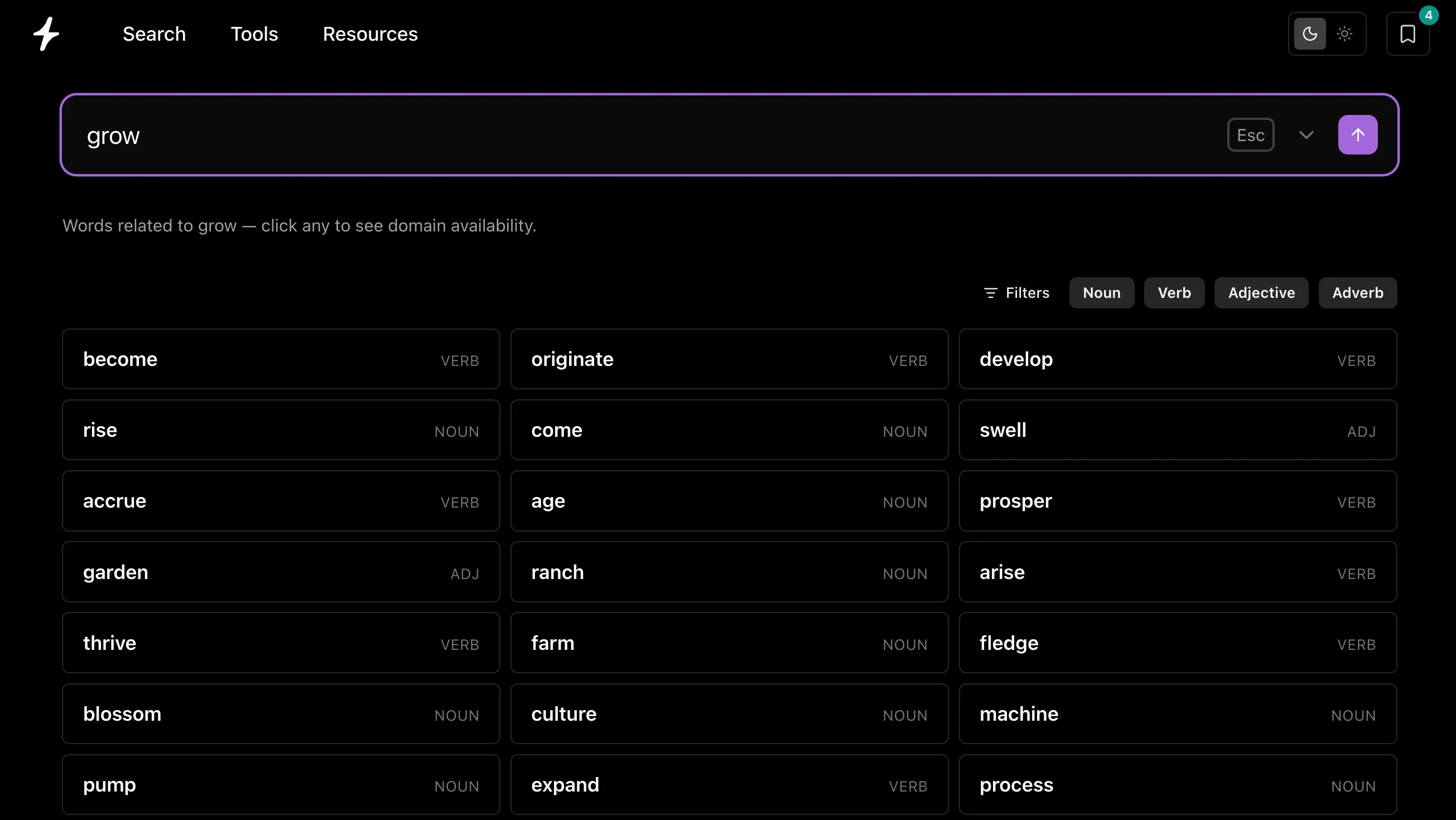
It’s the creative complement to our domain generator. The generator takes your keyword and takes the direct route to available prefixes, suffixes, and TLDs around it. The reverse dictionary is the indirect route, for when you only have the idea: describe the value your business delivers (say your product helps people grow) and you’ll surface words that tell that story without the obvious, already-taken match.
- Evocative brand names — describe the feeling you want (“calm,” “speed,” “trust”) and surface words you’d never have brainstormed.
- Unexpected angles — adjacent and associated words often make better brands than the obvious noun.
- One-word availability — pair it with our one-word dictionary domain lists and the domain generator to find names that are both meaningful and open.
For the bigger picture on turning a word into a brand, see how to choose a domain name and how to name your business.
Try it
Reverse Dictionary is live and free at instantdomainsearch.com/words — no account needed. You’ll also find it under the Tools menu in the nav bar.
Describe what you mean. We’ll find the word — and the domain name search to go with it.
Frequently asked questions
What is a reverse dictionary?
A reverse dictionary lets you find a word by its meaning instead of its spelling. You describe a concept — a definition, a feeling, or a few related words — and it returns the words that match. It’s the inverse of a normal dictionary, which starts from the word.
How is it different from a thesaurus?
A thesaurus gives you synonyms of a word you already have. A reverse dictionary works from meaning: it finds words whose definitions relate to your concept, which surfaces adjacent, creative results — like jiffy or trice for instant — instead of the dry synonym list a thesaurus returns.
Is it free?
Yes. The reverse dictionary is completely free and requires no account, like the rest of Instant Domain Search.
Can I find an available domain from a word?
Yes — that’s the point. Click any word in the results to see which domain extensions are available for it, then register through your preferred registrar or dig deeper in the domain checker.