chronosphere.io traffic, backlinks, authority, and more
Chronosphere.io is a cloud-native observability and monitoring platform for enterprises, offering scalable metrics, tracing, and analytics as a SaaS solution used primarily by SREs, DevOps, and engineering teams managing large-scale cloud infrastructure. The site is well-regarded within the cloud infrastructure and observability community and recognized by engineering organizations seeking high-scale telemetry solutions, with estimated daily visits in the hundreds.
Score assigned based on the strength of the domain online
Estimated monthly organic traffic from search engines
Total number of links from other websites pointing to this domain
Traffic Analysis
The site's traffic has declined by 2% year-over-year with over 3,222 monthly visits driven primarily by strong interest in observability and telemetry solutions for cloud-native and microservices environments, including log collection/forwarding, metrics/tracing workflows, and visualization/time-series analysis. Geographically, traffic is concentrated in North America (~63.7%), with a significant Asia‑Pacific presence (~27.0%) led by Australia and India, and a smaller but strategic European share (~8.4%), reflecting a user base centered on US enterprise buyers with growing adoption in APAC and targeted opportunities to expand further into European markets.
Domain Preview & WHOIS Information
Home
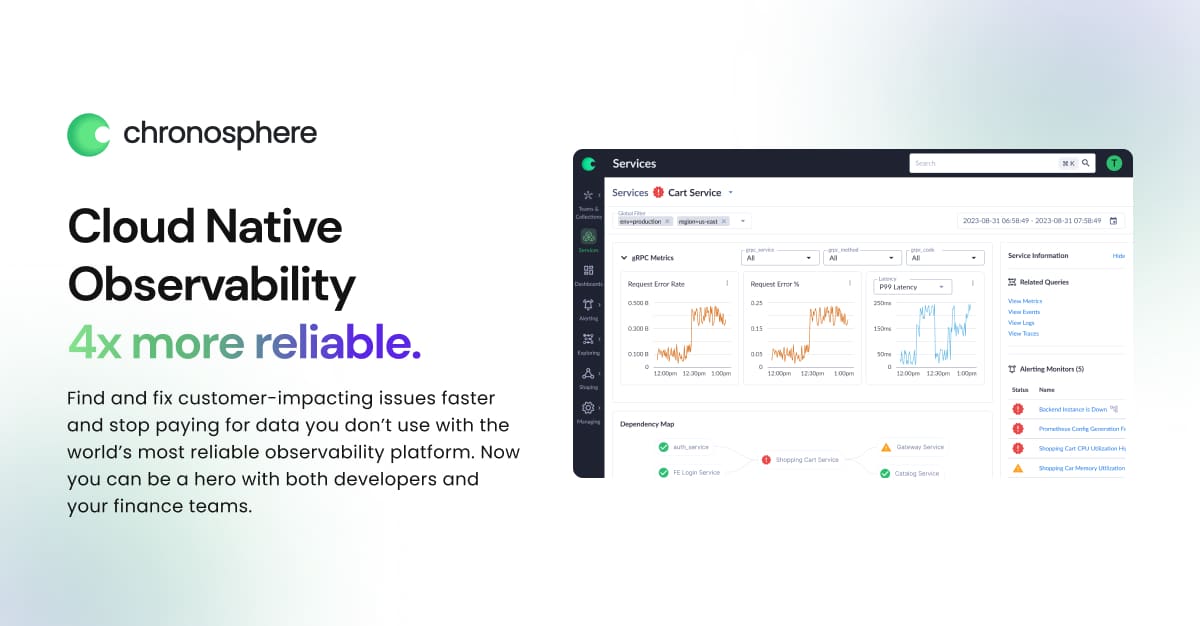
Find and fix customer-impacting issues faster and stop paying for data you don’t use. Chronosphere is the world’s most reliable observability platform for microservices and containers.
The domain chronosphere.io was registered on March 5, 2019, through gandi sas and uses Cloudflare for DNS and security. At 7 years old, the domain benefits from a proven track record and accumulated authority, signaling established credibility and providing SEO advantages from a mature online presence.
Backlink Profile and Referring Domains
Referring Domains
The backlink set for Chronosphere shows a mix of mostly medium-authority (DA 40-69) and lower-authority links with a few stronger placements — notably DA 57 from charity.wtf and a DA 41 membership listing, coming from technology publications, developer resources, and industry leaders that lend credibility to the profile. This blend of referring domains, combined with a sizable total backlink count and decent trust signals, supports Chronosphere’s organic visibility by reinforcing topical relevance and domain authority in search, strengthening its overall SEO strength.
The sample top links show a roughly balanced dofollow-to-nofollow distribution of approximately 44:56 dofollow:nofollow, meaning a significant portion of links are nofollow but the dofollow links from the higher-authority sources still pass valuable link equity. Anchor text is heavily branded — about 78% branded, 11% naked URLs, and 11% keyword-rich/other, which is largely natural and safe but could benefit from slightly more diverse, keyword-rich anchors to improve topical relevance without risking over-optimization.
Keyword Rankings
Top Ranking Keywords
The domain chronosphere.io demonstrates a concentrated keyword portfolio centered on brand and technical terms with predominantly low-competition queries and a mix of informational and transactional intent, highlighted by keywords with search volumes like 260, 210, 70, 210, and 50 and CPCs ranging from $0 to $8.47 that reflect both brand discovery and niche technical interest. The top keyword 'chronosphere careers' attracts daily searches in the dozens with a $0 CPC, indicating solid brand recognition. The other four keywords — a misspelled brand variant (chronoshpere, competition 5%), company lookups (chronosphere inc competition 10% and chronosphere company competition 5% with a higher $8.47 CPC), and a technical query (log files on disk, competition 0%) — are all low-competition terms that reveal a market positioning focused on brand-awareness and technical audience reach with selective commercial intent. The domain’s assets show strong organic visibility, healthy keyword portfolio, and competitive SEO performance.
Competitive Landscape
chronosphere.io competes in the observability and cloud monitoring space against established players like Prometheus and OpenTelemetry and newer alternatives such as Honeycomb and Mezmo. Compared with those incumbents, chronosphere.io shows a more modest organic footprint (3,222 visits) relative to leaders like OpenTelemetry and Prometheus, but it is positioned as a specialist focused on enterprise-scale metrics, offering a niche in cost-optimized, high-cardinality telemetry that has driven targeted adoption among cloud-native teams despite lower overall traffic.
With a Domain Authority score of 34, chronosphere.io sits on par with its listed competitors within the observability and cloud monitoring industry, indicating comparable backlink profiles even as organic traffic varies across providers. By targeting large engineering organizations with features like high-throughput metrics ingestion, Prometheus compatibility, and active cost controls—its key differentiators—chronosphere.io has secured enterprise adoption and market penetration through focused sales motion and product-led proof points, yielding concentrated but meaningful growth and organic visibility.
FAQ on chronosphere.io
Everything you need to know about chronosphere.io.
What is chronosphere.io's primary business model?
Chronosphere operates as a commercial observability platform provider, selling software and managed services to enterprises for large-scale metrics and monitoring. It offers a cloud-native, SaaS-based product that ingests Prometheus-compatible metrics and provides analytics, alerting, and cost-control features under subscription and enterprise licensing.
Is chronosphere.io considered a market leader, a challenger, or a niche player?
Chronosphere is considered a challenger in the observability market. It competes with established vendors by targeting enterprises with heavy metrics scale and cost-management needs, positioning itself against broader incumbents rather than as a niche single-feature provider.
What makes chronosphere.io unique compared to its competitors?
Chronosphere emphasizes enterprise-scale metrics ingestion and storage with Prometheus compatibility, designed to handle very high cardinality and volume while controlling cost through intelligent downsampling and retention policies. It also focuses on reliability and SLO-driven workflows for large, cloud-native environments, differentiating from log- or trace-centric vendors by prioritizing scalable metrics and cost predictability.
What are the most recent major updates or strategic shifts seen on chronosphere.io?
Recent public signals show Chronosphere doubling down on scalability, enterprise features, and ecosystem integrations—particularly compatibility with Prometheus and OpenTelemetry—to address large-scale cloud-native monitoring needs. The company has also emphasized cost optimization, SLO-driven observability, and expanding managed SaaS capabilities and integrations with other observability tools and cloud platforms.
Related Domains
Explore other domains similar to chronosphere.io.