Domain Name Glossary

Learn the terminology behind domain names, TLDs, DNS, WHOIS, and domain valuation. A reference guide from Instant Domain Search.

19 terms • Updated Dec 2025

19 terms

Domain Name

Technical

A domain name is the human-readable address used to access a website on the internet. Instead of typing a numeric IP address like 192.0.2.1, you type a memorable name like instantdomainsearch.com. Every website has a domain name: it's how users find you online and how your brand exists on the web.

Top-Level Domain (TLD)

Technical

A top-level domain (TLD) is the last segment of a domain name—the part that follows the final dot. In instantdomainsearch.com, the TLD is .com. TLDs sit at the highest level of the internet's hierarchical Domain Name System and determine which registry manages your domain name.

Country Code TLD (ccTLD)

Technical

A country code top-level domain (ccTLD) is a two-letter domain extension assigned to a specific country or territory. Examples include .uk for the United Kingdom, .de for Germany, .jp for Japan, and .ca for Canada. There are approximately 250 ccTLDs, each representing a nation or territory based on ISO 3166-1 alpha-2 codes. Unlike generic TLDs like .com or .net, ccTLDs are tied to geographic locations—though some have evolved far beyond their original purpose.

Domain Extension

Technical

A domain extension is the suffix at the end of a domain name, appearing after the final dot. In instantdomainsearch.com, the extension is .com. Extensions are also called top-level domains (TLDs), and the terms are used interchangeably. There are over 1,500 domain extensions available today, from familiar options like .com and .net to industry-specific choices like .app, .io, and .ai.

Premium Domain

Business

A premium domain is a domain name priced significantly higher than standard registration—ranging from hundreds to millions of dollars. Premium domains are valuable because they're short, memorable, contain desirable keywords, or use sought-after extensions like .com. Names like voice.com ($30 million), insurance.com ($35.6 million), and cars.com ($872 million) represent the high end, but most premium domain transactions happen in the $500–50,000 range for quality brandable or keyword-rich names.

Exact Match Domain (EMD)

SEO

An exact match domain (EMD) is a domain name that precisely matches a search query or keyword phrase. If someone searches "cheap flights," the exact match domain would be cheapflights.com. EMDs were once a powerful SEO tactic—owning the keyword as your domain could boost rankings significantly. Google's 2012 EMD Update reduced this advantage for low-quality sites, but exact match domains still offer benefits: instant relevance, memorability, and type-in traffic from users guessing URLs.

Aftermarket Domains

Business

Aftermarket domains are previously registered domain names available for purchase from their current owners rather than through standard registration. When someone already owns the domain you want, the domain aftermarket is where you buy it—through marketplaces, auctions, or direct negotiation. Prices range from under $100 for basic names to millions for premium domains like single-word .com names. The aftermarket accounts for billions of dollars in annual domain transactions.

Domain Parking

Business

Domain parking is the practice of registering a domain name without attaching it to an active website. A parked domain displays a placeholder page—often showing advertisements, a "for sale" notice, or simply a "coming soon" message. Domain owners park domains they aren't ready to develop, want to monetize passively, or intend to sell. While domain parking was once a significant revenue source, declining ad rates and changing user behavior have reduced its profitability substantially.

Expired Domains

Business

Expired domains are previously registered domain names that weren't renewed by their owners and have become available for new registration. When someone stops paying for a domain—whether intentionally or by accident—it eventually drops and can be registered by anyone. Expired domains can be valuable because they may retain backlinks, traffic, domain authority, and brand recognition from their previous life. Finding quality expired domains is a strategy used by SEO professionals, domain investors, and businesses seeking established web properties.

WHOIS

Technical

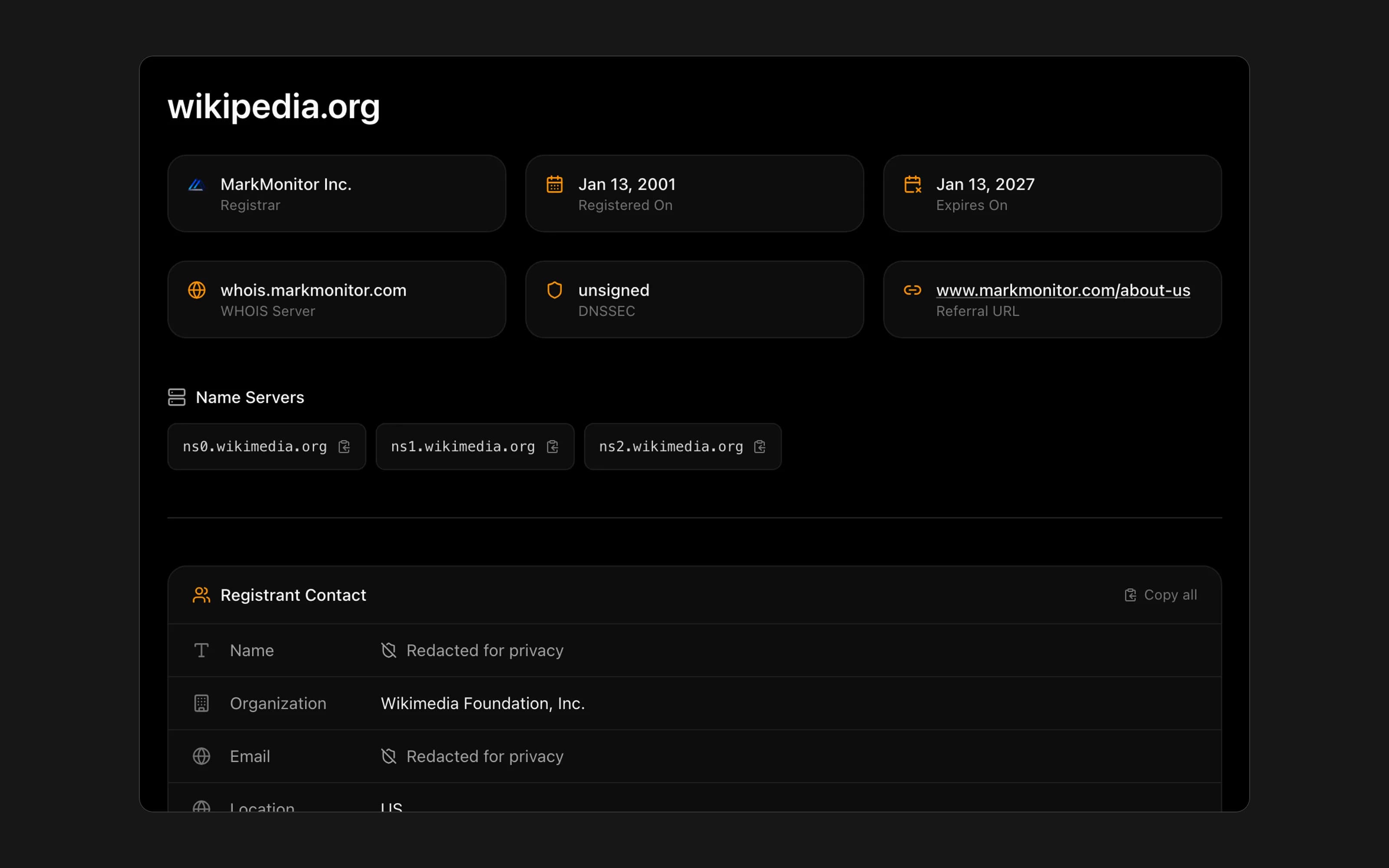
WHOIS is a public database and query protocol that displays registration information for domain names, including who owns a domain, when it was registered, when it expires, and which registrar manages it. When you perform a WHOIS lookup, you're querying this database to find out who owns a website's domain. While WHOIS has been the standard for domain ownership queries since the 1980s, privacy regulations like GDPR have led to widespread data redaction, and the newer RDAP protocol is gradually replacing it.

RDAP

Technical

RDAP (Registration Data Access Protocol) is the modern replacement for WHOIS, providing standardized access to domain name registration data. While WHOIS returns inconsistent plain text over unencrypted connections, RDAP delivers structured JSON responses over secure HTTPS with support for authenticated access. ICANN mandated RDAP support from domain registries and registrars starting in 2019, making it the current standard for querying domain ownership information.

Domain Registrar vs. Registry

Technical

A domain registrar is the company where you buy and manage domain names—like GoDaddy, Namecheap, or Cloudflare. A domain registry is the organization that maintains the authoritative database of all domains under a specific TLD—like Verisign for .com or PIR for .org. You interact with registrars; registrars interact with registries on your behalf. Understanding this distinction helps you navigate domain ownership, transfers, and the pricing chain that determines what you pay.

URL

Technical

A URL (Uniform Resource Locator) is the address you type into a browser to visit a website—like https://www.example.com/page. URLs are how you navigate the web, telling your browser exactly which resource to retrieve and where to find it. While people often use "URL" and "domain name" interchangeably, they're different: a domain name is one component of a URL, which also includes the protocol, path, and other elements that specify exactly what you want to access.

Brandable Domain

Business

A brandable domain is a domain name designed to function as a distinctive brand identity rather than describe what a business does. Names like Google, Spotify, Shopify, and Stripe are brandable domains—memorable, unique, and ownable. Unlike exact match domains (cheapflights.com) that describe services, brandable domains create identity through sound, feel, and association. They're often invented words, creative combinations, or repurposed terms that become synonymous with the companies behind them.

DNS (Domain Name System)

Technical

DNS (Domain Name System) is the internet's phone book—it translates human-readable domain names like google.com into the numeric IP addresses computers use to locate each other. When you type a URL into your browser, DNS servers work behind the scenes to find the correct IP address and connect you to the website. Without DNS, you'd need to memorize strings like 142.250.80.46 instead of simply typing google.com.

.ai Domain

Technical

The .ai domain is the country code TLD (ccTLD) for Anguilla, a small Caribbean island. However, .ai has become the go-to domain extension for artificial intelligence companies, AI startups, and tech projects worldwide. The coincidental match between Anguilla's country code and the "AI" abbreviation has made .ai domains highly sought after—and significantly more expensive than most other extensions, with standard registrations starting around $80–100/year.

Domain Authority

SEO

Domain authority is a search engine ranking score that predicts how likely a website is to rank in search results. Developed by Moz, it's measured on a scale from 1 to 100—higher scores indicate greater ranking potential.

Backlinks

SEO

Backlinks are incoming links from one website to another. When another site links to your page, that's a backlink. They're one of the most important ranking factors in search engine optimization—essentially votes of confidence that signal your content is worth referencing.

Generic TLD (gTLD)

Technical

A generic top-level domain (gTLD) is a domain extension that isn't tied to a specific country or territory. Unlike ccTLDs such as .uk or .de, gTLDs are available to anyone worldwide. The original gTLDs—.com, .net, and .org—remain the most recognized extensions on the internet. Since 2012, over 1,200 new gTLDs have launched, from .app and .blog to .xyz and .shop.