cortex.io traffic, backlinks, authority, and more
Cortex.io is a technology company offering AI-powered data integration and analytics solutions for enterprises and developers, providing tools for extracting, organizing, and acting on complex datasets across business and research environments. The site is modestly recognized within data science and enterprise IT communities but not widely known to the general public, maintaining niche visibility among its target users with estimated daily visits in the hundreds.
Score assigned based on the strength of the domain online
Estimated monthly organic traffic from search engines
Total number of links from other websites pointing to this domain
Traffic Analysis
The site's traffic has declined by 30% year-over-year with over 8,190 monthly visits driven primarily by interest in developer tooling and workflows, cloud migration and infrastructure modernization, and reliability/incident response topics that align with engineering and platform teams' needs. Traffic is concentrated in Asia-Pacific (~39.2%), North America (~35.7%), and EMEA (~22.8%), indicating strong demand from enterprise engineering organizations across APAC and the US while Europe and surrounding markets represent a meaningful but smaller portion of the domain’s target markets and industry presence.
Domain Preview & WHOIS Information
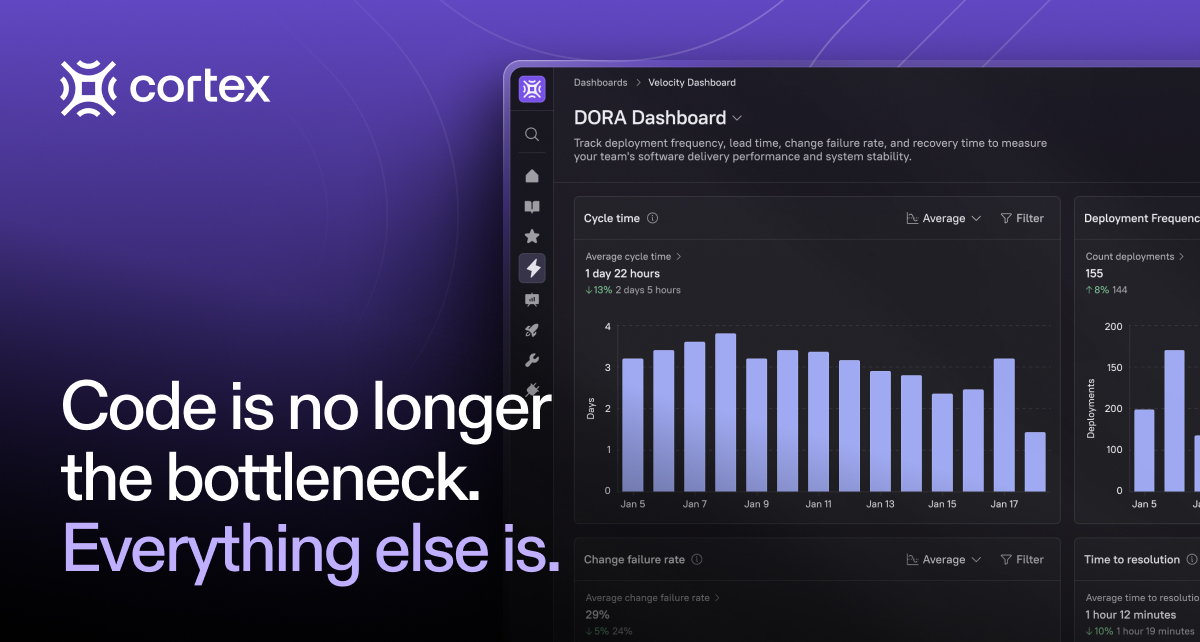
Cortex | EngOps Platform
Cortex is the Engineering Operations Platform that helps organizations continuously improve their operational maturity and reduce developer friction – so that the whole organization operates as one.
The domain cortex.io was registered on April 2, 2012, through key-systems gmbh and uses Google Cloud for DNS and security. At 13 years old, the domain carries established credibility, accumulated authority, and a mature online presence that bolster trust signals and long-term SEO benefits.
Backlink Profile and Referring Domains
The backlink profile for Cortex shows mostly lower-authority links with the domain's own Domain Authority around DA 36 and the top referring sources scoring under DA 40, with no DA 70+ or clearly high-authority placements; notable sources are primarily podcasts, technology publications, developer resources and industry organizations such as Spotify podcast listings, Built In job pages, Grafana Labs and USENIX. This distribution provides baseline credibility and referral traffic but limits strong organic ranking boosts — the links contribute to visibility and topical relevance but the overall SEO strength is constrained by the lack of medium- to high-authority backlinks and modest Trust/Domains metrics.
Based on the provided backlink entries, the dofollow-to-nofollow split is roughly 50:50, indicating a balanced distribution where the available dofollow links (about 5 of 10 listed) can pass link equity, though that equity is moderate given the lower authority of those sources. Anchor text is dominated by branded mentions — approximately 70% branded (Cortex / Cortex.io), 0% naked URLs, 0% keyword-rich, and 30% other (generic "View Website"), which is generally natural and safe for avoiding over-optimization but suggests an opportunity to diversify with targeted, contextual keyword anchors from higher-authority sites to strengthen relevance.
Keyword Rankings
Top Ranking Keywords
The domain cortex.io demonstrates a focused keyword portfolio around brand and cloud migration themes with top-ranking terms like cortex i (170), cloud migration tools (1,000) and product queries that position it at the intersection of developer-focused and IT decision-maker search intent, reflecting a targeted SEO approach with commercial and informational value. The top keyword 'cortex i' attracts daily searches in the dozens with a $0 CPC, indicating solid brand recognition. The other four keywords — cloud migration tools (1,000 SV, $14.28 CPC, 11% competition - low), cloud migration software (480 SV, $0 CPC, 4% competition - low), cortex idp (140 SV, $8.56 CPC, 20% competition - low) and cortex dev (90 SV, $0 CPC, 1% competition - low) — all hold #1 positions with generally low competition, revealing strong SERP control in a niche technical market and clear commercial intent around cloud migration solutions. Overall the domain's strengths are its concentrated topical relevance, top rankings across high-value terms and a healthy balance of brand and commercial queries, reflecting strong organic visibility.
Competitive Landscape
cortex.io competes in the developer tooling and software delivery/observability space against established players like Jellyfish, OpsLevel, GetDX, and newer alternatives such as Port.io and getdx.com. Compared to larger incumbents, cortex.io shows mid-tier traffic (8,190 organic visits) and a compact but comparable backlink footprint, positioning it as a technically focused alternative that leverages a niche technical integration and developer-centric messaging to capture users who prefer lightweight, API-first tooling over broader platform suites.
The domain carries a Domain Authority score of 36, which places it squarely on par with primary competitors in the developer tooling and software delivery industry but below enterprise-level platform leaders, indicating equal SEO competitiveness within this peer set. cortex.io targets developer and engineering teams with API-driven capabilities, tight integrations, and developer-friendly UX, which has translated into organic visibility and market penetration among niche technical buyers and contributed to strong word-of-mouth growth.
FAQ on cortex.io
Everything you need to know about cortex.io.
What is cortex.io's primary business model?
Cortex.io operates primarily as a B2B SaaS provider, selling subscription access to its engineering and developer productivity intelligence platform. Customers typically pay recurring fees for access to analytics, integrations with CI/CD and source control systems, and support services tailored to software delivery teams.
Is cortex.io considered a market leader, a challenger, or a niche player?
Cortex.io is best characterized as a challenger in the engineering productivity and software delivery intelligence space. It competes with better-known firms by focusing on specific workflow and analytics capabilities while aiming to expand its market presence against established vendors.
What makes cortex.io unique compared to its competitors?
Cortex.io differentiates itself through a combination of developer-focused analytics, deep integrations with source control and CI/CD toolchains, and an emphasis on actionable insights that map technical activity to delivery outcomes. The platform also positions itself on ease of instrumentation and workflow-centric views that appeal to engineering managers and platform teams.
What are the most recent major updates or strategic shifts seen on cortex.io?
Publicly available specifics on recent product releases may be limited, but cortex.io appears to be following broader market trends by enhancing integrations, investing in analytics and automation, and incorporating AI-driven insights to surface productivity and flow metrics. Strategically, the company is focused on expanding enterprise capabilities, improving interoperability with popular DevOps tools, and sharpening propositions that tie engineering metrics to business value.
Related Domains
Explore other domains similar to cortex.io.