grammarly.com traffic, backlinks, authority, and more
Grammarly.com is an AI-powered writing assistance platform in the software and edtech industries that provides grammar, spelling, punctuation, style, and clarity suggestions as a SaaS tool used by students, professionals, writers, ESL learners, and businesses. The site is widely recognized among the general public and its target users for improving writing quality and productivity, maintaining strong brand awareness and enterprise adoption with estimated daily visits in the hundreds of thousands.
Score assigned based on the strength of the domain online
Estimated monthly organic traffic from search engines
Total number of links from other websites pointing to this domain
Traffic Analysis
The site's traffic has grown by 15% year-over-year with over 12,220,726 monthly visits driven primarily by increased demand for AI-assisted writing and editing features, citation and reference tools, and quick grammar and usage lookups that boost both individual productivity and academic workflows. The audience is concentrated in North America (~45.2% of traffic), followed by Asia-Pacific (~39.8%) and Europe (~8.7%), a distribution that underscores strong penetration in primary English-speaking and high-education markets while highlighting significant growth opportunities across APAC for product localization and enterprise partnerships.
Domain Preview & WHOIS Information
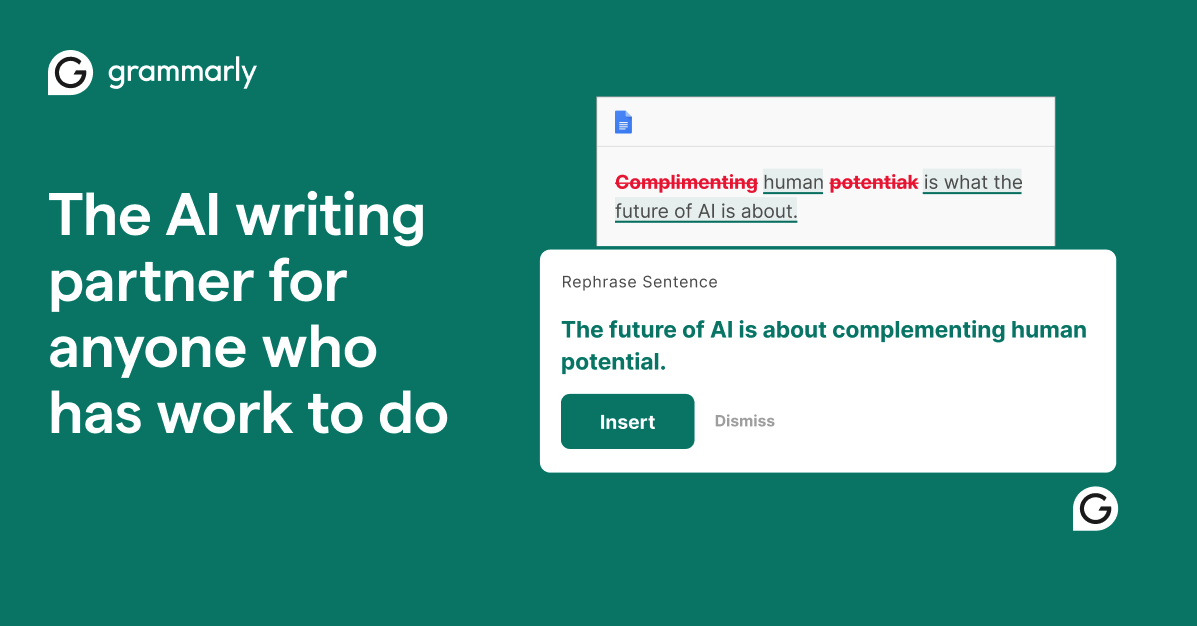
Grammarly: Free AI Writing Assistance
Grammarly makes AI writing convenient. Work smarter with personalized AI guidance and text generation on any app or website.
The domain grammarly.com was registered on July 1, 2009, through godaddy.com, llc and uses AWS for DNS and security. At 16 years old, the domain benefits from established credibility, a mature online presence, a proven track record, and accumulated authority that strengthen trust signals, backlink profile, and SEO performance, making it well-positioned for continued organic visibility and ranking stability.
Backlink Profile and Referring Domains
Backlinks
Referring Domains
The backlink profile for Grammarly shows predominantly medium-authority (DA 40-69) backlinks among the top referring pages (most top links fall in the DA 51–66 range) with strong overall site metrics (site DA reported at 89) and notable placements on technology publications, the Chrome Web Store, Wikipedia, and education resources which act as reputable referral sources. This mix of widespread medium-authority citations combined with high overall domain metrics contributes significantly to Grammarly’s organic visibility by reinforcing topical relevance and trust, boosting its SEO strength and capacity to rank for competitive keywords.
The sampled links display an approximate dofollow-to-nofollow ratio of 80:20, with the majority being dofollow — meaning the dofollow links from higher-tier referring pages (mid-60s DA) effectively pass link equity and support ranking signals. Anchor text is dominated by branded (60%), with naked URLs (20%) and other/generic anchors (20%) (e.g., “Website”), while keyword-rich anchors (0%) are absent; this is largely natural and healthy for a large brand but suggests some opportunity to diversify anchor profiles with targeted keyword-rich anchors for improved topical relevance.
Keyword Rankings
Top Ranking Keywords
The domain grammarly.com presents a diversified keyword portfolio focused on writing improvement and AI-assisted editing, capturing both branded and high-volume utility queries which underscores its product-led SEO positioning and audience targeting. The top keyword 'ai checker' attracts daily searches in the tens of thousands with a $0.32 CPC, indicating strong commercial value. The other keywords — email etiquette (volume 1,830,000, competition 3%), the common misspelling grammerly (volume 301,000, competition 1%), plagiarism checker (volume 368,000, competition 31%), and grammarly ai (volume 110,000, competition 4%) — all sit in low-competition ranges, revealing a market where Grammarly holds favorable SERP positions across both branded and transactional intent audiences with limited paid competitive pressure. Overall the domain shows strong organic visibility and a healthy keyword portfolio, reflecting competitive SEO performance and robust topical authority.
Technology Stack
 AmazonAmazon CloudFrontAmazon S3
grammarly.com is built on a modern frontend stack that mixes React with legacy helper libraries like jQuery, orchestrated via Next.js for server-side rendering and static generation benefits, and bundled with Webpack to optimize asset delivery — a combination that improves runtime performance and developer experience through component-driven architecture and faster builds. On the backend and delivery side the site runs on Amazon EC2 with static assets in Amazon S3 served globally through Amazon CloudFront and fronted by nginx, giving the application strong reliability, scalability and global distribution while offloading heavy static delivery to the CDN for consistent performance worldwide.
The security and DNS layer is anchored by DigiCert SSL certificates and HSTS to enforce HTTPS, with reCAPTCHA for bot mitigation and Okta for identity management, together providing secure authentication, protection against automated abuse and helping ensure content is served securely and quickly across regions (in concert with the CDN for DDoS protection and fast load times). Observability and product tooling include Google Analytics, Google Tag Manager, Mixpanel and Hotjar to inform development, monitoring and UX improvements, and the stack is amenable to enhancements like type safety via TypeScript, efficient data fetching with GraphQL, or modern CSS solutions where present to further strengthen developer productivity and runtime clarity.
Competitive Landscape
grammarly.com competes in the writing assistance and grammar checking space against established players like ProWritingAid, QuillBot, and institutional resources such as Purdue (OWL), and newer alternatives like Scribbr and consumer tools built into Microsoft Editor and Google Docs. Compared to these players, grammarly.com shows stronger broad-market traction — it leads in organic traffic (12.2M) and widespread integrations, positioning it as the mass-market, multi-platform leader with a freemium model and real-time AI-driven corrections that capture everyday writers and enterprise customers alike.
With a Domain Authority score of 89, grammarly.com sits on par with direct competitors in the writing assistance industry, meaning domain credibility is equivalent but Grammarly leverages higher traffic and visibility to dominate SERP real estate. Its focus on consumer and professional user targeting, coupled with browser extensions, document editor integrations, plagiarism checking, and advanced style suggestions, has driven strong organic visibility and market penetration, translating into sustained user growth and high brand recall.
FAQ on grammarly.com
Everything you need to know about grammarly.com.
What is grammarly.com's primary business model?
Grammarly operates a freemium SaaS model: it offers a free writing assistant with basic grammar and spelling checks and sells premium subscriptions with advanced features like style suggestions, tone detection, plagiarism checking, and enterprise plans for teams. Revenue is generated primarily from individual monthly/annual subscriptions and business/education contracts, plus integrations with third-party platforms and app marketplaces.
Is grammarly.com considered a market leader, a challenger, or a niche player?
Market leader. Grammarly is widely recognized as a market leader in consumer-facing AI writing assistance, with broad brand recognition, a large user base, and extensive integrations compared with competitors focused on narrower segments.
What makes grammarly.com unique compared to its competitors?
Grammarly differentiates itself through its extensive cross-platform integrations (browser extensions, desktop apps, Microsoft and Google integrations, mobile keyboard), a polished user experience, and an emphasis on readability, tone and clarity in addition to grammar. It also combines machine learning-powered suggestions with plagiarism detection and enterprise features, positioning itself as an end-to-end writing assistant for individuals and organizations.
What are the most recent major updates or strategic shifts seen on grammarly.com?
In recent years Grammarly has pushed into generative AI capabilities and personalization with products like GrammarlyGO, expanded enterprise and education offerings, and deeper integrations across productivity tools to capture professional workflows. The company has also emphasized privacy, compliance, and scalability for business customers while iterating on mobile and browser experiences to keep pace with evolving AI writing trends.