permit.io traffic, backlinks, authority, and more
Permit.io is a technology company offering an authorization and permissions management platform for software developers and engineering teams in the identity and access management and security industry. The site is primarily known within developer and security communities rather than the general public, maintaining modest visibility among its target users with estimated daily visits in the dozens.
Score assigned based on the strength of the domain online
Estimated monthly organic traffic from search engines
Total number of links from other websites pointing to this domain
Traffic Analysis
The site's traffic has declined by 57% year-over-year with over 2,293 monthly visits driven primarily by a concentrated interest in access-control and permissions topics — including HTTP status/code troubleshooting, authentication/authorization patterns, and enterprise permission models that inform product-led searches and troubleshooting behavior. Geographically the audience is heavily skewed to North America (primarily the US) at 45.3%, followed by Latin America (led by Brazil) at 15.1%, and Asia‑Pacific (led by India and Australia) at 13.5%, indicating a strong US/enterprise security market presence with secondary opportunity growth in Latin American and APAC markets where the domain could localize content and developer resources to regain traction.
Domain Preview & WHOIS Information
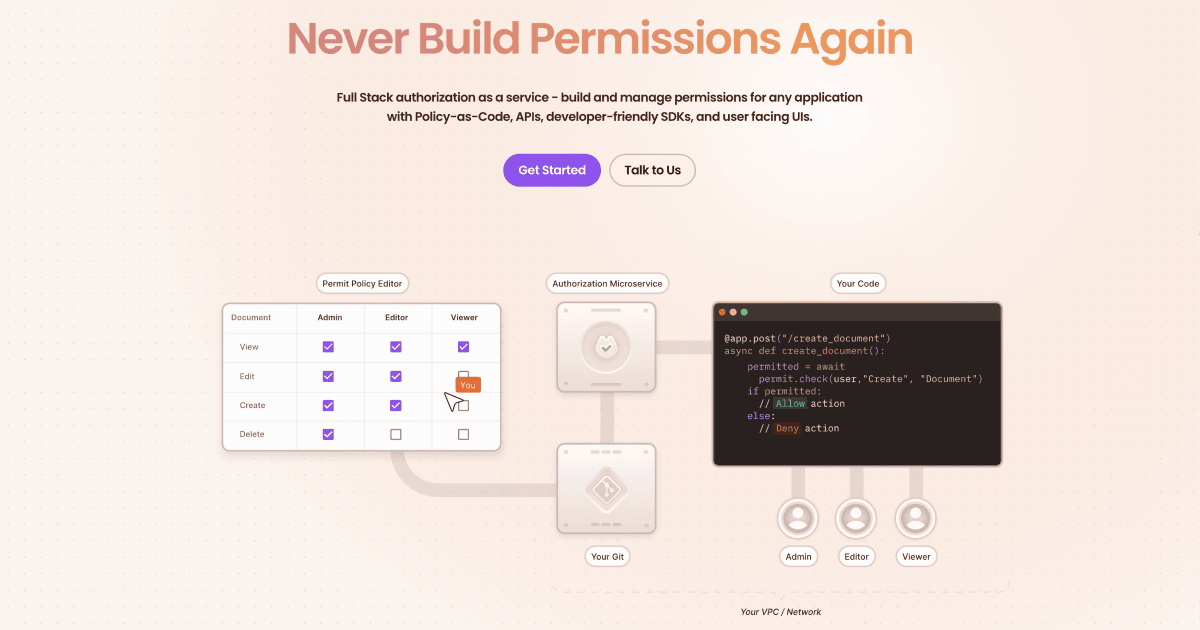
Permit.io | Permissions for the AI Era
Control what AI agents can do — at action time, across every system they touch. The control plane for agentic identity and fine-grained authorization.
The domain permit.io was registered on April 21, 2013, through gandi sas and uses AWS for DNS and security. At 12 years old, the domain likely benefits from established credibility, a mature online presence, and accumulated authority, which can translate into stronger trust signals, improved search visibility, and a proven track record supporting long-term SEO performance.
Backlink Profile and Referring Domains
Referring Domains
The backlink profile for Permit.io is dominated by low-to-medium authority referring domains (most top links are below DA 40 with a small number in the DA 40-69 range), coming primarily from developer resources and technology publications such as GitHub and Medium rather than top-tier outlets; a handful of medium-authority placements (e.g., DA 45) provide some uplift but there are no evident DA 70+ sources. This mix yields a modest but tangible link footprint — a high volume of referring domains and total backlinks supports crawl frequency and topical relevance, contributing to improved organic visibility while the lack of very high-authority links limits major upward shifts in rankings (so overall SEO strength is moderate).
The explicit dofollow-to-nofollow ratio in the provided top-link sample is heavily skewed toward nofollow — approximately 0:100 (dofollow:dofollow-to-nofollow) based on the listed links — meaning there is minimal direct link equity being passed from these entries, and any dofollow links from high-authority sources would be especially valuable for authority transfer. Anchor texts are predominantly branded: Branded 82%, Naked URLs 0%, Keyword-rich 0%, Other 18% (generic labels like “💻 Website” or “io”), which is relatively natural and safe but indicates an opportunity to diversify with more keyword-rich anchors and secure more dofollow placements to strengthen organic rankings.
Keyword Rankings
Top Ranking Keywords
The domain permit.io presents a focused keyword portfolio centered on branded searches, parking-permit related queries, news, and a high-value technical term, showing niche industry targeting with primarily low-competition keywords and a mix of informational and commercial intent that positions the site as a specialized authority in authorization and permit solutions. The top keyword 'permitio' attracts daily searches in the dozens with a $0 CPC, indicating solid brand recognition. The other four keywords — parking permits.io (390 SV, $1.97 CPC, 5% competition), parking permit io (170 SV, $1.97 CPC, 5% competition), permit.io news (40 SV, $0 CPC, 0% competition), and fine grained authorization (260 SV, $5.9 CPC, 32% competition) — are all in the low-competition band (0–33%) and reveal a market where the domain competes primarily on niche technical authority and localized commercial intent rather than in high-bid, saturated verticals. Overall the domain demonstrates strong organic visibility, a healthy keyword portfolio, and competitive SEO performance.
Competitive Landscape
permit.io competes in the authorization and permissions management space against established players like Styra, OSO (osohq.com) and Aserto, and newer alternatives such as Permify and other modern policy-as-code offerings. Compared to more established players, permit.io shows a smaller but focused traffic profile (2,293 organic visitors) and similar backlink footprint, signaling a growing niche presence driven by a developer-first positioning and integrations that capture targeted developer and platform engineering interest rather than broad enterprise marketing.
With a Domain Authority of 32, permit.io sits on par with direct competitors in the authorization and permissions industry (all listed rivals also score 32), meaning SEO authority is comparable but organic traffic and conversion depend more on product-market fit and channel execution. By targeting developers and platform teams with developer-friendly SDKs, granular permissions tooling, and quick integration patterns, permit.io has achieved strong developer adoption and organic visibility, enabling steady market penetration despite parity in raw DA.
FAQ on permit.io
Everything you need to know about permit.io.
What is permit.io's primary business model?
Permit.io operates as a software-as-a-service (SaaS) provider of authorization and permissions infrastructure for development teams. It sells access to hosted authorization services, SDKs, and management tooling on a subscription basis, often with tiered plans for startups to enterprises and usage-based pricing for API calls or seats. The company focuses on reducing engineering time spent building and maintaining access control by providing a managed, policy-driven platform.
Is permit.io considered a market leader, a challenger, or a niche player?
Permit.io is best characterized as a challenger. It competes directly with specialized authorization vendors and seeks to displace in-house implementations by emphasizing developer experience and modern policy models, but it is not as broadly established as longer-standing market leaders in adjacent policy or service mesh segments.
What makes permit.io unique compared to its competitors?
Permit.io emphasizes a developer-first experience with easy-to-use SDKs, a visual permissions model, and hosted policy management that combines RBAC/ABAC concepts for fine-grained access control. It also positions itself around fast integration, real-time authorization checks, and auditability, aiming to minimize custom authorization code and accelerate time-to-market compared with building in-house solutions or using lower-level policy engines.
What are the most recent major updates or strategic shifts seen on permit.io?
Publicly available specifics on the very latest releases may be limited, but permit.io has been following industry trends toward managed, cloud-native authorization: expanding integrations and SDK support, improving developer UX, and enhancing policy-as-code and observability features. Strategically, the company appears focused on scaling enterprise capabilities such as audit logs, role and policy management, and performance for real-time authorization to compete with established authorization platforms.
Related Domains
Explore other domains similar to permit.io.