tremor.so traffic, backlinks, authority, and more
Tremor.so is a technology platform in the software and data analytics industry that provides lightweight libraries and tools for real-time signal processing and telemetry, primarily serving developers, researchers, and engineering teams working on audio, IoT, and analytics projects. The site has modest recognition within its niche among technical users and open-source contributors, known mainly to specialists and project collaborators, with estimated daily visits in the dozens.
Score assigned based on the strength of the domain online
Estimated monthly organic traffic from search engines
Total number of links from other websites pointing to this domain
Traffic Analysis
The site's traffic has grown by 13% year-over-year with over 405 monthly visits driven primarily by interest in UI and developer-facing visualization tooling — think charting and mapping components, dashboard and KPI displays, date and progress widgets, grid/layout systems, and integrations with modern React/design-system workflows. Geographically the audience is heavily concentrated in North America (83.8%), with a smaller but notable European share (9.0%) led by Italy and Spain, and an emerging Asia‑Pacific presence (4.6%); this skew toward the US suggests strong traction among North American product and engineering teams while Europe and APAC represent clear expansion opportunities for the domain’s open‑source visualization and UI toolset.
Domain Preview & WHOIS Information
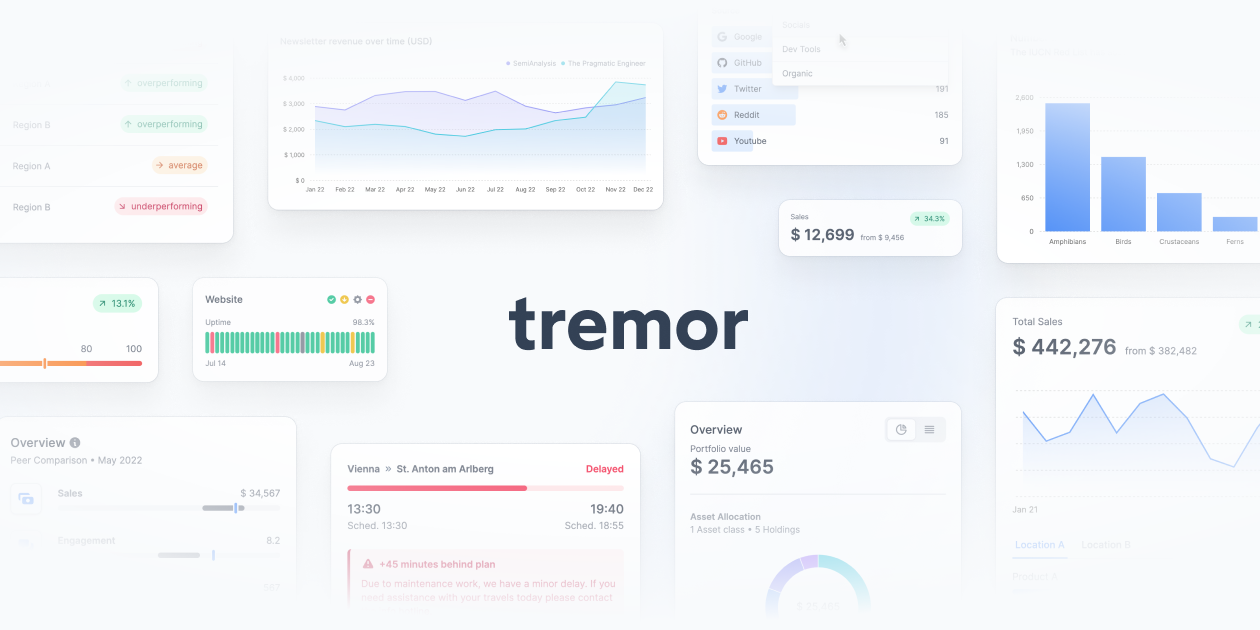
Tremor – Copy-and-Paste Tailwind CSS UI Components for Charts and Dashboards
Open-source, accessible React UI components styled with Tailwind CSS to build charts and dashboards.
The domain tremor.so was registered on February 6, 2022, through namecheap inc and uses Registrar-servers for DNS and security. At 4 years old, the domain is in a mid-age phase indicating a developing online presence and growing authority, offering developing presence, growing authority, increasing trust signals, and the beginnings of a proven track record that can contribute to improved SEO and brand credibility.
Backlink Profile and Referring Domains
Tremor's backlink profile is largely composed of lower-authority sources with the site's overall metrics showing a modest footprint (overall Domain Authority ~27, with many referring pages reporting DA below 40 and only isolated mid-range entries like DA 22 and DA 16), and there are no DA 70+ or clearly high-authority domains in the sample; the links mostly come from technology publications, developer resources, and GitHub-based pages rather than major industry outlets or industry leaders. This mix provides useful topical relevance within developer and tech communities and contributes to steady organic visibility, but the current profile limits Tremor's ability to gain strong cross-site authority and broader organic search gains without acquisition of higher-DA placements.
The sample shows a dofollow-to-nofollow split of approximately 40:60, indicating a greater share of nofollow links but a meaningful set of dofollow links from developer blogs and tech posts that can still pass link equity when coming from the stronger of those sources. Anchor text is fairly split between branded (50%) and naked URLs (50%), with 0% keyword-rich anchors in this set, which is a natural/healthy signal against over-optimization but also suggests missed opportunities to diversify with descriptive, topical anchors for improved keyword relevance.
Keyword Rankings
Top Ranking Keywords
The domain tremor.so shows a focused keyword portfolio centered on UI and React developer tooling with consistent #1 rankings across its target terms, modest to low search volumes (e.g., 210, 140, 90) and low competition percentages that position it as a niche B2B technical resource. The top keyword 'tremor ui' attracts daily searches in the dozens with a $4.89 CPC, indicating moderate market presence. The other keywords — primarily tremor react (two entries at 140 SV, $7.43 CPC, 4% competition) and tremor charts (90 SV, $0 CPC, 1% competition) — all rank #1 and show low competition (0-33%), revealing a technically specialized audience and a market position that benefits from targeted developer intent and limited paid-ad competition. The domain’s strengths include consistent top rankings, targeted keyword themes, and strong organic visibility across its niche developer-focused terms.
Competitive Landscape
tremor.so competes in the web UI components and front-end library space against established players like rsuitejs.com and daterangepicker.com, and newer alternatives such as hypeserver.github.io and sensortower.github.io. Compared with more established players it shows a modest but meaningful footprint — middle-tier organic traffic (405 visits) with a substantial backlink base suggesting decent developer-focused reach, while its niche emphasis on lightweight, analytics-oriented components has driven targeted interest even though larger libraries (e.g., rsuitejs at 1,296 visits) capture broader attention.
With a Domain Authority score of 27, tremor.so sits on par with direct peers in the web UI components / front-end library industry, indicating comparable backlink authority but varying organic traction across competitors. By targeting developer audiences with well-documented, performance-oriented components, strong examples, and easy integration, tremor.so has leveraged organic visibility and developer word-of-mouth to penetrate the market despite not leading in raw traffic.
FAQ on tremor.so
Everything you need to know about tremor.so.
What is tremor.so's primary business model?
Tremor.so is primarily an open-source UI component library and design system focused on building data dashboards and analytics interfaces, distributed under permissive licenses. Its business model centers on community adoption, sponsorships, and ecosystem growth rather than a traditional product sales model, with potential for commercial services, integrations, or partnerships layered around the core open-source project.
Is tremor.so considered a market leader, a challenger, or a niche player?
Niche player. Tremor.so occupies a focused niche in the dashboard- and analytics-oriented UI space, appealing to teams building data-heavy interfaces rather than competing broadly with general-purpose UI frameworks or major commercial analytics platforms.
What makes tremor.so unique compared to its competitors?
Tremor.so differentiates itself with a purpose-built set of Tailwind-friendly React components optimized for dashboards and time-series data visualization, including ready-made metric cards, responsive grids, and chart integrations. Its design emphasizes simplicity, consistent styling, and quick assembly of analytics screens, which makes it especially attractive to developers who want polished dashboard UX with minimal custom styling.
What are the most recent major updates or strategic shifts seen on tremor.so?
Recent public activity has focused on expanding component coverage, improving charting capabilities, and tightening integration with modern frontend stacks (React, TypeScript, Tailwind), reflecting a strategy of maturing the library for production-grade dashboards. If specific release details are not recorded, the observable trend is toward better developer ergonomics, accessibility, performance improvements, and growing community adoption and documentation.
Related Domains
Explore other domains similar to tremor.so.