Ask three domain appraisal tools what a name is worth and you get three numbers, none of them explained. One is trained on retail asking prices, one on auction results, one on data that stopped in 2024. They agree on almost nothing, and none of them will show you the sales they used. Domain investors have a phrase for the whole category: “all appraisal tools suck.”
We built the Instant domain appraisal to be the one that shows its work. Type a domain and you get a value in USD, the three prices a name can fetch, a 0–100 score, and every factor that moved the number, next to the domain’s own reported sale if it has one and a live check of whether it’s available and at what price. It’s free, there’s no account, and there’s no paywall.
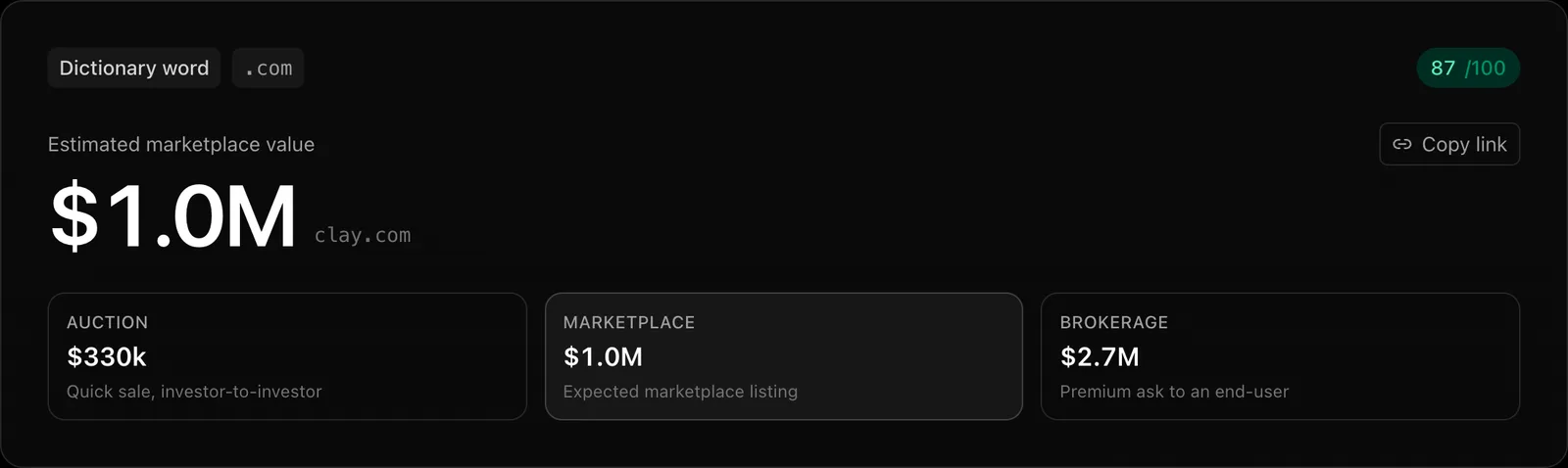
A value, and the three prices behind it
A domain doesn’t have one price. It has a quick-sale price to another investor, a marketplace price as a listing, and a brokerage price to the one company that needs the name. The same domain can be worth eight times more in the last case than in the first. Most tools collapse that into a single figure like $158,328, which suggests an accuracy no model has.
The result leads with the marketplace value, because that’s the number most people are asking for, and puts the auction and brokerage figures beside it. If you’re selling, that’s your ladder: open at the brokerage figure with an end user, list at the marketplace figure, and treat the auction figure as your floor.
Every signal, named
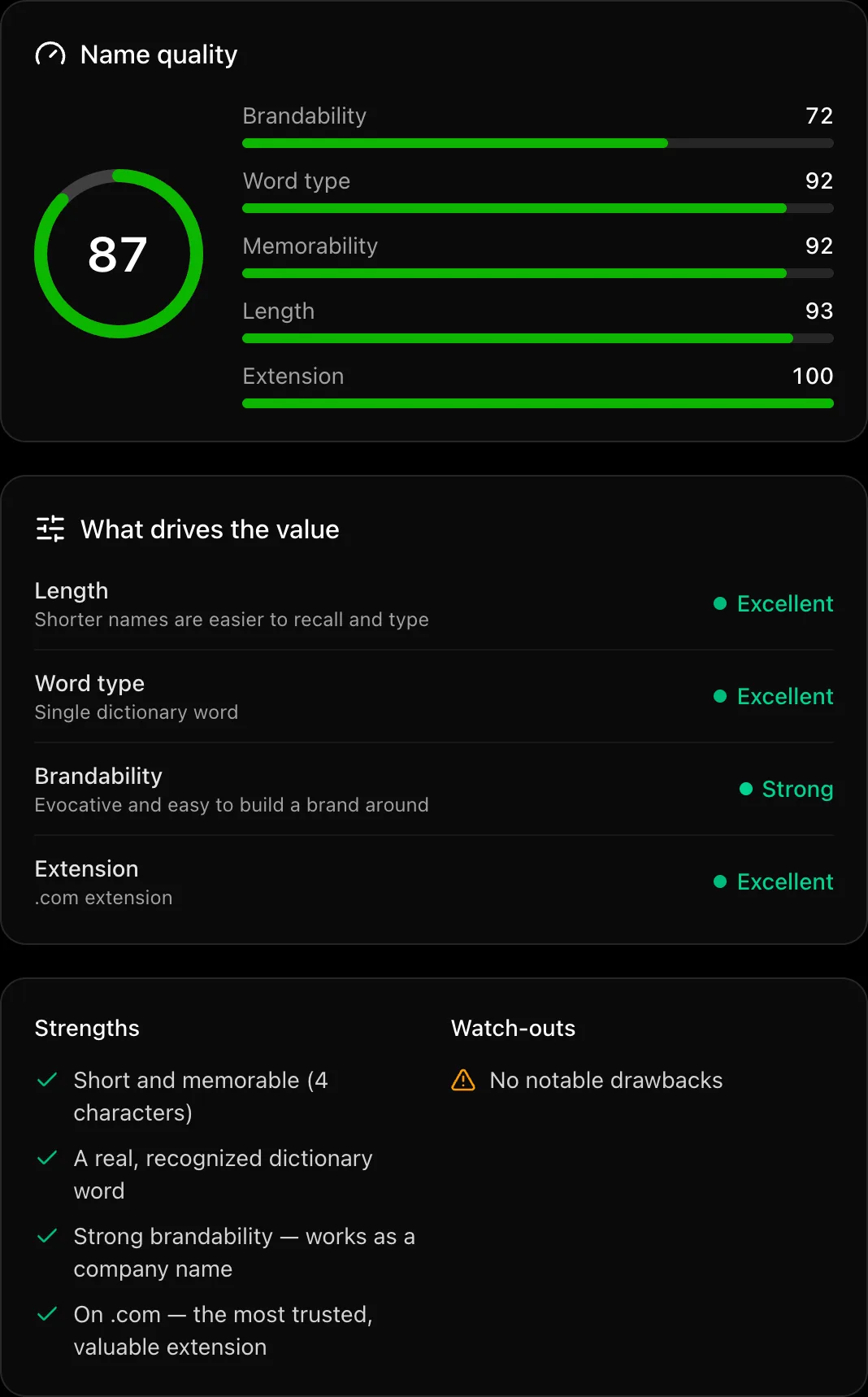
Under the value is the part no other free tool offers: what the model actually read. Length. Word type. Familiarity. Brandability. Keyword demand. Extension. Penalties. Whether the exact domain has a reported sale, whether it’s one of the world’s most-visited websites, whether it’s short enough to carry a premium of its own. Then the live checks: availability and price, aftermarket listings, extension competition, domain rating, and age. Each one shows up as a finding in plain words, so you can see why a name landed where it did, and argue with it.
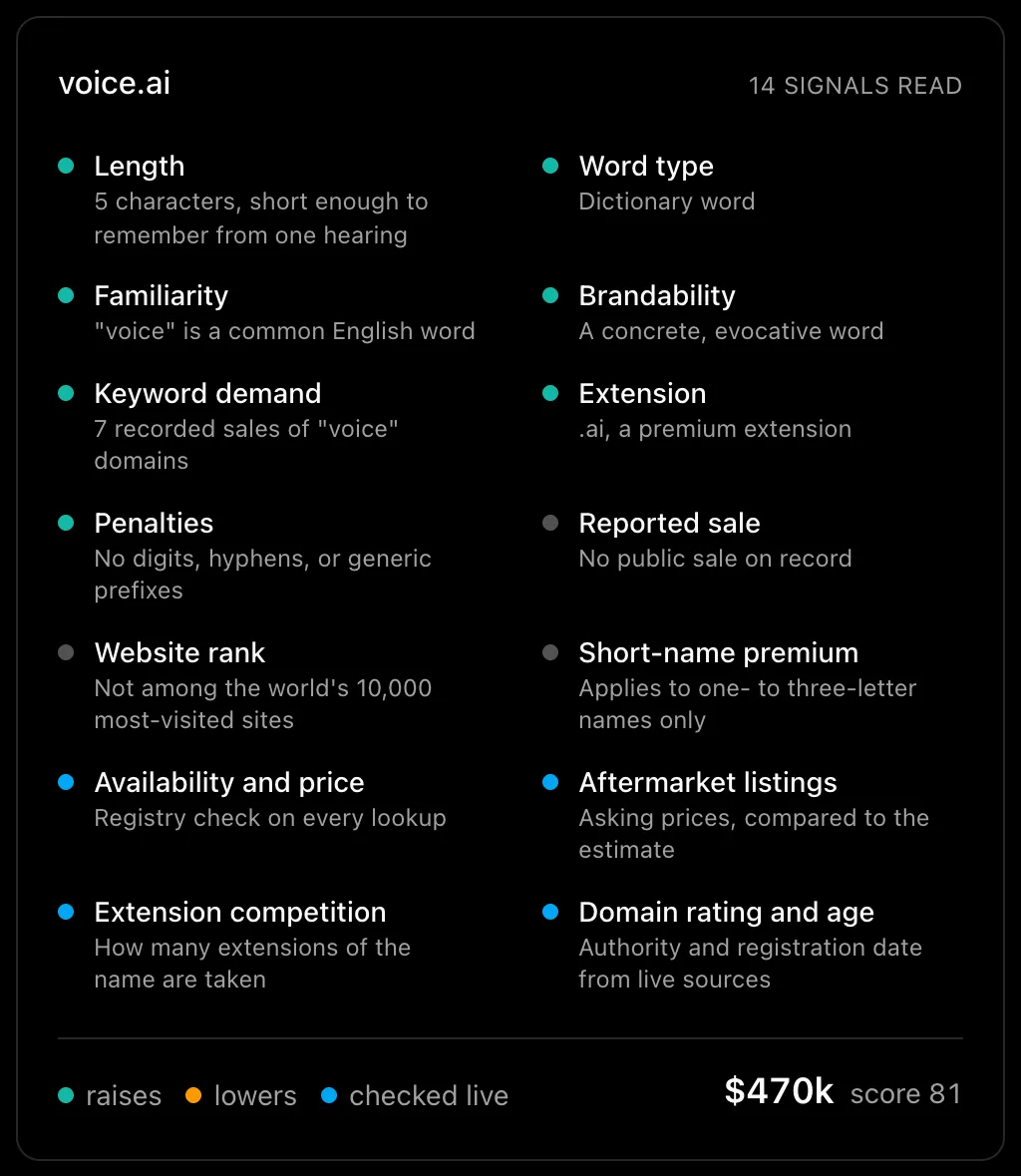
A few of the factors are worth explaining, because they’re where this model differs from the others.
Brandability comes from what a word means, not how it sounds. A concrete, common noun (clay, voice, cursor) reads as a brand in a way an abstract adjective (durable, crude) never does, and the companies that pay seven figures for one-word .coms know it. The model uses Brysbaert’s concreteness ratings, a dataset of how vividly people picture each of 40,000 English words, and gives concrete common nouns and action verbs a premium. Coined names like figma or twilio get their own signal: how English-like their letters are, which is what separates a name you can say and spell from a string of consonants.
Keyword demand comes from real sales. NameBio publishes statistics on what domains built on each word have sold for, as a whole name and as a prefix or suffix. Words with a track record get a capped premium. Words without one don’t get penalized; most brandable startup names have no keyword history at all.
Generic prefixes are penalized on purpose. getharbor, tryharbor, harborapp: names like these can be generated by the thousand, and the sales data says they sell for a few thousand dollars when they sell at all. The model treats a startup prefix or suffix as a discount, so you can’t make a name look valuable by gluing “app” onto it.
The model errs low. It was calibrated against reported sales from 2025 and 2026, and where we had to choose, we chose to undervalue. A two-word compound that sold for six figures was a survivor; most names built the same way never sell. In our checks against reported sales from 2025 and 2026, most estimates landed within a factor of three of the price paid, and the misses were almost always on the low side.
Reported sales set the floor
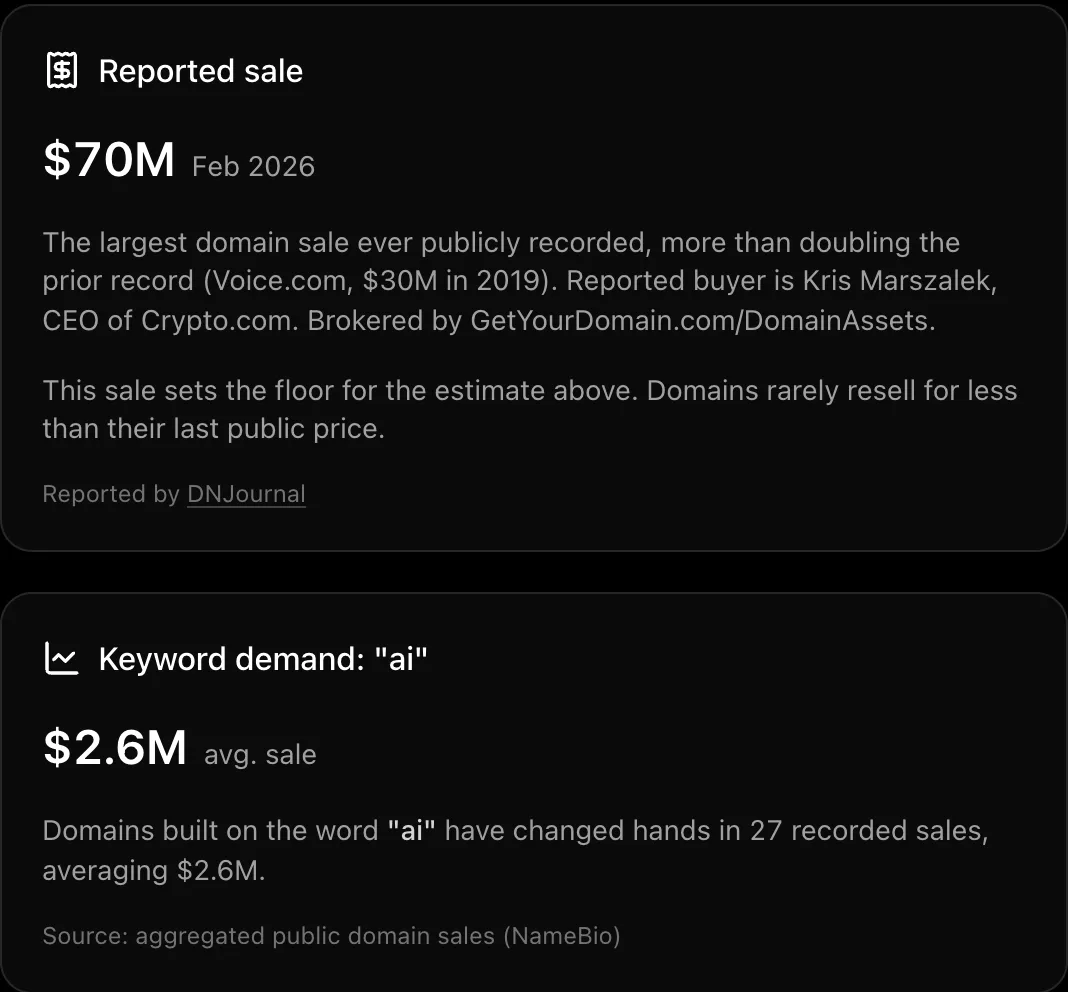
Here’s the thing about ai.com. Judged on its letters alone, a two-letter .com built on a hot keyword, the model would put it around $1.6 million. It sold in February 2026 for $70 million, the largest reported domain sale in history, and the buyer launched a company on it with a Super Bowl ad.
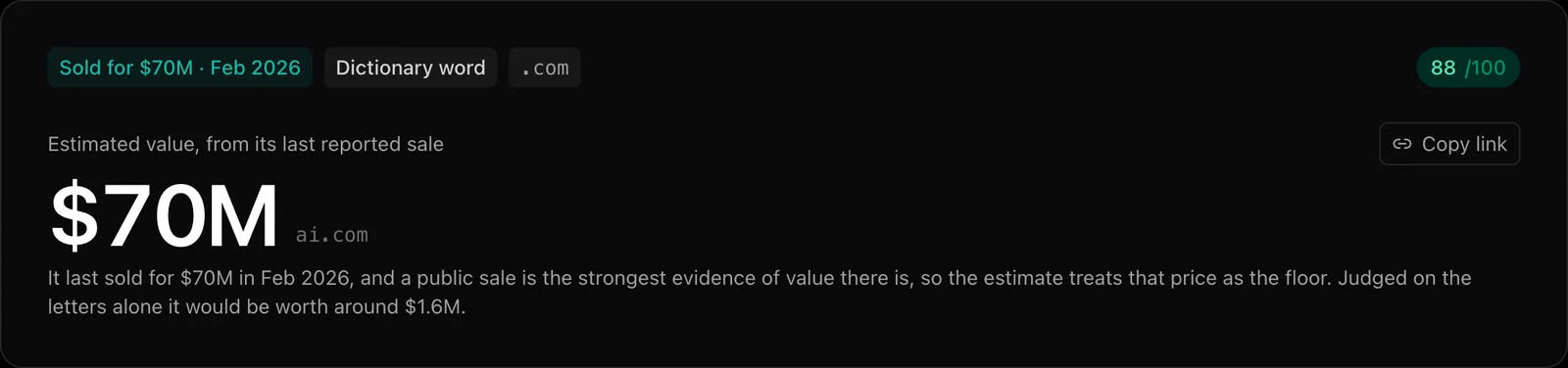
No name-based model can predict that, and the tool doesn’t pretend to. What it does instead is keep a table of publicly reported sales, from DNJournal’s charts going back to 1998 through this year’s, and treat a domain’s own sale as a floor. The result says so in plain words, shows the price, the month, and who reported it, with a link to the report, and separates the sale from what the letters alone would earn. When the domain has since grown into something bigger than its last sale, as fb.com has, the sale shows but doesn’t bind.
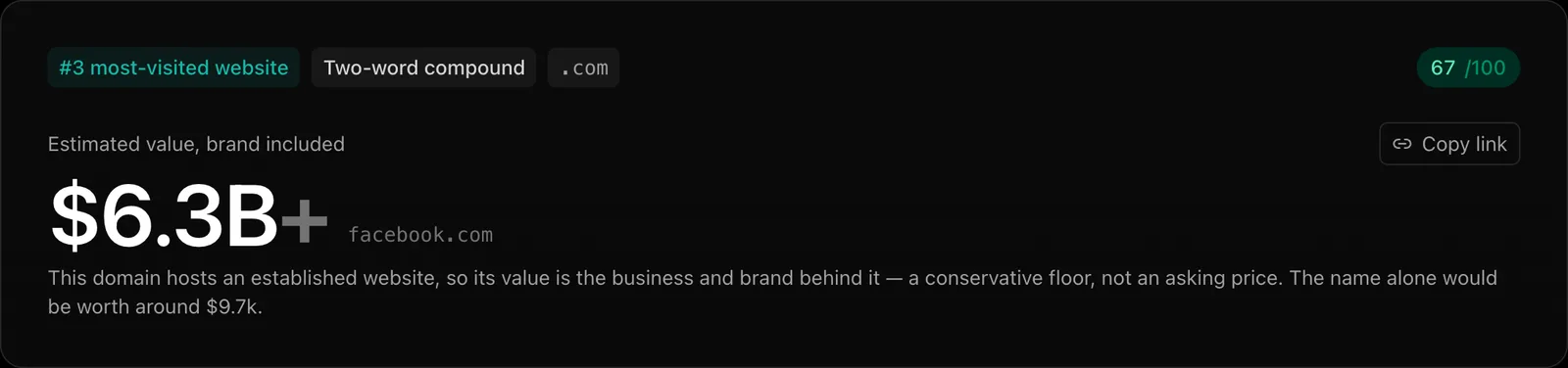
The same logic applies to established websites. facebook.com is a two-word compound, and as letters it would price in the thousands. It’s also one of the three most-visited domains on the planet, so the tool prices it as a business, with a rank-based floor in the billions, and says clearly that this is a floor and not an asking price.
Checked against the live market
An estimate is only useful next to a real price, so every appraisal also runs a live registry check. The result says whether the name is available to register, a premium registration, listed on the aftermarket, or taken, and when there’s a listing it says whether the ask sits below, near, or above the estimate. Beside that: how many extensions of the same name are already registered (a demand signal that’s hard to fake), the registration date from the registry’s RDAP record, and the Ahrefs Domain Rating for a registered name, which separates an operating website from a parked string of letters.
What it doesn’t know
We’d rather tell you what the tool can’t see than have you find out. It can’t see the one buyer who needs this exact name for a product they’ve already built, which is where most of the record sales come from. It can’t see a trademark that makes a name unusable, though our trademark search can. It can’t see private deals, which never appear in any dataset. And it can’t tell a bad word from a good one when both are equally pronounceable; it knows figma is brandable, but it would say the same of a coined name you’d never put on a business card.
That’s why the result shows a range instead of a single figure, why it names its data sources and the month they were built, and why the summary at the bottom says when a sale or a website floor overrode the letters-only estimate. The same domain always gets the same answer, and you can copy a link to any result that reopens it exactly.
How it compares
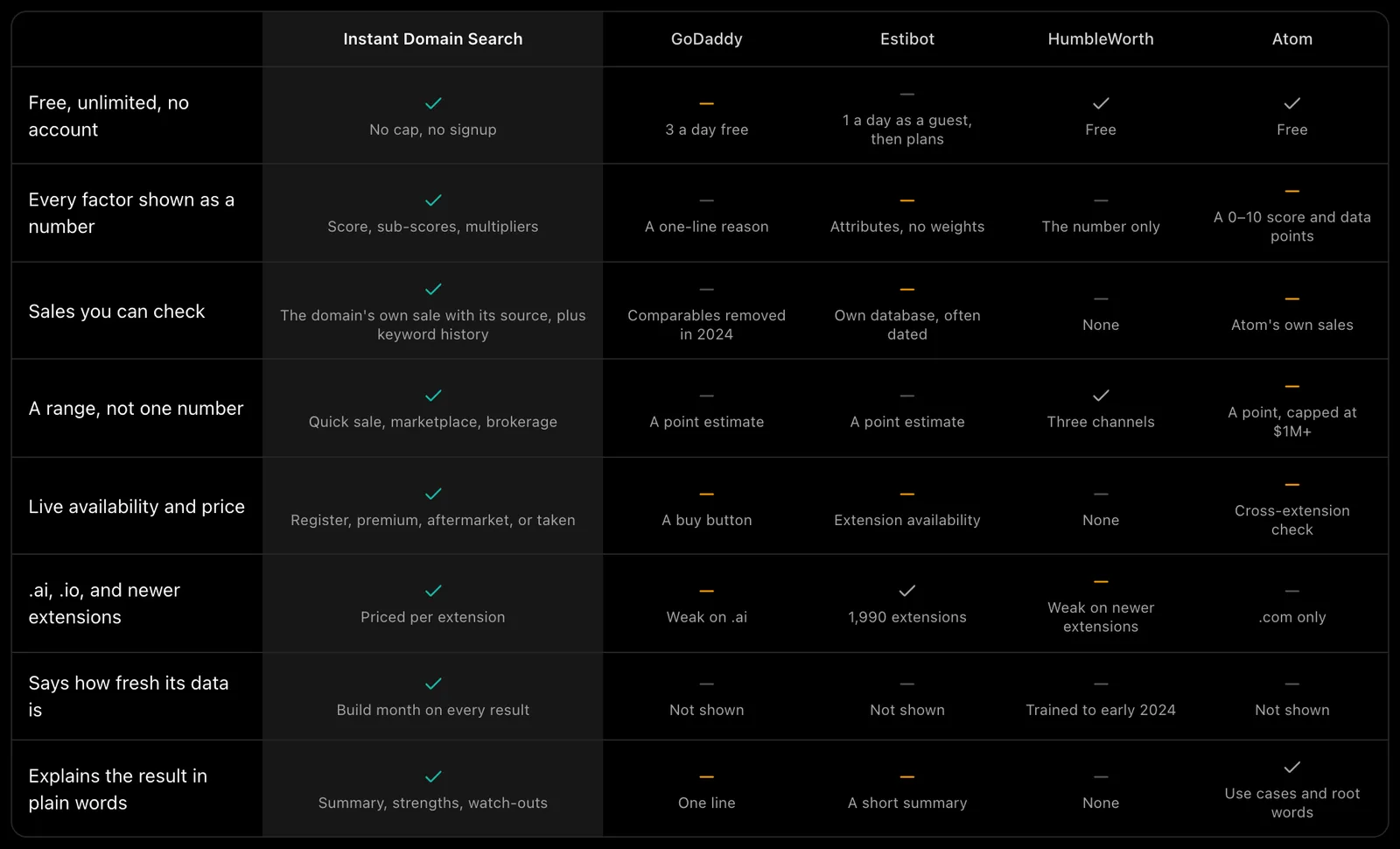
We researched the free appraisal tools people actually use, including Domain Name Wire’s June 2026 review of fifteen of them against real, undisclosed sales. The short version: GoDaddy removed its comparable sales in 2024 and caps you at three appraisals a day; Estibot gives guests one a day; HumbleWorth is free and fast but shows a number with nothing behind it; Atom, which won that review, shows its work but values .com only. The full table is on the page.
Under the hood
The model is deterministic: a value is the product of a handful of factors, each with a coefficient we can point to, calibrated against reported sales and locked by a suite of tests that fail if a change moves an anchor domain out of its band. The dataset behind it (a 32,000-word dictionary with frequencies, 14,500 concreteness ratings, NameBio’s statistics for 13,000 keywords, the Tranco list of the world’s 10,000 most-visited domains, and our table of reported sales) is rebuilt every month and served from cloud storage. It runs on our servers, and the results are cached at the edge, so an appraisal you’ve seen once comes back instantly for the next person.
Try it
The appraisal tool is live and free at instantdomainsearch.com/domain-appraisal. Type the domain you own, the one you’re negotiating for, or the one you’re about to register. If the estimate surprises you, the factors will tell you why, and the sales will tell you whether to believe it.
Frequently asked questions
Is the domain appraisal free?
Yes. There’s no account to create, no paywall, and no paid report. We earn a small referral fee when you register a domain through one of our registrar links; the price you pay is the same as going to the registrar directly.
How accurate is it?
Treat any automated appraisal as a starting point. In our checks against reported sales from 2025 and 2026, most estimates landed within a factor of three of the price paid, and the misses were almost always low. The result shows a range and the sales it used, so you can judge it rather than take it on faith.
Does it value .ai and .io domains?
Yes. Every extension is priced on its own scale. .ai carries a clear premium over .io and .co, backed by two years of sales such as Bot.ai at $1.2 million, and sits below .com. Extensions with no resale market are capped, because no word rescues an extension nobody buys.
Can I appraise a whole list?
Not yet in one go. Run the list through bulk domain search to see which names are registered, then appraise the ones that matter.