agora.io traffic, backlinks, authority, and more
Agora.io is a communications technology company that provides real-time voice, video, and interactive streaming APIs and SDKs for developers and businesses to integrate live audio/video, messaging, and low-latency streaming into apps across gaming, education, telehealth, and enterprise. The site is well known among developers and businesses seeking embedded real-time engagement solutions and maintains a modest but steady profile within its target markets, with estimated daily visits in the hundreds.
Score assigned based on the strength of the domain online
Estimated monthly organic traffic from search engines
Total number of links from other websites pointing to this domain
Traffic Analysis
The site's traffic has declined by 60% year-over-year with over 12,296 monthly visits driven primarily by interest in video calling and conversational AI solutions, including branded and variant search queries focused on SDKs, real‑time video performance and AI-driven conversational features. Geographically the audience is concentrated in the Asia‑Pacific region (~64% of traffic, led by India and Bangladesh), followed by North America (~22.7%, led by the US) and the Middle East & Africa (~7%), a spread that implies strong adoption and developer demand in South and Southeast Asia with secondary enterprise and developer interest in US markets but limited traction across Europe.
Domain Preview & WHOIS Information
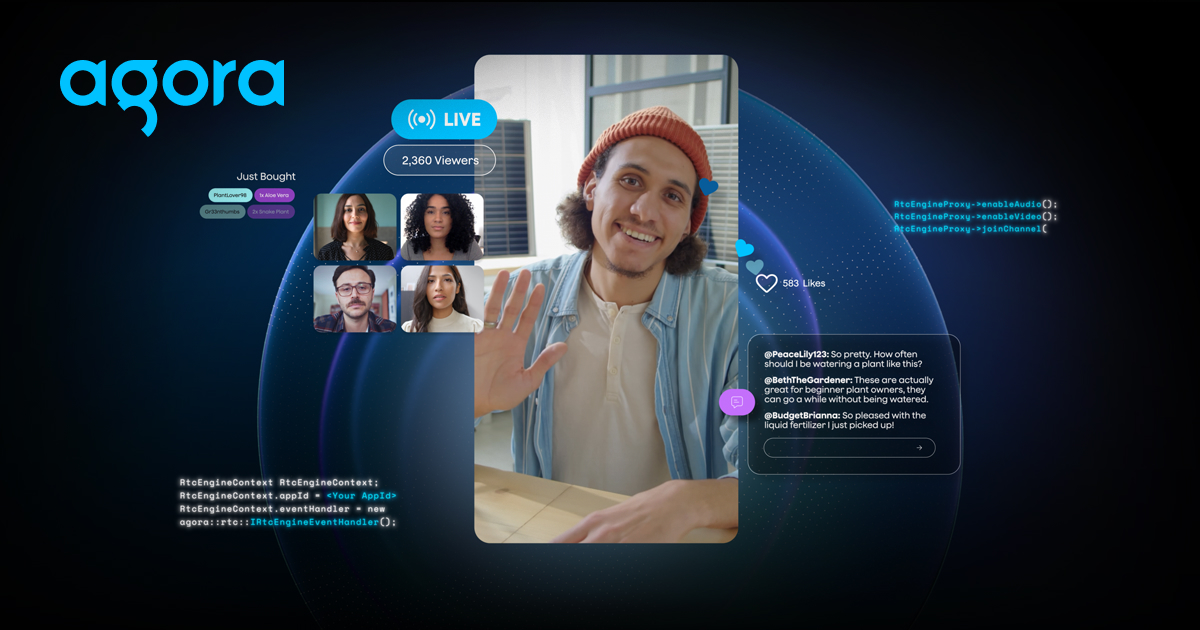
Agora Real-Time Voice and Video Engagement
The Real-Time Engagement Platform for meaningful human connections. People engage longer when they see, hear, and interact with each other. With Agora, you can embed vivid voice and video in any application, on any device, anywhere.
The domain agora.io was registered on May 31, 2013, through godaddy.com, llc and uses AWS for DNS and security. At 12 years old, the domain demonstrates established credibility, a mature online presence, and accumulated authority, indicating strong trust signals, a proven track record, and SEO benefits that support higher search visibility and user confidence.
Backlink Profile and Referring Domains
Referring Domains
The backlink profile for Agora shows a strong skew toward medium-authority (DA 40-69) referring domains with an overall site Domain Authority of 74 and many referring domains in the mid-40s; notable sources include technology publications like Streaming Media and developer resources such as GitHub and App Store listings which together indicate a mix of editorial and product-related mentions from high-authority platform types even if few individual links are in the 70+ bracket. This blend of mid-to-high quality referring domains contributes to Agora’s organic visibility by supplying topical relevance from developer resources and sector industry leaders, supporting the domain’s overall SEO strength and trust signals across search engines.
Counting the link types in the sample, there are 2 dofollow and 8 nofollow links, an approximate distribution of 18:82 (dofollow:nofollow) which shows a predominance of nofollow mentions but still includes dofollow links from influential platforms that can pass meaningful link equity—particularly when emanating from medium-authority or above sources. Anchor text is heavily branded with 7/10 anchors as “Agora.io” or variations (~70% branded), 1/10 as a naked URL (~10% naked URL) and 2/10 as generic/keyword-rich anchors like “App Support” or “Developer Website” (~20% other/keyword-rich), a profile that reads largely natural but would benefit from a slightly more diverse distribution of descriptive, contextual keyword anchors over time.
Keyword Rankings
Top Ranking Keywords
The domain agora.io presents a focused keyword portfolio centered on brand, product, and commercial intent with high first-page rankings across niche developer and buyer queries, showing themes around SDKs, AI, pricing, and corporate identity that position it as a specialized real-time communications platform. The top keyword 'agora inc' attracts daily searches in the dozens with a $0 CPC, indicating solid brand recognition. The other four keywords — **"agora video sdk news" (SV 320, CPC $0, competition 0%), **"agora ai" (SV 260, CPC $2.62, competition 22%), **"agora io" (SV 170, CPC $3.05, competition 28%), and **"agora pricing" (SV 170, CPC $6.46, competition 26%) — sit in generally low competition brackets, revealing a technical, intent-driven audience and pockets of commercial opportunity (notably higher CPC on pricing) rather than broad consumer competition. The domain's strengths include strong organic visibility and a healthy keyword portfolio, reflecting competitive SEO performance in its niche.
Competitive Landscape
agora.io competes in the real-time communications and engagement SDK space against established players like Twilio, Zoom, Vonage, Dolby.io and newer alternatives such as Dyte and Daily. Compared with larger incumbents, agora.io shows stronger organic traffic (about 12k monthly) than the listed peers in the dataset and leverages a developer-first positioning and low-latency audio/video specialization as a niche differentiator that drives targeted traffic and product-led adoption despite similar backlink footprints.
The domain reports a Domain Authority score of 51, which sits on par with the immediate competitive set in this real-time communications industry and suggests comparable baseline SEO credibility across these domains. By focusing on developer-centric APIs, low-latency AV performance, and scalable SDKs as key capabilities, agora.io has driven organic visibility and product-led growth that translate into higher market penetration among app builders and stronger word-of-mouth within technical buyer segments.
FAQ on agora.io
Everything you need to know about agora.io.
What is agora.io's primary business model?
Agora.io sells a cloud-based real-time engagement platform and developer APIs that enable low-latency voice, video, and messaging capabilities for apps and services. It charges customers on a usage-based model (e.g., minutes, concurrent connections, add-on features) and also offers tiered enterprise contracts and support services for larger customers.
Is agora.io considered a market leader, a challenger, or a niche player?
Agora.io is considered a market leader in the real-time communications developer platform space, competing with other major RTC and communications-platform-as-a-service providers. It has broad adoption across live streaming, telehealth, education, gaming, and social apps and is recognized for its global network and SDK ecosystem.
What makes agora.io unique compared to its competitors?
Agora differentiates itself with a global low-latency real-time network and a comprehensive set of cross-platform SDKs that simplify integration of voice, video, and interactive streaming into apps. It also emphasizes developer-friendly tools, performance optimizations (e.g., ultra-low latency and packet recovery), and additional features like real-time messaging, recording, and moderation to support complex live-engagement scenarios.
What are the most recent major updates or strategic shifts seen on agora.io?
In recent years Agora has focused on broadening its real-time engagement platform beyond basic RTC by adding richer developer tools, enhanced SDKs, cloud recording, moderation features, and integrations to support enterprise use cases. The company has also been aligning with market trends by improving scalability and global infrastructure and exploring AI-driven enhancements (noise suppression, voice effects, and analytics) to improve user experience and developer value.
Related Domains
Explore other domains similar to agora.io.