flyte.org traffic, backlinks, authority, and more
Flyte.org is the home of Flyte, an open-source cloud-native workflow orchestration platform for building, scheduling, and managing scalable data and machine learning pipelines, primarily serving data engineers, ML engineers, and platform teams. The site is well-known within the data and ML infrastructure communities but has limited mainstream recognition, attracting mostly technical users and contributors with estimated daily visits in the dozens.
Score assigned based on the strength of the domain online
Estimated monthly organic traffic from search engines
Total number of links from other websites pointing to this domain
Traffic Analysis
The site's traffic has declined by 32% year-over-year with over 728 monthly visits driven primarily by interest in AI/ML orchestration, Python developer tooling and integrations, distributed computing and pipeline/caching concerns, plus some biotech-related discovery and integrations. Traffic is concentrated in North America (~47.3%), Asia‑Pacific (~39.2%) and Europe (~5.0%), reflecting strong U.S. enterprise and developer adoption, growing traction across India and Southeast Asia, and relatively limited penetration in European markets for this industry-focused domain.
Domain Preview & WHOIS Information
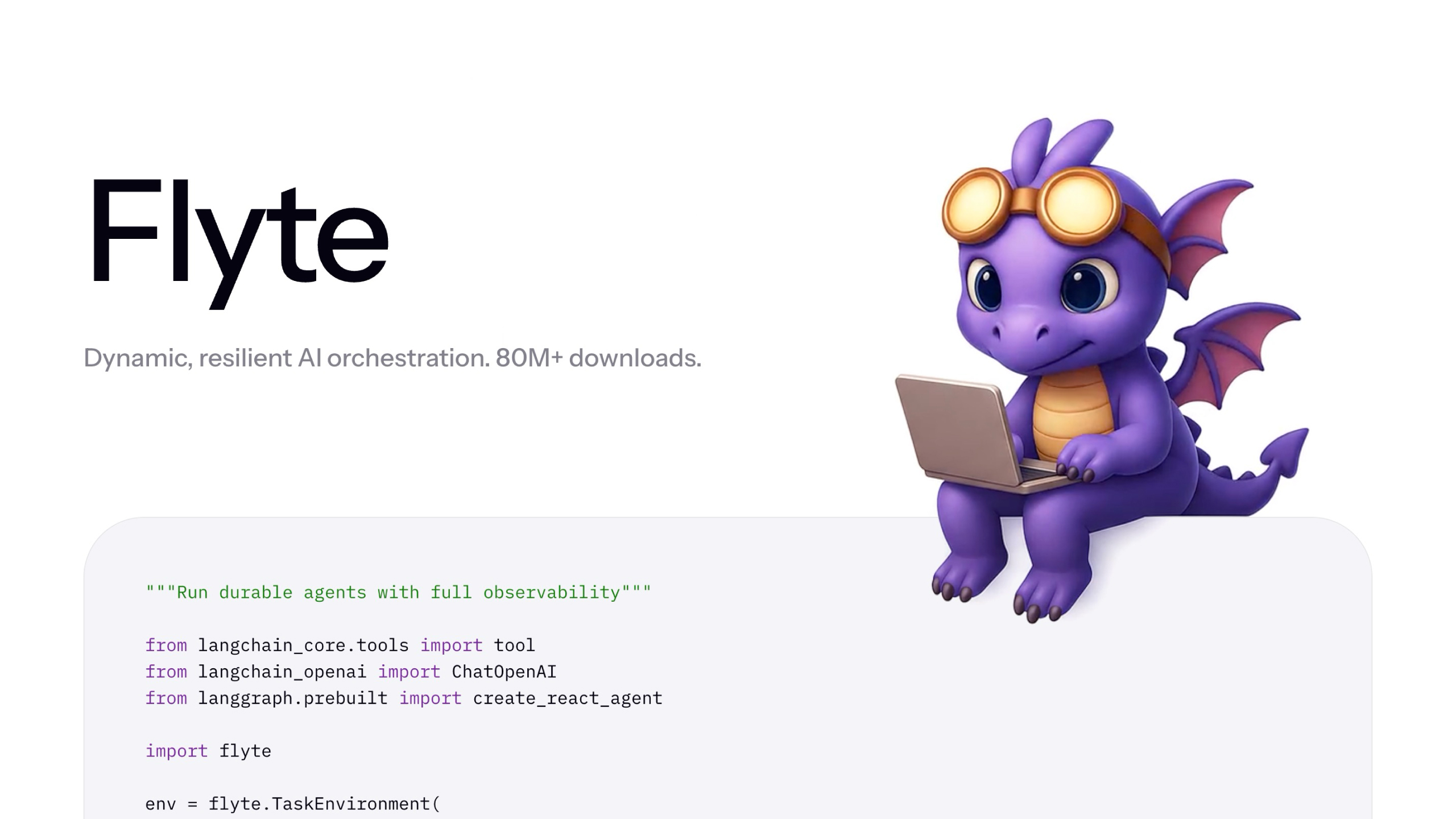
Flyte | One Platform for Your AI Orchestration Needs
Dynamic, resilient AI orchestration. 80M+ downloads.
The domain flyte.org was registered on July 7, 2016, through 1api gmbh and uses Cloudflare for DNS and security. At 9 years old, the domain likely enjoys established credibility, a mature online presence, a proven track record and accumulated authority that can strengthen trust signals and long-term SEO performance.
Backlink Profile and Referring Domains
Flyte's backlink profile is dominated by lower to mid-level authority sources, with most top links scoring under DA 40 and the highest example at DA 36, indicating a prevalence of lower-authority and modest medium-authority referring domains rather than DA 70+ powerhouses; notable source types include technology publications, developer resources, and mentions from former employer and community posts (e.g., Lyft Engineering, Medium, Airflow-related posts). This mix provides decent topical relevance and referral traffic potential that supports Flyte's visibility in niche technical searches and contributes positively to its overall SEO strength, but the absence of clear high-authority backlinks limits major gains in broad organic rankings.
The sample top 10 backlinks show an approximate dofollow:nofollow 40:60 distribution (4 dofollow, 6 nofollow), a ratio where dofollow links from the stronger available sources still pass meaningful link equity while the majority nofollow mentions help with referral diversity and brand signals. Anchor text is heavily skewed toward branded forms — branded 80%, naked URLs 10%, keyword-rich 0%, and other 10% — which is natural for a recognizable project but suggests a need to acquire more varied and keyword-rich anchors to strengthen topical relevance and target organic rankings.
Keyword Rankings
Top Ranking Keywords
The domain flyte.org demonstrates a concentrated, branded keyword portfolio focused on workflow orchestration and developer tools, combining low-to-moderate search volumes with a mix of high and low CPCs that position it as an authoritative niche resource with defensible rankings. The top keyword 'flyte company' attracts daily searches in the dozens with a $1.24 CPC, indicating moderate market presence. The other keywords — 'flyte workflow' (30 SV, $7.25 CPC, 26% competition), 'pyflyte' (50 SV, $0.49 CPC, 1% competition), 'flyte cache' (40 SV, $0 CPC, 33% competition) and 'flytr' (70 SV, $0.49 CPC, 1% competition) — are all low-competition terms that reflect a technical, developer-focused audience and reveal a market positioning that is niche, specialized, and relatively easy to defend but limited in broad commercial demand. Overall the domain shows healthy keyword portfolio and strong organic visibility with competitive SEO performance.
Competitive Landscape
flyte.org competes in the cloud-native workflow orchestration and machine learning data orchestration space against established players like union.ai, latch.bio, and dkube.io, and newer alternatives such as flytetheband.com. Compared to these peers, flyte.org shows a mid-level traffic footprint (728 organic visits) and similar backlink depth, positioning it as a developer- and community-focused alternative to larger incumbents by leaning on an open-source, Kubernetes-native stack and developer/community-first integrations that drive steady interest despite not having the highest raw traffic.
In the cloud-native workflow orchestration industry flyte.org's Domain Authority score of 32 sits in parity with direct competitors in the table, indicating comparable domain credibility but room to grow against top-tier platforms. By targeting ML engineers and platform teams with features like scalable DAG scheduling, SDKs, and Kubernetes integration—strengths that produce organic visibility and community-driven adoption—flyte.org has achieved modest market penetration and consistent backlink acquisition that supports further growth.
FAQ on flyte.org
Everything you need to know about flyte.org.
What is flyte.org's primary business model?
Flyte.org is primarily an open-source project and community-driven platform for orchestrating data and machine-learning workflows; the project itself is freely available under an open-source license. Commercial activity around Flyte typically comes from ecosystem vendors and service providers who offer hosted/managed Flyte, enterprise support, consulting, and integrations rather than a single proprietary product sold directly by the project.
Is flyte.org considered a market leader, a challenger, or a niche player?
Challenger. Flyte is widely recognized as a strong challenger in the workflow and ML orchestration market, gaining traction against incumbents by focusing on scalable, reproducible, and data-aware workflow patterns while still growing broader adoption and ecosystem integration.
What makes flyte.org unique compared to its competitors?
Flyte emphasizes reproducibility, strong typing and versioning of workflows, and first-class data lineage and provenance, which differentiates it from many orchestration tools that focus mainly on scheduling. It is designed for cloud-native Kubernetes deployments with built-in scalability and extensibility, and it provides SDKs and constructs tailored to machine-learning and data workloads that simplify large-scale pipeline development and reuse.
What are the most recent major updates or strategic shifts seen on flyte.org?
Recent public activity around Flyte has focused on expanding ecosystem integrations, improving developer experience, and enabling managed/enterprise deployment options through partner vendors and community governance. If specific release details are not referenced here, the general strategic direction is toward broader cloud and Kubernetes integrations, stronger commercial support channels, and continued investment in scalability, observability, and data lineage features.
Related Domains
Explore other domains similar to flyte.org.