kedro.org traffic, backlinks, authority, and more
Kedro.org is the official site for Kedro, an open-source Python framework in the data engineering and machine learning industry that provides tools and best practices for building reproducible, production-ready data science pipelines, primarily used by data scientists, machine learning engineers, and analytics teams. The site is well-regarded within the data science and MLOps community though relatively niche to the general public, recognized by practitioners and organizations seeking scalable pipeline standards, with estimated daily visits in the dozens.
Score assigned based on the strength of the domain online
Estimated monthly organic traffic from search engines
Total number of links from other websites pointing to this domain
Traffic Analysis
The site's traffic has declined by 25% year-over-year with over 370 monthly visits driven primarily by interest in data serialization and dataset management workflows, Python pipeline frameworks and related integrations for model tracking and artifact handling, and practical troubleshooting around reading and partitioning data. Traffic is concentrated in Latin America, Europe and North America — led by Brazil (33.6%), Italy (12.9%) and the United States (12.0%) — indicating strong regional adoption among data engineering and ML communities in those markets while highlighting opportunities to grow presence in the US and other enterprise-heavy regions.
Domain Preview & WHOIS Information
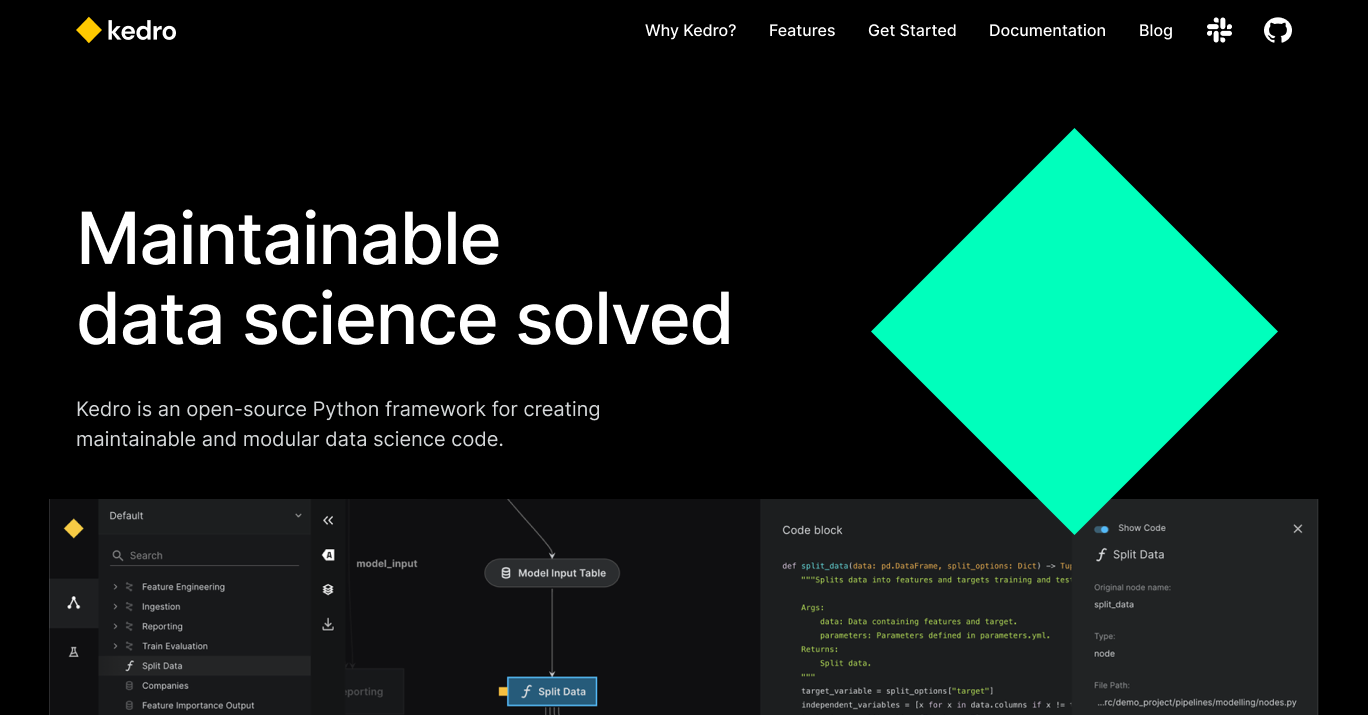
Kedro
An open-source framework for data engineering and data science code
The domain kedro.org was registered on July 17, 2020, through 1api gmbh and uses Dnsimple for DNS and security. At 5 years old, the domain benefits from a mature online presence and proven track record, offering stronger trust signals and SEO potential through accumulated authority, with a greater likelihood of established backlinks and user recognition.
Backlink Profile and Referring Domains
Backlinks
Kedro’s backlink profile is dominated by low-authority referring pages, with site-level Domain Authority clustered around DA 30-40 and few, if any, genuine DA 70+ placements; the visible citations come from developer resources and small technology publications (Snowflake-related posts, Xebia, GetInData) alongside a conspicuous set of spammy bulk listings showing anomalous metrics. This mixed-quality profile delivers topical relevance for data engineering and MLOps queries but limits broad organic ranking power because the majority of link equity originates from lower-trust sources rather than high-authority or industry leaders that would materially boost SEO strength.
The observed link set shows approximately 80:20 dofollow:nofollow distribution (about 8 dofollow vs 2 nofollow in the sample), meaning most links are passing equity and the dofollow links from higher-trust developer resources provide the clearest SEO value. Anchor text is skewed toward naked domain anchors and branded forms — roughly 70% naked URLs (kedro.org), 30% branded anchors ("Kedro"), and 0% keyword-rich, a pattern that signals overtly branded/naked-link distribution which is natural in part but needs attention to reduce spammy naked-URL volume and increase diverse, descriptive anchors for healthier organic performance.
Keyword Rankings
Top Ranking Keywords
The domain kedro.org presents a focused keyword portfolio centered on brand assets and developer help topics, mixing brand queries (logo, variations) with technical/documentation troubleshooting terms, signaling a niche SEO positioning serving both recognition and technical users. The top keyword 'kedro logo' attracts daily searches in the dozens with a $0 CPC, indicating solid brand recognition. The other keywords (developer hints and test-naming queries, plus the variant kedros with 210 monthly searches and $5.07 CPC) show predominantly low competition (0-33%) with one keyword at 33% competition, revealing a technical audience niche with limited commercial bidding but meaningful branded interest and light SEO rivalry. The domain's strengths lie in its targeted, developer-focused keyword set and consistent rankings, reflecting strong organic visibility and a healthy keyword portfolio.
Competitive Landscape
kedro.org competes in the data engineering and machine learning project scaffolding space against established players like Apache Airflow, MLflow, and DVC, and newer alternatives such as Dagster and Cookiecutter Data Science. Compared to these more established platforms, kedro.org shows modest but consistent organic traffic (370 monthly visits) and a relatively high backlink footprint for its size, positioning it as a focused, documentation- and community-driven alternative that gains traction through a niche emphasis on reproducible, production-ready ML pipelines and a plugin ecosystem rather than broad enterprise marketing.
With a Domain Authority score of 32, kedro.org sits on par with the listed peer sites in this dataset but remains below the DA typically seen for heavyweight orchestration and ML ops brands in the data engineering / MLOps industry, indicating room to grow against bigger incumbents. By targeting data scientists and ML engineers with features like project templating, pipeline abstraction, and extensible plugins, kedro.org has driven organic visibility and strong word-of-mouth growth, enabling steady market penetration within its niche despite lower overall traffic compared to major competitors.
FAQ on kedro.org
Everything you need to know about kedro.org.
What is kedro.org's primary business model?
Kedro.org is primarily an open-source software project that provides a production-ready Python framework for reproducible data and machine learning pipelines. Its ecosystem is supported by consulting, training, and professional services provided by its creators and partners, along with commercial integrations and enterprise tooling around the core open-source offering.
Is kedro.org considered a market leader, a challenger, or a niche player?
Challenger. Kedro is a well-recognized framework in the ML engineering and data pipeline space with strong adoption among organizations seeking reproducible, production-ready workflows, but it sits alongside larger orchestration and platform incumbents rather than dominating the broader market.
What makes kedro.org unique compared to its competitors?
Kedro emphasizes software engineering best practices for data science by enforcing modular project structure, clear pipeline abstractions, and configuration-driven workflows, which helps teams build maintainable and testable pipelines. Its focus on reproducibility, a data catalog, built-in visualization (Kedro-Viz), and a plugin architecture for integrations distinguishes it from ad-hoc scripts and simpler workflow tools.
What are the most recent major updates or strategic shifts seen on kedro.org?
Recent activity has emphasized extending the framework’s extensibility and integrations—improving plugin support, cloud and orchestration connectors, and tooling for deployment and observability—while maintaining the open-source core. In general, the project continues to move toward better enterprise readiness through richer integrations with MLOps tools, enhanced UX for pipeline visualization, and stronger guidance for productionization.
Related Domains
Explore other domains similar to kedro.org.