opensea.io traffic, backlinks, authority, and more
Opensea.io is a leading NFT marketplace in the blockchain and digital collectibles industry, enabling creators, collectors, and traders to mint, buy, sell, and discover non-fungible tokens and related digital assets. It is widely recognized among cryptocurrency enthusiasts, artists, and collectors as one of the primary platforms for NFTs, maintaining strong brand awareness and consistent activity with estimated daily visits in the thousands.
Score assigned based on the strength of the domain online
Estimated monthly organic traffic from search engines
Total number of links from other websites pointing to this domain
Traffic Analysis
The site's traffic has declined by 41% year-over-year with over 121,002 monthly visits driven primarily by searches and referral interest in niche meme and creator/celebrity content, collectible and crypto project queries, and a subset of adult-oriented and controversial image-based topics. Traffic is concentrated in Asia-Pacific (≈44.1%), Europe (≈28.4%) and North America (≈21.0%), indicating OpenSea’s audience is strongest in APAC markets with significant European engagement and a sizable North American base — a distribution that suggests priorities for localization, regional payments, and compliance should focus on APAC and Europe while maintaining product-market fit in the U.S. market.
Domain Preview & WHOIS Information
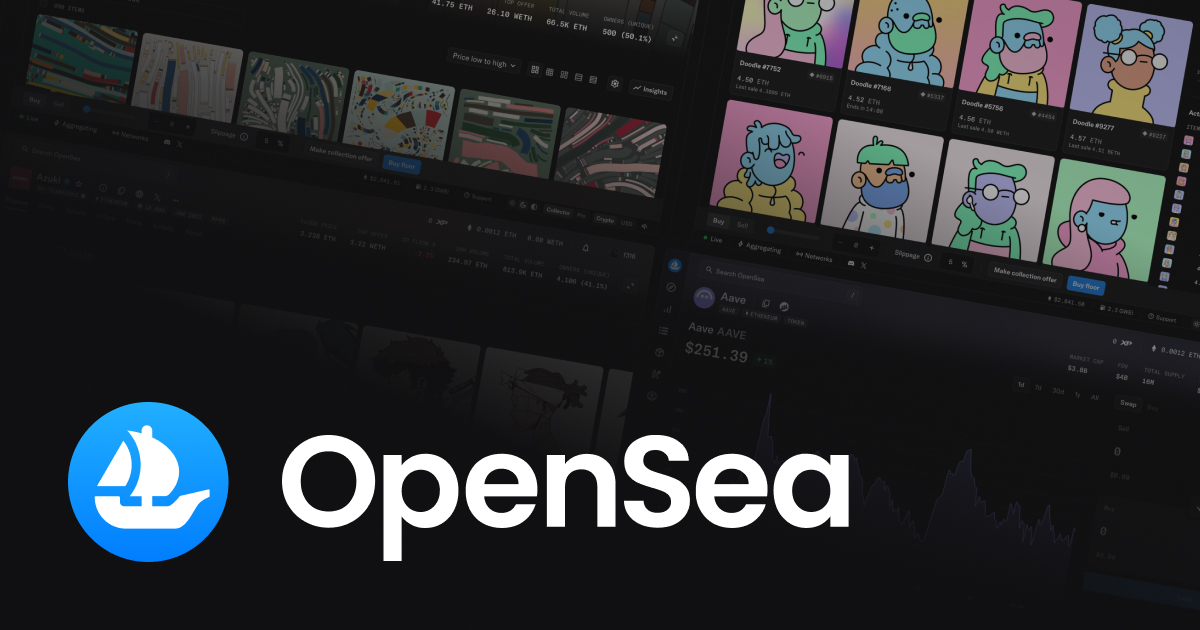
OpenSea, exchange everything — token trading and NFT marketplace
OpenSea, exchange everything — token trading and NFT marketplace. Welcome to the best place to discover, trade, and create onchain.
The domain opensea.io was registered on December 28, 2017, through gandi sas and uses Cloudflare for DNS and security. At 8 years old, the domain benefits from a proven track record, accumulated authority, and a mature online presence that contribute to stronger trust signals and SEO advantages compared with newer sites.
Backlink Profile and Referring Domains
Backlinks
Referring Domains
OpenSea's backlink profile is dominated by medium-authority (DA 40-69) sources with many referring domains including notable mentions from technology publications, developer resources and industry leaders (e.g., a DA61 personal site, GitHub DA55, Medium and TheNewsCrypto DA52/46), and there is a notable absence of DA 70+ high-authority links in the sample. This breadth of medium-DA links combined with a large total backlink footprint and a Trust Score 60 contributes positively to OpenSea's organic visibility by signaling topical relevance, referral traffic, and steady authority that underpins its overall SEO strength.
In the sampled top links there are 4 dofollow and 6 nofollow entries, indicating an approximate 40:60 dofollow:nofollow distribution (a slightly nofollow-weighted or balanced distribution) where dofollow links from medium-authority sources still pass meaningful link equity and help rankings. Anchor text shows a mix with approximately 30% branded (OpenSea), 40% naked URLs (opensea.io / http://opensea.io), 20% keyword-rich (e.g., "Sign up") and 10% other, a reasonably natural distribution that favors brand and URL anchors but should be monitored to ensure continued diversity and avoid over-optimization.
Keyword Rankings
Top Ranking Keywords
The domain opensea.io has a concentrated keyword portfolio centered on NFT marketplace and blue-chip NFT culture terms, with high-ranking placements for both brand variations and category-level queries that signal dominant category authority and audience alignment. The top keyword 'opensaea' attracts daily searches in the dozens with a $3.52 CPC, indicating solid brand recognition. The other keywords — "nft marketplace opensea" (SV 1,000, CPC $0, Competition 0%), "nft marketplace" (SV 5,400, CPC $1.95, Competition 17%), "bored ape yacht club" (SV 5,400, CPC $2.17, Competition 1%), and "openseas" (SV 880, CPC $0, Competition 0%) — show low competition across the board (0–17% = low competition) and reveal a market positioning that combines strong category dominance with high-interest NFT culture keywords driving audience intent. Overall the domain demonstrates strong organic visibility, healthy keyword portfolio, competitive SEO performance.
Technology Stack
 Amazon
opensea.io is built on a modern frontend stack that mixes component-driven UI with progressive delivery: React for composable interfaces, legacy uses of jQuery where needed for smaller DOM interactions, and Next.js to enable server-side rendering and improved initial load performance and optimal SEO, while Styled Components provides scoped, themeable styles that boost developer productivity and runtime performance. This frontend sits on a robust infrastructure layer using Amazon EC2 for core hosting, Cloudflare for CDN and optimization, nginx as a performant HTTP edge/server, and Vercel for serverless deployments or edge routing—combining reliability, scalability, and global distribution with the operational flexibility of serverless functions and edge caching.
The security and DNS layer leverages LetsEncrypt for automated TLS, HSTS to enforce HTTPS, and DNSSEC to strengthen DNS authenticity, together providing strong encryption, integrity, and protections that help mitigate DDoS vectors while ensuring fast, trusted load times across regions. Observability and analytics employ tools like Google Analytics, Google Tag Manager, Segment, and Datadog to instrument user behavior, manage tags without code changes, route analytics to multiple endpoints, and monitor performance and errors—enhancing developer workflow, operational visibility, and the end-user experience.
Competitive Landscape
opensea.io competes in the NFT marketplace and digital collectibles space against established players like DappRadar, MagicEden, NFTNow and newer alternatives such as nftpricefloor.com. Compared to these rivals opensea.io is positioned as the broad, generalist marketplace with much higher organic traffic and a stronger market presence driven by first-mover advantage and liquidity, enabling it to capture demand across many NFT verticals while competitors show more niche or platform-specific patterns.
With a Domain Authority score of 60, opensea.io sits on par with its industry peers in the NFT marketplace sector, meaning SEO authority is competitive but not a differentiator versus peers who show similar DA. opensea.io’s targeting of both creators and high-volume collectors, along with features like a massive catalog, cross-chain listings and a large developer/community ecosystem, have delivered strong word-of-mouth growth and organic visibility, translating into substantially higher traffic and market penetration than most listed alternatives.
FAQ on opensea.io
Everything you need to know about opensea.io.
What is opensea.io's primary business model?
OpenSea operates as a peer-to-peer NFT marketplace that monetizes transactions by charging service fees on sales and facilitating creator royalties through smart contracts and marketplace tooling. The platform also earns revenue from promotions, premium listing features, and API or enterprise services provided to partners. By supporting minting and multi-chain listings, OpenSea captures fees at multiple points in the NFT lifecycle.
Is opensea.io considered a market leader, a challenger, or a niche player?
Market leader. OpenSea is widely recognized as one of the largest and most prominent NFT marketplaces by volume, user base, and brand recognition. Its early-mover advantage, broad asset coverage and extensive ecosystem integrations have kept it at the forefront of the NFT market.
What makes opensea.io unique compared to its competitors?
OpenSea’s uniqueness stems from its broad multi-collection, multi-chain marketplace that supports a wide variety of NFT standards and asset types, combined with a large user base and deep liquidity. It also distinguishes itself with developer-focused tooling, an open protocol approach (including its Seaport protocol), and a familiar, consumer-oriented marketplace UX that lowers friction for creators and collectors. These elements together create a network effect that reinforces discovery and resale activity.
What are the most recent major updates or strategic shifts seen on opensea.io?
In recent years OpenSea has focused on protocol-level improvements and product refinements, notably migrating to and promoting the Seaport marketplace protocol to improve trading flexibility and reduce fees. The company has also emphasized multi-chain support, improved discovery and creator tools, and governance and community engagement around royalties and marketplace rules in response to industry feedback. If specific short-term product launches are not publicly detailed, the broader strategic direction is toward better UX, lower transaction friction, and tighter alignment with evolving NFT standards and layer-2 solutions.