rootly.com traffic, backlinks, authority, and more
Rootly.com appears to be a SaaS incident management and automation platform serving engineering, DevOps, SRE, and IT operations teams to coordinate incident response, runbooks, on-call workflows, and postmortems. The site has modest recognition within the tech and DevOps community and among target enterprise users, but remains relatively niche compared with major cloud vendors, with estimated daily visits in the hundreds.
Score assigned based on the strength of the domain online
Estimated monthly organic traffic from search engines
Total number of links from other websites pointing to this domain
Traffic Analysis
The site's traffic has grown by 51% year-over-year with over 4,319 monthly visits driven primarily by interest in AI-driven site reliability and SRE roles, incident management and response platforms and tooling, real‑time status and uptime information for cloud and email services, product comparisons, and practical role/glossary guidance. Geographically the audience is heavily skewed to North America (US + CA = 67.0% of traffic), with meaningful footholds in Europe (≈12.1%) and Asia‑Pacific (≈17.5%), a distribution that aligns with a product focused on North American tech customers while signaling growing international demand across enterprise and cloud‑native markets.
Domain Preview & WHOIS Information
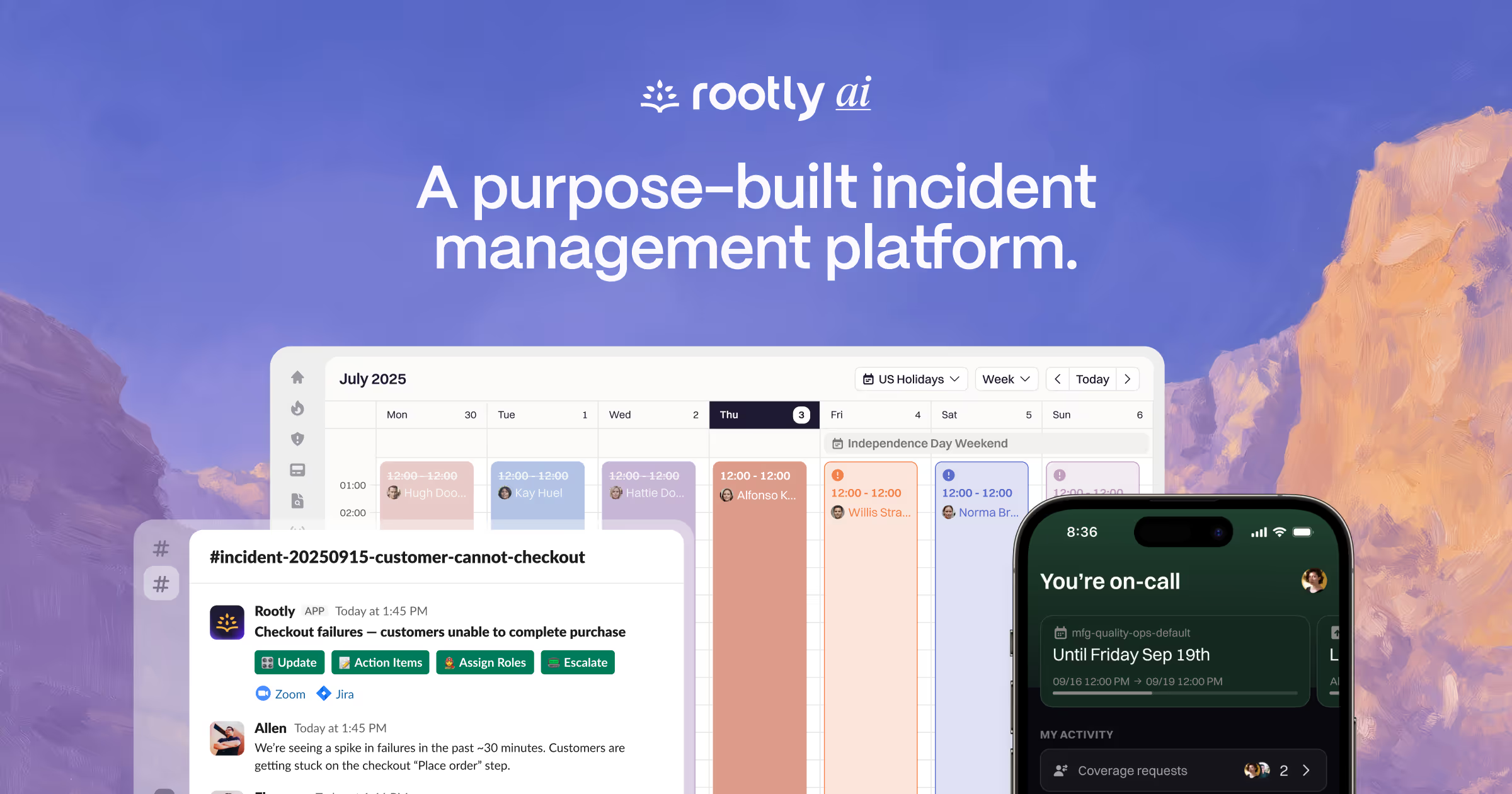
AI-native incident management platform | Rootly
The all-in-one incident management platform, including AI SRE agents—built for fast-moving engineering teams to detect, manage, learn from, and resolve incidents faster.
The domain rootly.com was registered on May 27, 2006, through amazon registrar, inc. and uses Cloudflare for DNS and security. At 19 years old, this age signals established credibility, a mature online presence, a proven track record, and accumulated authority that can strengthen trust signals and provide SEO advantages over newer domains.
Backlink Profile and Referring Domains
Referring Domains
The backlink profile for Rootly shows a mixed quality mix with a standout DA 62 link from developer resources (GitHub) and several lower-authority placements around DA 19–29, indicating a predominance of medium to lower-authority sources rather than DA 70+ or high-authority editorial coverage; notable source types include developer resources (GitHub) and Slack Marketplace listings which are valuable for relevance and product integration visibility. This pattern supports Rootly’s organic search performance by providing topical relevance and referral traffic from platform integrations, contributing to overall SEO strength through volume of links (37,166) and a reasonable number of referring domains (2,166), even if link authority is concentrated below top-tier levels.
The top-links sample yields an approximate dofollow-to-nofollow ratio of 70:30, reflecting 7 dofollow Slack Marketplace entries versus 3 nofollow entries (including the GitHub link), so while dofollow links from higher-authority sources typically pass more link equity, in this dataset the strongest DA link is nofollow which limits immediate authority transfer. Anchor text distribution is heavily skewed toward naked URLs (80%), with branded anchors (20%), keyword-rich (0%), and other (0%), a profile that is generally natural due to marketplace listings but could benefit from more varied branded and descriptive keyword anchors to strengthen topical relevance and reduce over-reliance on URL anchors.
Keyword Rankings
Top Ranking Keywords
The domain rootly.com presents a concentrated keyword portfolio that blends brand-centric queries (careers, pricing, API) with broader engineering-topic traffic around software engineering roles and acronyms, showing a mix of niche product intent and informational reach. The top keyword 'rootly careers' attracts daily searches in the dozens with a $0 CPC, indicating solid brand recognition. The other keywords — "rootly pricing" (SV 70, CPC $6.3, competition 60% - moderate), "rootly api" (SV 50, CPC $1.64, competition 17% - low), "swe means" (SV 1,300, CPC $0, competition 0% - low) and "sre's in swe" (SV 480, CPC $0, competition 0% - low) — show a competitive mix where commercial intent is concentrated on pricing while high-volume informational terms signal broader industry visibility with low competitive pressure. Overall the domain demonstrates healthy keyword portfolio and strong organic visibility with room to monetize branded commercial queries.
Competitive Landscape
rootly.com competes in the incident management and on-call response space against established players like PagerDuty and FireHydrant, and newer alternatives such as incident.io and xurrent. Compared to more established players, rootly.com shows a modest but meaningful presence — with lower overall traffic than category leaders (PagerDuty’s much larger organic footprint) but higher traffic than some niche rivals (e.g., FireHydrant), and it has carved out growth by focusing on a developer-friendly, Slack-first incident workflow that drives adoption in engineering teams.
rootly.com has a Domain Authority score of 34, which, according to the competitive table, places it on par with direct competitors in the incident response industry rather than ahead or behind from an authority perspective. By targeting engineering and SRE teams with features like automated runbooks, post-incident reports, and deep collaboration hooks, rootly’s emphasis on developer-focused workflows and automation has generated strong word-of-mouth growth and improved organic visibility, helping it gain niche market penetration despite larger incumbents.
FAQ on rootly.com
Everything you need to know about rootly.com.
What is rootly.com's primary business model?
Rootly operates a B2B SaaS business model, offering an incident management platform that teams subscribe to for automating incident response, runbooks, on-call coordination, and post-incident workflows. Revenue is generated through paid subscription tiers that scale with features, seats, and enterprise requirements, often integrated with existing tools like Slack, PagerDuty, and ticketing systems.
Is rootly.com considered a market leader, a challenger, or a niche player?
Challenger. Rootly is not as large or established as incumbents like PagerDuty but competes strongly within the incident management space by targeting modern engineering teams with streamlined, automation-first workflows. It positions itself to take share from larger players by focusing on developer-centric integrations and simpler operational UX.
What makes rootly.com unique compared to its competitors?
Rootly emphasizes a Slack-first, automation-driven approach to incident operations, combining runbooks, coordination, and postmortem processes into a single workflow to reduce manual overhead. Its focus on developer ergonomics, fast integrations with common toolchains, and built-in post-incident documentation and analytics differentiate it from broader monitoring or alerting platforms.
What are the most recent major updates or strategic shifts seen on rootly.com?
Public specifics on the very latest releases may be limited, but Rootly’s recent strategic direction reflects industry trends: deepening automation, expanding integrations and APIs, improving enterprise controls, and strengthening post-incident analytics and runbook capabilities. The company appears focused on making incident response more proactive and repeatable for engineering teams while integrating more tightly with collaboration and observability toolchains.
Related Domains
Explore other domains similar to rootly.com.