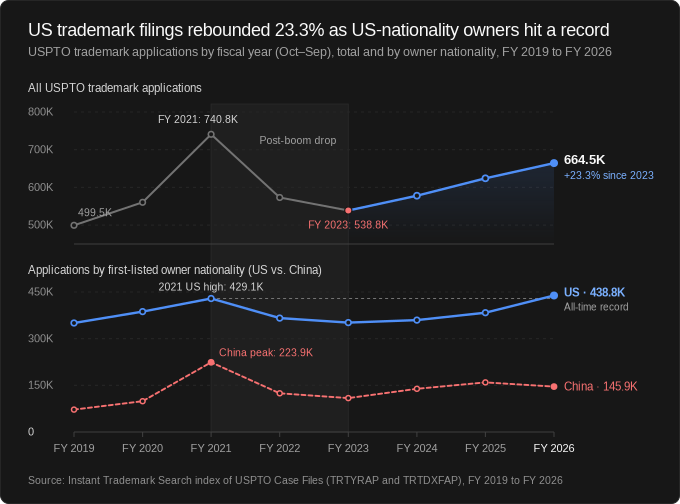
US federal trademark filings are climbing again, led by US-nationality owners and software brands. In fiscal year 2026 (October 1, 2025, through September 30, 2026, the October–September window used for annual USPTO totals below unless noted), applicants filed 664,477 trademark applications in our daily Case Files index, up 23.3% from the 2023 low (904,483 application classes in the USPTO’s workload tables, and 664,767 applications in the 12 months ending October 31, 2026). Filings from China-nationality owners remain 35% below their 2021 subsidy peak, while applications from US-nationality owners reached an all-time high of 438,816 in 2026 (440,377 in the 12 months through October), passing their 2021 record.
Three years ago, the US trademark register was coming down from its pandemic peak. E-commerce launches and municipal filing subsidies in China lifted 2021 volume to 740,845 applications and pushed first-action wait times past eight months. Filings then fell for two years to 538,806 in 2023, alongside the 2023–2024 contraction in whether .com is still growing and why domain registrations are growing. Since 2023, applications have risen three years in a row while the USPTO cut first-action wait times in half to 4.1 months.
Nice Class 42, which covers software as a service, cloud platforms, and artificial intelligence services, grew 65.5% over three years to 78,190 applications, and one in three Class 42 filings now names artificial intelligence in its goods and services. We examined all 14,425,496 deduplicated applications and registrations in our USPTO trademark search index through November 21, 2026, alongside USPTO workload reports and the January 2025 fee changes, to see where new filings are concentrated and how many reach registration.
How many trademarks are filed with the USPTO each year?
Before the pandemic, US federal trademark volume grew from 437,206 applications in 2017 to 499,471 in 2019. Volume rose to 560,513 in 2020 and peaked at 740,845 in 2021, including a single-month record of 93,045 applications in December 2020 ahead of the January 2021 fee increase. Filings then fell 22.6% to 573,292 in 2022 and another 6% to 538,806 in 2023.
Volume bottomed in 2023, then rose 7.3% to 578,074 in 2024, 8% to 624,094 in 2025, and 6.5% to 664,477 in 2026, up 125,671 applications (+23.3%) over three years. Between April and June 2026, applicants filed 180,029 marks, the busiest quarter since early 2021.
The USPTO’s Trademarks Dashboard and annual workload tables report the same turn in classes filed rather than distinct serial numbers. Because one application can claim multiple Nice classes (averaging 1.33 to 1.37 classes per application across this window) and Madrid extensions enter on slightly different schedules, we compare the two series side by side rather than mixing them. USPTO classes filed dropped from 943,928 in 2021 to 737,018 in 2023, then climbed to 767,138 in 2024 (+4.1%), 824,192 in 2025 (+7.4%), and 904,483 in 2026 (+9.7%, and +22.7% above 2023).
| Year (Oct 1–Sep 30) | Applications in case files | US-nationality owners | China-nationality owners | USPTO workload classes filed | Annual class change |
|---|---|---|---|---|---|
| 2021 | 740,845 | 429,138 | 223,932 | 943,928 | +27.9% |
| 2022 | 573,292 | 365,998 | 124,384 | 787,795 | −16.5% |
| 2023 | 538,806 | 351,701 | 108,979 | 737,018 | −6.4% |
| 2024 | 578,074 | 359,518 | 138,940 | 767,138 | +4.1% |
| 2025 | 624,094 | 383,556 | 159,532 | 824,192 | +7.4% |
| 2026 | 664,477 | 438,816 | 145,880 | 904,483 | +9.7% |
Grouping applications by the first listed owner’s nationality (Owner.nationality in case files, which records legal nationality or state of organization rather than applicant domicile) separates the 2021 spike from the 2026 recovery. Between 2019 and 2021, applications from China-nationality owners more than tripled from 72,021 to 223,932 (30.2% of all US filings), driven by cross-border marketplace sellers and municipal trademark subsidies. In December 2020, China-nationality owners filed 44,623 US applications, briefly passing US-nationality owners (39,734). After those subsidies ended and the USPTO tightened US-counsel rules and sanctioned high-volume filing mills, applications from China-nationality owners fell by more than half to 108,979 in 2023.
In 2026, filings from China-nationality owners slipped 8.6% to 145,880, still 34.9% below their 2021 peak, while all other non-US nationalities held steady at 79,014. Applications from US-nationality owners rose from 351,701 in 2023 to 438,816 in 2026 (66% of all filings), the highest US-nationality total in the USPTO archive.
USPTO trademark filing fees and wait times in 2026
The growth through 2025 and 2026 arrived despite higher entry-level USPTO trademark filing fees. On January 18, 2025, the USPTO’s 2025 trademark fee changes retired TEAS Plus ($250 per class) and TEAS Standard ($350 per class) in favor of a single $350 base application fee per class in Trademark Center. Applicants who type custom goods-and-services text into the free-form box instead of picking pre-approved entries from the Trademark ID Manual now pay an extra $200 per class ($550 total), plus $200 for each 1,000 characters beyond the first 1,000 and $100 per class for incomplete applications. Section 8 post-registration maintenance fees also rose from $225 to $325 per class, and WIPO Madrid filings rose from $500 to $600 per class on February 18, 2025.
On Friday, January 17, 2025, the final day of the $250 TEAS Plus tier, applicants submitted 7,659 applications in a single day, more than triple a normal January weekday. Volume across January 1–17 hit 47,004 applications before dropping to 14,384 across January 18–31 and 38,443 in February 2025. Like the wholesale fee pull-forwards in .com domains, that dip lasted only a few weeks. By March 2025, monthly filings were back at 53,165, and quarterly volume climbed to 165,996 in the first quarter of 2026 and 180,029 in the second quarter.
Examination wait times fell over the same period. After the 2021 backlog pushed average first-action wait times to 8.2 months in late 2023 and total disposal time to 14.6 months, the USPTO’s 2026 trademark review reported that first-action pendency dropped to 4.1 months and total disposal pendency fell to 9.5 months, while unexamined inventory shrank 12% to 305,978 classes. Alongside standardized ID Manual filings and the removal of 14,000 invalid applications and registrations for fraud in 2026, the office launched Class ACT on March 19, 2026, an internal AI system that assigns international trademark classes, design search codes, and pseudo marks in five minutes or less instead of a multi-month pre-examination queue.
Software and AI in Trademark Class 9 and Class 42
Grouping filings into 12-month windows ending October 31 (matching the window in our .com study) shows how Nice classification volume moved from physical goods to software. During the 12 months ending October 31, 2021, Class 25 (clothing, footwear, and headwear) was the busiest class among all 45 trademark classes in the US system with 92,607 applications, ahead of Trademark Class 9 (downloadable software, mobile apps, and electronics) at 86,347, while Trademark Class 42 (software as a service, cloud computing, and technological research) ranked fifth at 50,863.
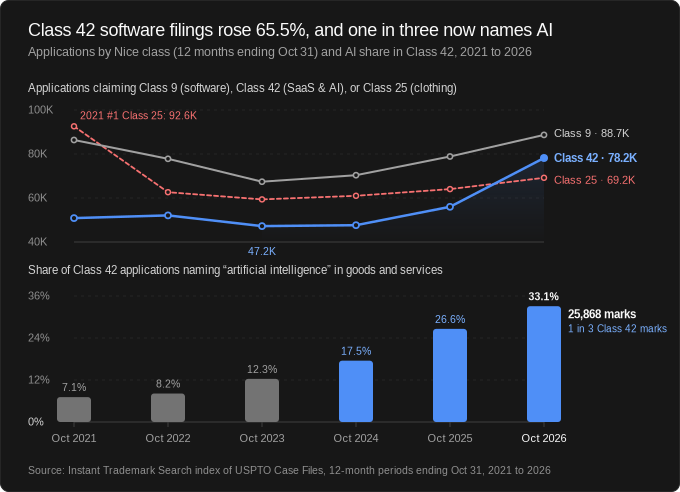
In the 12 months ending October 31, 2026, Class 25 sat 25.3% below its 2021 peak at 69,181 applications, and other 2021 consumer categories such as Class 21 (housewares, down 34.2%) and Class 28 (toys and games, down 23.8%) remained lower as well. Class 9 moved into first place at a record 88,704 applications (+31.6% since 2023), Class 41 (education, training, and online media) rose to 87,542 (+34.6% since 2023), and Class 42 grew 65.5% from its 2023 low (47,238 to 78,190), including a 39.7% gain in the past year from 55,979 in 2025. Together, 141,418 applications in the past year claimed Class 9 or Class 42, or 21.3% of all US trademark filings.
Much of Class 42’s gain comes from AI services. On January 1, 2026, the USPTO adopted the 13th edition of the Nice Classification, adding Class 42 entries for artificial intelligence as a service (AIaaS) and artificial intelligence consultancy to the pre-approved ID Manual so applicants avoid the $200 free-form surcharge. Across all classes, applications containing the phrase artificial intelligence in their goods and services grew nearly sixfold over four years, from 5,649 in 2022 (1% of all filings) to 19,186 in 2025 (3.1%) and 32,517 in 2026 (4.9%, or roughly one in 20 US trademark filings). Inside Class 42, 33.1% of applications (25,868 of 78,190) now name artificial intelligence, up from 7.1% in 2021. In Class 9, that share rose from 3.6% to 16.1% (14,238 applications).
AI agent trademarks, ChatGPT, and descriptive terms
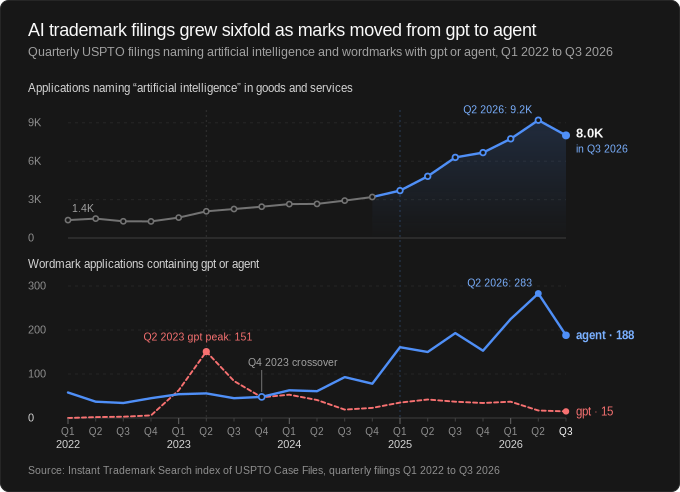
Trademark wordmarks followed the same curve we saw in 133.1 million new .com domains, on a register where each filing costs hundreds of dollars. After ChatGPT launched in late 2022, USPTO wordmark applications containing gpt jumped from nine in 2022 to 319 in the 12 months ending October 31, 2023, peaking at 151 in the second quarter of 2023 (the same quarter first-time gpt .com domains peaked at 41,200).
Of the 319 gpt applications filed in the 12 months through October 2023, 216 (67.7%) are dead, 59 (18.5%) remain pending (including OpenAI’s own December 2022 applications for GPT and CHATGPT, with 36 suspended under status code 654 and 12 in opposition under 774), and 44 (13.8%) are live registrations. Within the 216 dead records, 138 abandoned after no timely office-action response (602), 39 ended after an inter-partes decision (604), 33 were expressly abandoned (601 and 605), and one lapsed with no Statement of Use (606). Bulk case files record current lifecycle status codes rather than the specific refusal grounds inside each office action. By 2026, new gpt trademark filings had fallen 71% to 93.
Over 2025 and 2026, founders moved away from model acronyms and toward AI agent trademarks and distinct brand names. Wordmark applications containing agent quadrupled from 202 in 2023 to 843 in the 12 months ending October 31, 2026, nine times gpt’s total, while applications describing AI agent, software agent, or autonomous agent tools in their goods and services jumped from 57 in calendar year 2023 to 1,697 across the first three quarters of 2026 (where literal AI AGENT wordmarks face descriptive scrutiny under USPTO examination rules unless paired with a distinctive brand). Most AI software applicants skipped buzzwords in the brand name. Even in 2026, marks containing gpt, agent, or a standalone ai token account for about 5,000 filings, meaning roughly six out of seven applicants describing artificial intelligence in their goods and services chose an ordinary or coined brand name.
| 12 months ending October 31 | All USPTO applications | Class 9 or Class 42 | Goods/services name “artificial intelligence” | Mark contains gpt | Mark contains agent |
|---|---|---|---|---|---|
| 2022 | 567,653 | 111,469 (19.6%) | 5,649 (1.0%) | 9 | 195 |
| 2023 | 541,861 | 98,868 (18.2%) | 7,576 (1.4%) | 319 | 202 |
| 2024 | 586,223 | 102,700 (17.5%) | 10,925 (1.9%) | 150 | 280 |
| 2025 | 624,193 | 116,194 (18.6%) | 19,186 (3.1%) | 147 | 611 |
| 2026 | 664,767 | 141,418 (21.3%) | 32,517 (4.9%) | 93 | 843 |
Live, dead, and intent-to-use trademark approval rates
Across all 14,425,496 case files in our index on November 21, 2026, 3,766,934 (26.1%) are live registrations, 1,329,638 (9.2%) are pending applications, and 9,328,924 (64.7%) are dead or abandoned marks.
Much of that attrition comes from people reserving names before a product ships, the legal equivalent of parking an unused .com. In 2026, 47.5% of applicants (315,332 filings) submitted an intent-to-use trademark application under Section 1(b), up from 43.5% in 2025. Across settled cohorts filed between 2017 and 2022, applications backed by commercial use at filing reached registration 73.7% to 77% of the time, whereas intent-to-use applications registered 37.8% to 45.5% of the time. Roughly three in 10 intent-to-use filings become abandoned trademarks under status code 606 after clearing examination because the applicant never submits a Statement of Use. Even after registration, 3.49 million marks across the archive were later cancelled under Section 8 when owners did not prove continued use between years five and six.
Trademark vs. domain name availability
In the 12 months ending October 31, 2026, registrants added 32.34 million first-time .com names against 664,767 US trademark applications, or 49 brand-new .com domains for every trademark filing. Short names on the federal register are still heavily spoken for. Across 3,339,183 distinct live or pending alphanumeric wordmarks, 92.6% of all 17,576 three-letter A–Z combinations (16,279) are claimed somewhere on the register, including 52.2% (9,178) in Class 9 or Class 42.
Unlike DNS, where or resolves to one registrant worldwide, trademark law scopes rights to related goods and services. Across our live index, 200,393 distinct wordmarks are held under two or more distinct owner names at the same time, and 23,351 appear under five or more, led by single words such as TITAN (197 distinct live owner names), APEX (172), ATLAS (167), and ECLIPSE (155). A taken .com does not mean a word is blocked in your Nice class, and registering one of the popular domain extensions in 2026 such as .ai, .app, or a prefixed .com gives you no defense against domain name trademark infringement if another software company already holds a confusingly similar mark in Class 9 or Class 42.
Public USPTO case files also have clear limits. They cover federal applications and registrations only, so they do not record unregistered common-law rights earned through local or commercial use, state trademark registers, or foreign registers outside Madrid designations. Our wordmark counts also exclude visual conflicts among the 1,509,720 design-only logo records that carry no mark text, and case files cannot tell whether a pending intent-to-use AI filing will ship a real product next year.
How to check if a name is trademarked and available as a domain
With 141,418 software and technology marks entering the federal pipeline in the past year, screening candidates while you brainstorm avoids costly rebrands later. Run a free US trademark search on Instant to check all 14.43 million live, pending, and dead USPTO records as you type, filter to Class 9, Class 42, or your industry’s Nice class, and switch between exact, prefix, fuzzy, and phonetic matching to spot look-alike or sound-alike conflicts. You can read more about how we built the daily index in Introducing Instant Trademark Search.
To check both in one view, open a candidate in domain research to check availability of a domain, WHOIS and zone-file history, and matching USPTO marks side by side. You can also run an instant domain name search across 800+ extensions, or test variations in the domain name generator and business name generator with built-in domain checks. If you work inside Claude, ChatGPT, or Cursor, our free Domain Search MCP and ChatGPT plugin query both domain availability and indexed USPTO trademark records during the conversation.
Instant Trademark Search is built for early screening and research, not legal advice. Before you commit to a brand or pay non-refundable filing fees, confirm any candidate in USPTO TSDR, check common-law use on the web, and consult a trademark attorney, as we outline in our nine-step guide on how to choose a domain name.
Frequently asked questions
How many trademarks are there in the US in 2026?
On November 21, 2026, our daily index of the USPTO Trademark Case Files dataset held 14,425,496 total records, including 3,766,934 live registered trademarks, 1,329,638 pending applications, and 9,328,924 dead or abandoned records. Annual filings rose three years in a row from 538,806 applications in 2023 to 664,477 in 2026 (+23.3%), led by an all-time record 438,816 applications from US-nationality owners.
How much does a trademark cost at the USPTO in 2026?
Since January 18, 2025, the base USPTO trademark filing fee in Trademark Center is $350 per international class when you select pre-approved goods and services from the Trademark ID Manual. Typing custom free-form descriptions adds a $200 surcharge per class ($550 total), plus $200 for each 1,000 characters beyond the first 1,000 and $100 per class for incomplete applications.
How long does it take to get a trademark in 2026?
According to the USPTO’s 2026 results, average first-action wait time (from filing to an examiner’s first office action or approval) dropped to 4.1 months, down from 8.2 months in late 2023, and average total disposal time to registration, allowance, or abandonment fell to 9.5 months. Intent-to-use applications and opposed marks take longer, and 37.8% to 45.5% of intent-to-use filings in 2017–2022 cohorts ultimately registered compared with 73.7% to 77% for use-in-commerce filings.
What are Trademark Class 9 and Class 42 for software and AI?
Most software and AI products file in Trademark Class 9 (downloadable software, mobile apps, and AI hardware) or Trademark Class 42 (software as a service, cloud platforms, and artificial intelligence as a service). In the 12 months ending October 31, 2026, Class 9 led all Nice classes with 88,704 applications, while Class 42 grew 65.5% from its 2023 low to 78,190 applications, with 33.1% of Class 42 filings naming artificial intelligence.
Does registering a domain name give you trademark rights?
No. Registering a domain name reserves a DNS web address at a registry, not trademark rights in commerce. Another business may already hold a live or pending federal trademark for the same or a confusingly similar name in your Nice class even when .com, .ai, or .app is open to register, and using an infringing domain in that industry can trigger a trademark dispute or UDRP complaint.
Sources and method
| Source | Published | Used for |
|---|---|---|
Instant Trademark Search and USPTO Open Data Portal bulk data (TRTYRAP and TRTDXFAP) | Through November 21, 2026 | 14,425,496 canonical records, live/pending/dead counts, annual and 12-month cohorts, owner nationality, Nice class totals, AI goods-and-services counts, wordmark crowding, and intent-to-use outcomes |
| USPTO Trademarks Dashboard and Financial and Performance Reporting | Quarterly, 2021 to 2026 | Official application classes filed (943,928 in 2021, 737,018 in 2023, and 904,483 in 2026) and quarterly pendency series |
| USPTO 2026 Trademark results | October 28, 2026 | 2026 first-action pendency (4.1 months), disposal pendency (9.5 months), unexamined inventory (305,978 classes), and 14,000 invalid records removed |
| USPTO Summary of 2025 trademark fee changes | Effective January 18, 2025 | $350 base application fee, $200 free-form ID and character-count surcharges, $100 incomplete surcharge, and Section 8 maintenance fees |
| USPTO announcement of Class ACT | March 19, 2026 | Automated pre-examination classification, design search codes, and pseudo-mark generation |
| USPTO Nice Classification 2026 update | October 1, 2025 (effective January 1, 2026) | Adoption of Nice Classification 13th edition (version 2026) in the USPTO ID Manual |
| Is .com still growing? and Instant History | November 23, 2026 | Comparison with 32.34 million first-time .com zone entries and gpt vs. agent domain cohorts through October 31, 2026 |
Instant Trademark Search builds its canonical dataset from the USPTO’s complete 2025 annual case-file archive (TRTYRAP, 90 parts covering filings through December 31, 2025) merged with all 2026 daily transaction archives (TRTDXFAP) through November 21, 2026, keeping the newest revision of each eight-digit serial number ordered by transaction date, source publication date, object generation, and file name. Status categories (live, pending, and dead) map USPTO numeric status codes using the published lifecycle table (status::categorize in trademarks-core). Owner nationality reads the first listed owner’s <nationality> country or US state of organization (without separate applicant domicile fields). Alphanumeric wordmark comparisons strip punctuation and spaces and convert ASCII letters to one case.