Finding the right domain name is the first step in building anything online. But where you search matters more than most people realize. The tool you use determines how fast you get results, how many extensions you can check, what you pay, and whether a registrar is quietly logging every name you look up.
We compared 9 of the most popular domain search tools available in 2026. Here’s what actually differentiates them, what each one does well, and how to pick the right one for what you’re doing.
What to look for in a domain search tool
Before diving into individual tools, here’s what separates a great domain search experience from a mediocre one:
- Search speed — Does the tool show results as you type, or do you submit a query and wait? The difference between sub-25ms and multi-second responses changes how you explore names. Instant feedback lets you iterate on ideas. Waiting for each check slows you down.
- Data source — This is the one most people don’t think about. Some tools query registries directly (VeriSign, Google Registry, Identity Digital) for authoritative availability data. Others rely on WHOIS lookups, which can be stale, or registrar APIs that may cache results. The data source determines accuracy.
- TLD coverage — Can you search
.comonly, or 800+ extensions? If you’re exploring newer TLDs like.ai,.io,.dev, or.store, coverage matters. - Pricing transparency — Does the tool show you what a domain costs? From one registrar or multiple? Registration price and renewal price are often different, and the gap can be significant.
- Privacy — When you search on a registrar’s domain tool, that registrar sees every domain you check. If you’re a startup in stealth mode, a domain investor researching assets, or a company evaluating competitor brand variations, this is a real concern.
- Name generation — Does the tool only check exact matches, or can it suggest alternatives? AI-powered generators, prefix/suffix variations, and semantic suggestions help you discover names you wouldn’t have thought of.
- AI and API integration — In 2026, many domain workflows start inside an AI assistant or a script. Tools with API access or MCP (Model Context Protocol) support let you check domains without leaving your workflow.
- Purchase model — Search-first tools let you compare prices across registrars and buy wherever is cheapest. Sell-first tools funnel you toward purchasing from them. Both models work, but understanding the difference helps you interpret results and pricing.
The 9 best domain search tools in 2026
1. Instant Domain Search
Best for: Speed, privacy, and multi-registrar price comparison
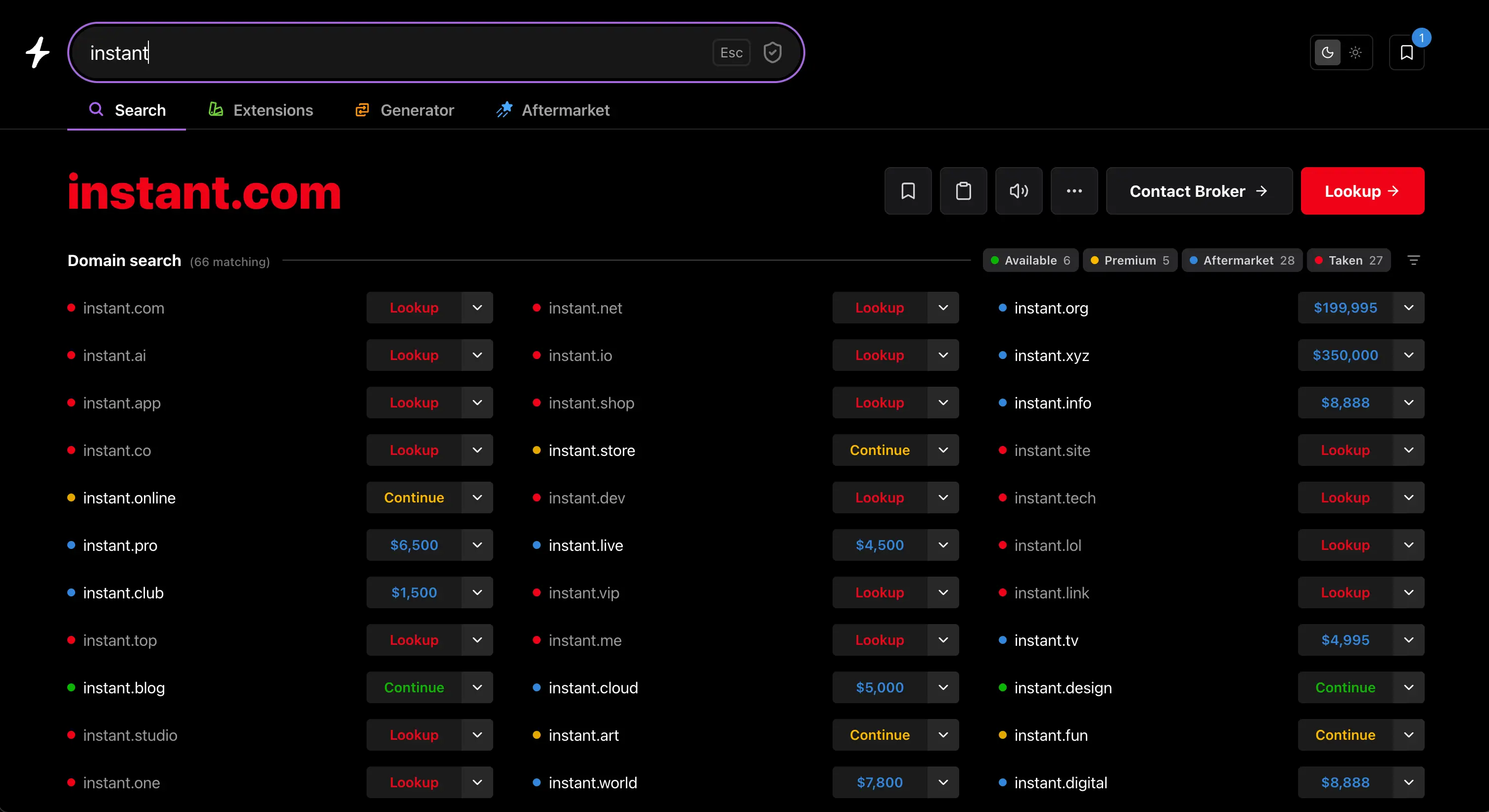
Instant Domain Search has been building domain search for 20 years, serving nearly 50 million searches since 2005. The core differentiator is architecture: searches run against a local index of zone files built from direct registry partnerships with VeriSign, Google Registry, Radix, Identity Digital, and others. That means sub-25ms results that stream back as you type, powered by JSON streaming rather than traditional API lookups.
Key features:
- As-you-type results in sub-25ms via registry-level data
- 800+ TLD coverage across registries, aftermarkets, and premium listings
- Multi-registrar pricing comparison showing costs from Namecheap, GoDaddy, Porkbun, Spaceship, and more via smart partner routing
- Domain name generator with AI-powered suggestions, prefixes, suffixes, and semantic alternatives
- Bulk domain search for checking up to 5,000 domains at once
- Expired domains search for finding dropping domains with existing authority
- Curated domain lists of brandable, short, and themed names for inspiration
- Check Domain Availability deep-dive tool with WHOIS data, registrar pricing, and aftermarket listings
- MCP server for checking domains directly from Claude, Cursor, or any AI assistant
- No account required, 100% free
Privacy approach: Searches run against a local zone file index. No queries are forwarded to retail registrar APIs. The only time a registrar learns about your interest is when you click a purchase link. This is unique among domain search tools. Read how it works.
Limitations: Instant Domain Search is not a registrar — it doesn’t sell domains directly. When you’re ready to buy, it links you to partner registrars where you can complete the purchase. There’s no domain management (DNS settings, transfers, renewals) since those are registrar functions.
2. GoDaddy
Best for: Beginners who want everything in one place
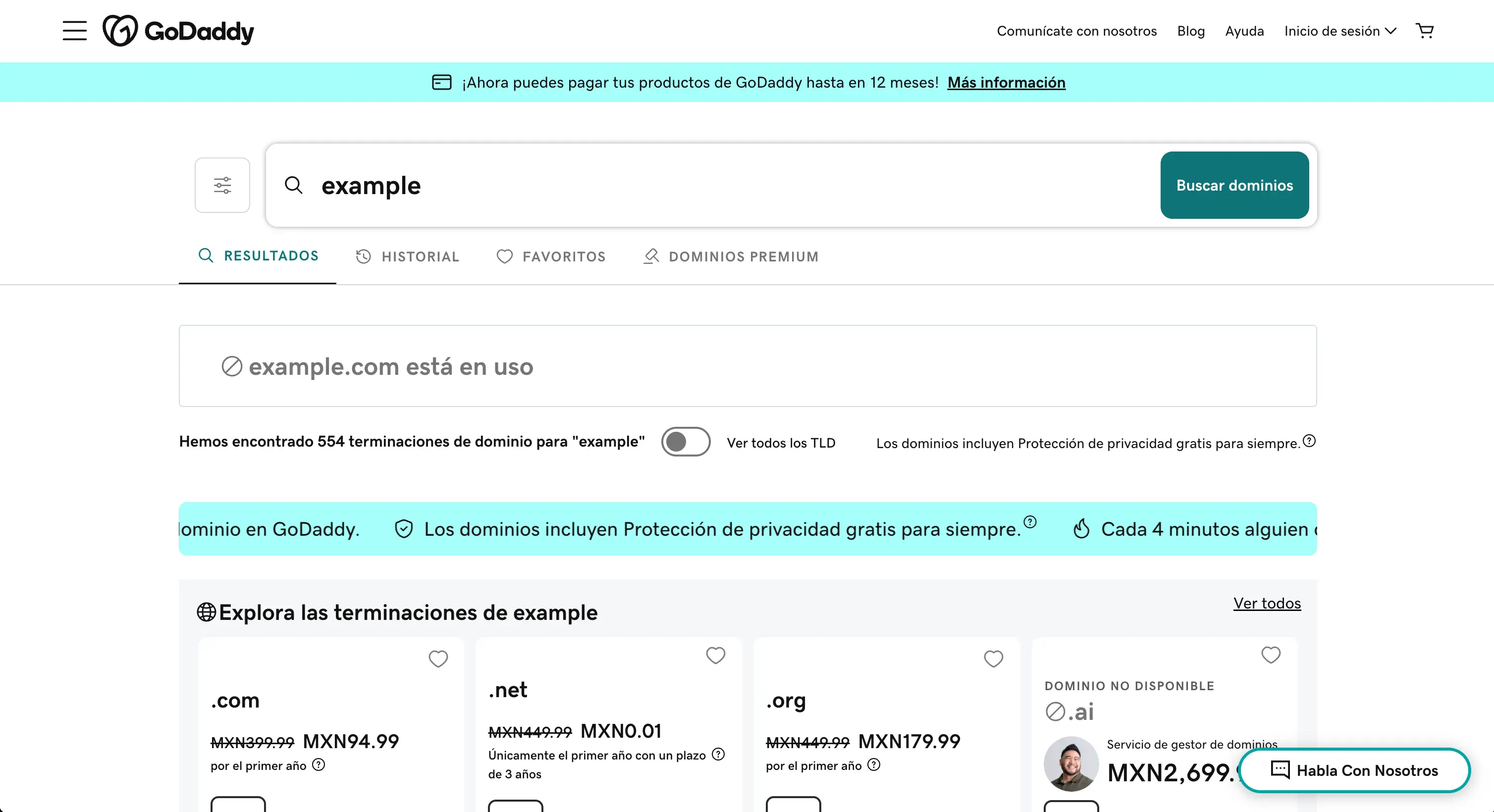
GoDaddy is the world’s largest domain registrar by market share, and there’s a reason for that. Their platform bundles domain search, registration, hosting, email, website builder, and marketing tools into a single ecosystem. If you want one account for everything, GoDaddy delivers that convenience.
Key features:
- 518+ extensions
- Bundled hosting, email, website builder, and marketing tools
- Domain appraisal tool for estimating domain values
- Aftermarket access through Afternic (GoDaddy’s acquisition)
- 24/7 phone support
- Domain Privacy protection available at checkout
- Bulk search for up to 500 domains
Privacy approach: GoDaddy is the world’s largest registrar. All searches run through their infrastructure and are subject to their data practices.
Limitations: Heavy upselling during the purchase flow — expect add-on offers for privacy protection, email, hosting, and website builder at every step. Introductory prices are often significantly lower than renewal prices. WHOIS privacy costs extra on most plans. The search experience prioritizes conversion over exploration.
You can also search for domains and see GoDaddy’s pricing directly on Instant Domain Search — results include GoDaddy alongside other registrars so you can compare before committing.
3. Namecheap
Best for: Budget-friendly registration with creative name generation tools
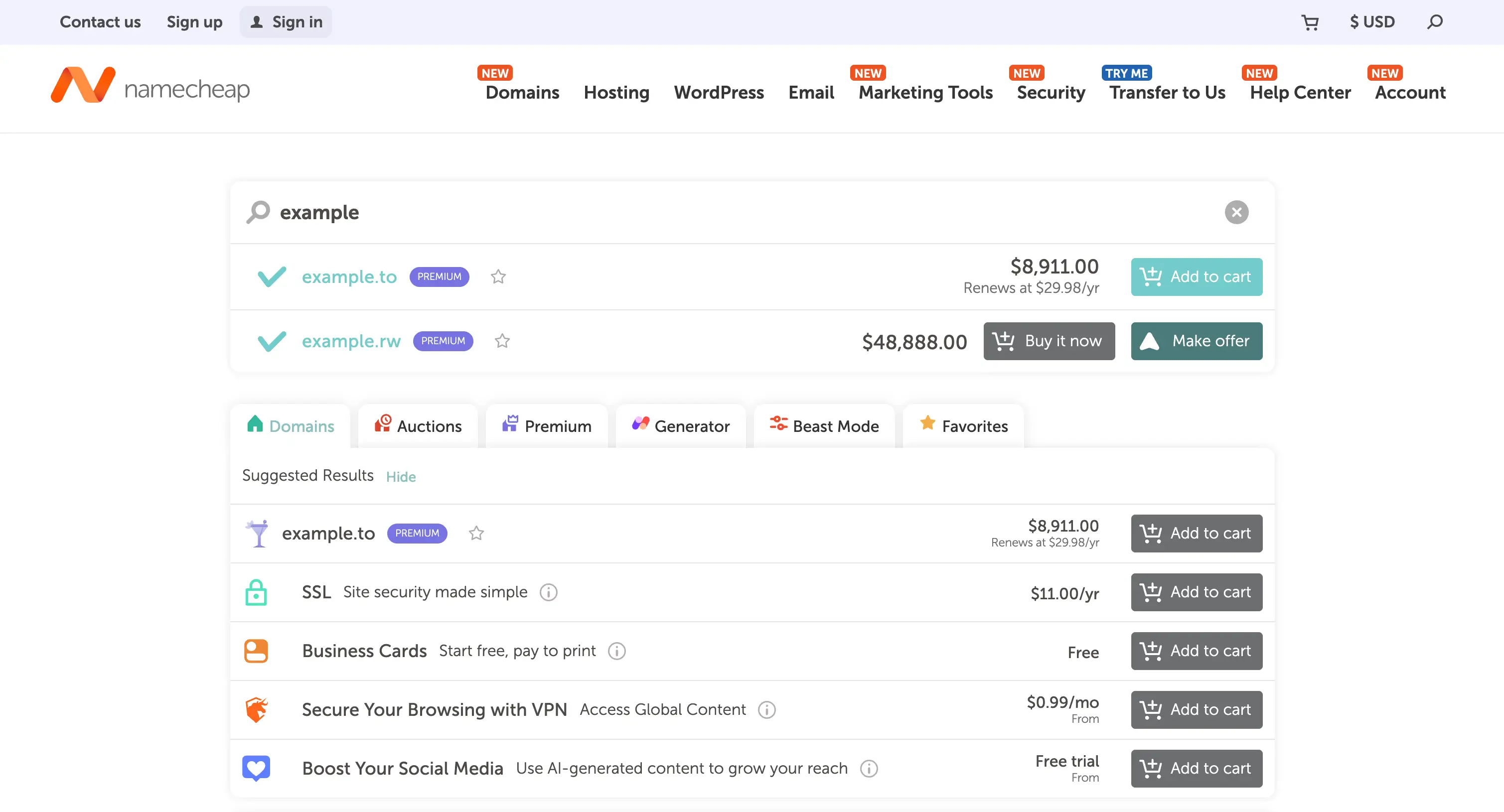
Namecheap lives up to its name with consistently low introductory pricing and a feature set that punches above its price point. Their Beast Mode is one of the more creative domain search tools available — it combines bulk availability checking with domain hacks, vowel dropping, and prefix/suffix transforms that help you brainstorm names you wouldn’t have found manually.
Key features:
- 1,164+ TLDs — the largest selection on this list
- Beast Mode with domain hack suggestions (e.g., “hire” becomes “hi.re”), vowel dropping, and creative transforms
- Up to 5,000 domains per Beast Mode search
- Free WhoisGuard privacy protection
- Low introductory pricing
- CSV import and export
- Shareable search links for team collaboration
- Marketplace for aftermarket domains
Privacy approach: Namecheap is a retail registrar. When you search on their platform, availability checks run through their registrar infrastructure. They can see every domain you search for.
Limitations: Renewal prices are often higher than introductory prices — check the renewal cost before registering. Beast Mode’s creative transforms can generate a lot of noise alongside useful suggestions. No MCP or AI assistant integration.
Namecheap pricing is included in Instant Domain Search results, so you can compare their rates against other registrars in real time as you search.
4. Porkbun
Best for: Transparent pricing with no renewal markup
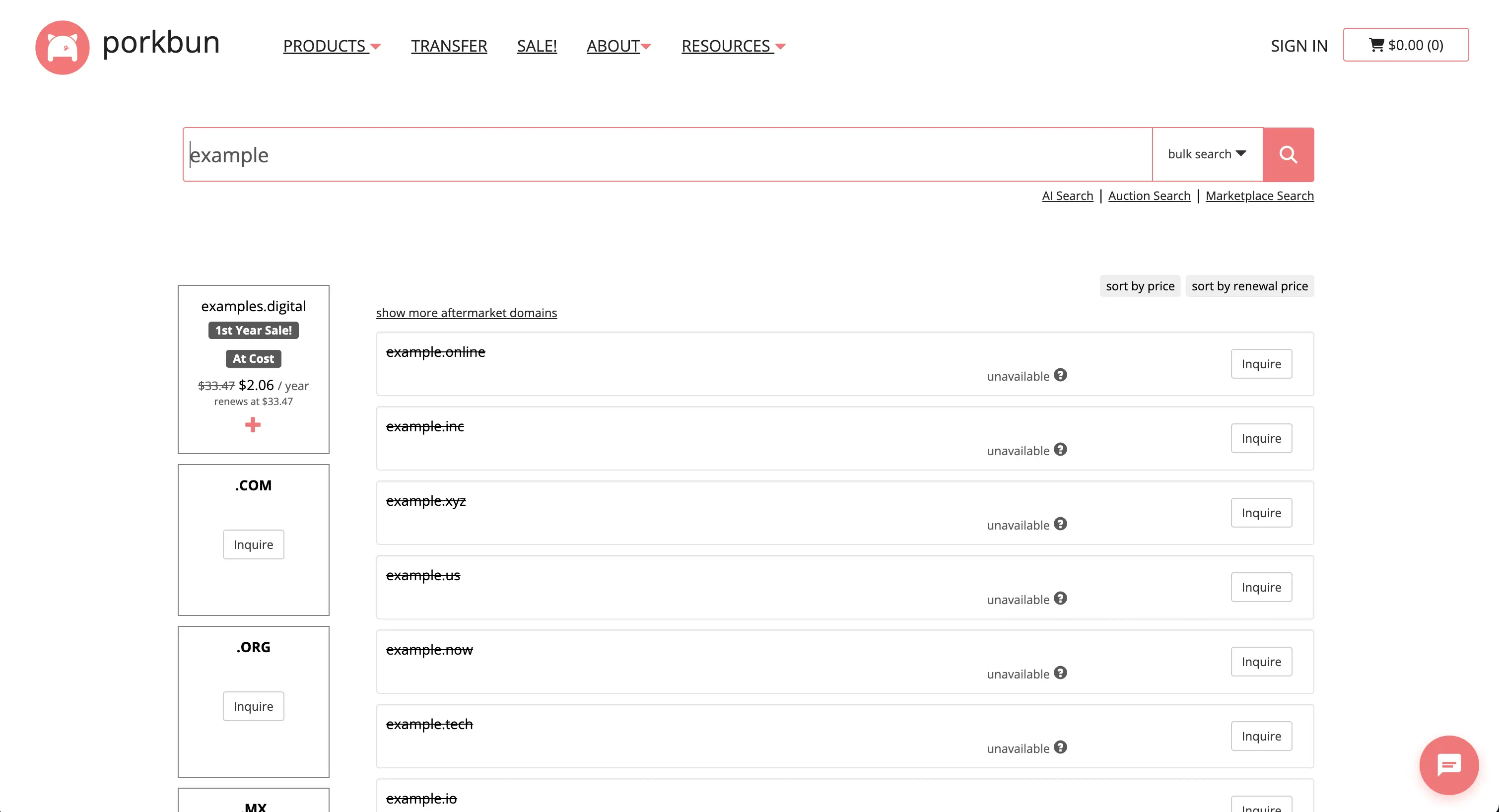
Porkbun has earned a loyal following among domain buyers who are tired of the introductory-price-to-expensive-renewal bait-and-switch. Their pricing model is straightforward: the price you see is close to what you’ll pay on renewal. Combined with free WHOIS privacy and free SSL certificates on every domain, the total cost of ownership is often the lowest of any traditional registrar.
Key features:
- 500+ TLDs
- Free WHOIS privacy and SSL certificates with every domain
- Transparent pricing — registration and renewal prices are clearly listed
- Public API for registration, renewals, transfers, DNS, DNSSEC, SSL, and hosting, plus a free sandbox, dry runs, signed webhooks, and idempotency keys
- Official MCP server (porkbun.com/mcp)
- Phone (1.855.767.5286) and live chat, 9 AM to 5 PM Pacific every day, plus 24/7 email
- Clean, modern interface
- Competitive pricing especially on newer TLDs
Privacy approach: Porkbun is a registrar. Searches go through their systems.
Limitations: Basic search experience — no as-you-type results, no AI suggestions, no creative name generation. Bulk search limited to 100 domains. Domain management interface can be clunky for large portfolios.
Porkbun is one of the registrars integrated into Instant Domain Search — you can see their pricing alongside other registrars and go directly to Porkbun to register when they have the best price.
5. Hostinger
Best for: All-in-one web presence with competitive domain pricing
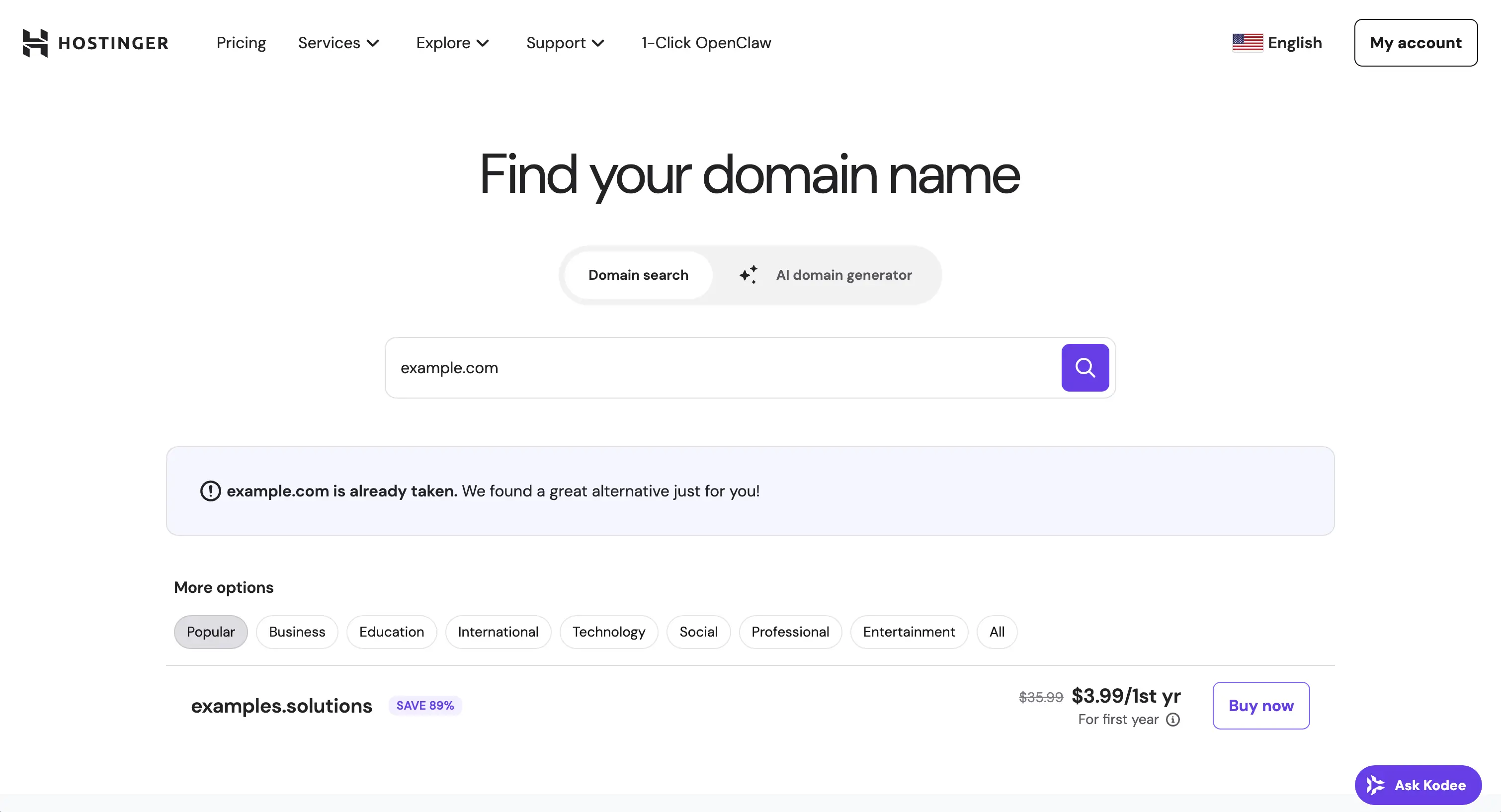
Hostinger has grown rapidly by combining affordable hosting with domain registration, AI website builder tools, and a polished onboarding experience. Their domain search is tightly integrated with their hosting plans, making it easy to go from finding a name to having a live website in one session. For users who want domain + hosting together without GoDaddy-level upselling, Hostinger hits a good middle ground.
Key features:
- 300+ TLDs with competitive introductory pricing
- Free domain included with most hosting plans (first year)
- AI website builder and WordPress hosting integration
- Free WHOIS privacy on all domains
- Intuitive control panel (hPanel)
- 24/7 live chat support
- Domain forwarding and DNS management included
Privacy approach: Hostinger is a registrar. Domain searches go through their infrastructure.
Limitations: Lowest prices require multi-year hosting commitments. Domain-only registration (without hosting) is available but less prominently featured. TLD selection is narrower than Namecheap or Dynadot. Renewal pricing increases after the introductory period. The domain search is secondary to their hosting product.
Hostinger pricing is also available through Instant Domain Search — search for any domain and you’ll see Hostinger’s rates compared to other registrars.
6. Domain.com
Best for: Simple, straightforward domain registration
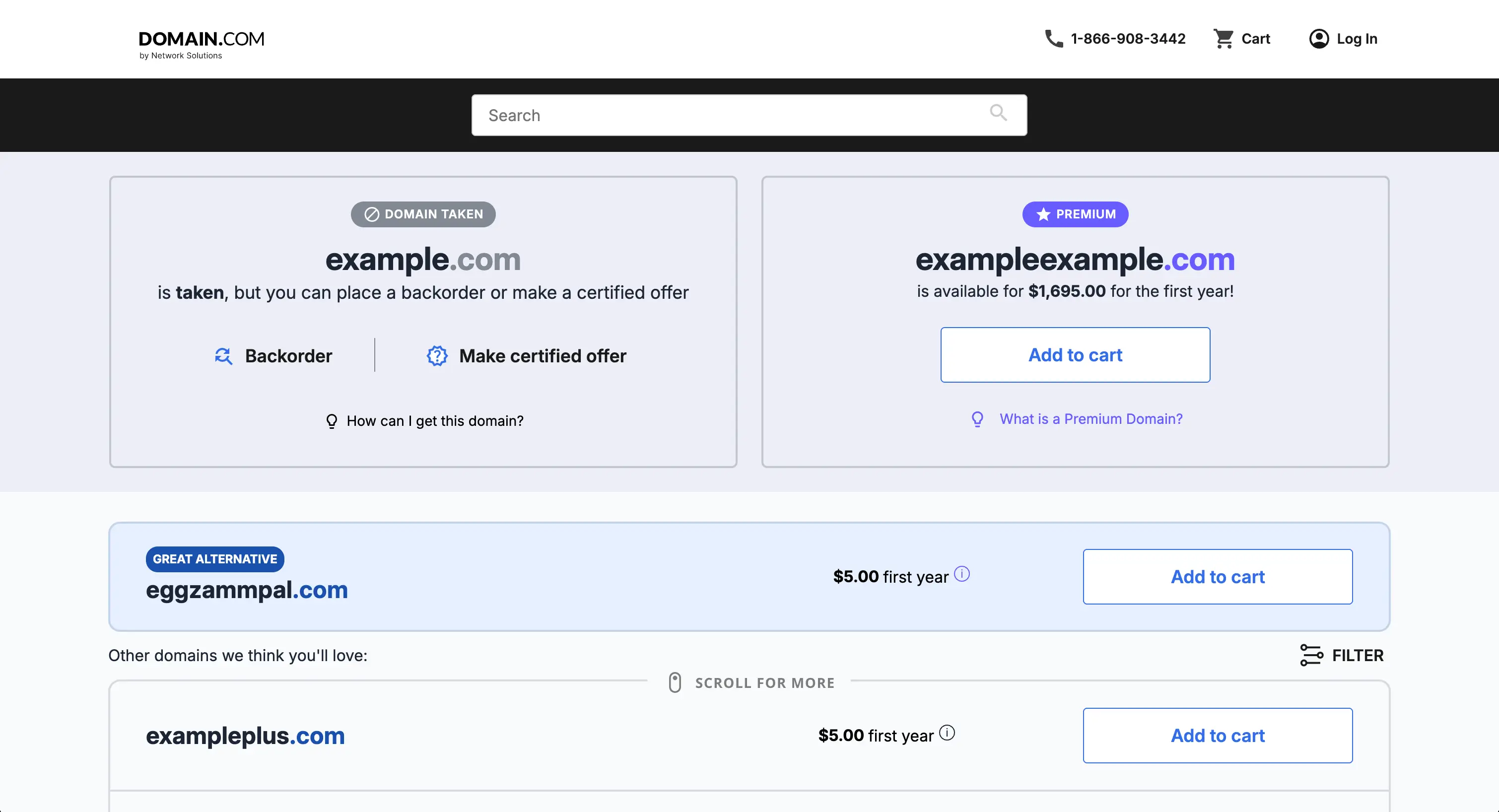
Domain.com keeps things simple. The platform focuses on making domain registration easy without overwhelming you with features or add-ons. Their search suggests alternatives when your first choice is taken, and the checkout process is relatively clean. For someone who just wants to register a domain without thinking too hard about it, Domain.com delivers that simplicity.
Key features:
- 300+ TLDs
- Free WHOIS privacy with Domain Privacy + Protection
- Website builder and hosting packages available
- Professional email integration
- Domain transfer support with price-lock guarantee
- SSL certificates included with hosting plans
Privacy approach: Domain.com is a registrar (owned by Newfold Digital, which also owns Bluehost and Web.com). Standard registrar data practices apply to searches.
Limitations: Introductory pricing can be significantly lower than renewal pricing — always check renewal costs. Fewer TLDs than larger registrars. No bulk search. No API access. No AI features or name generation tools. Add-on upselling at checkout, though less aggressive than GoDaddy.
You can compare Domain.com’s pricing with other registrars on Instant Domain Search before deciding where to register.
7. Cloudflare Registrar
Best for: At-cost domain registration with no markup
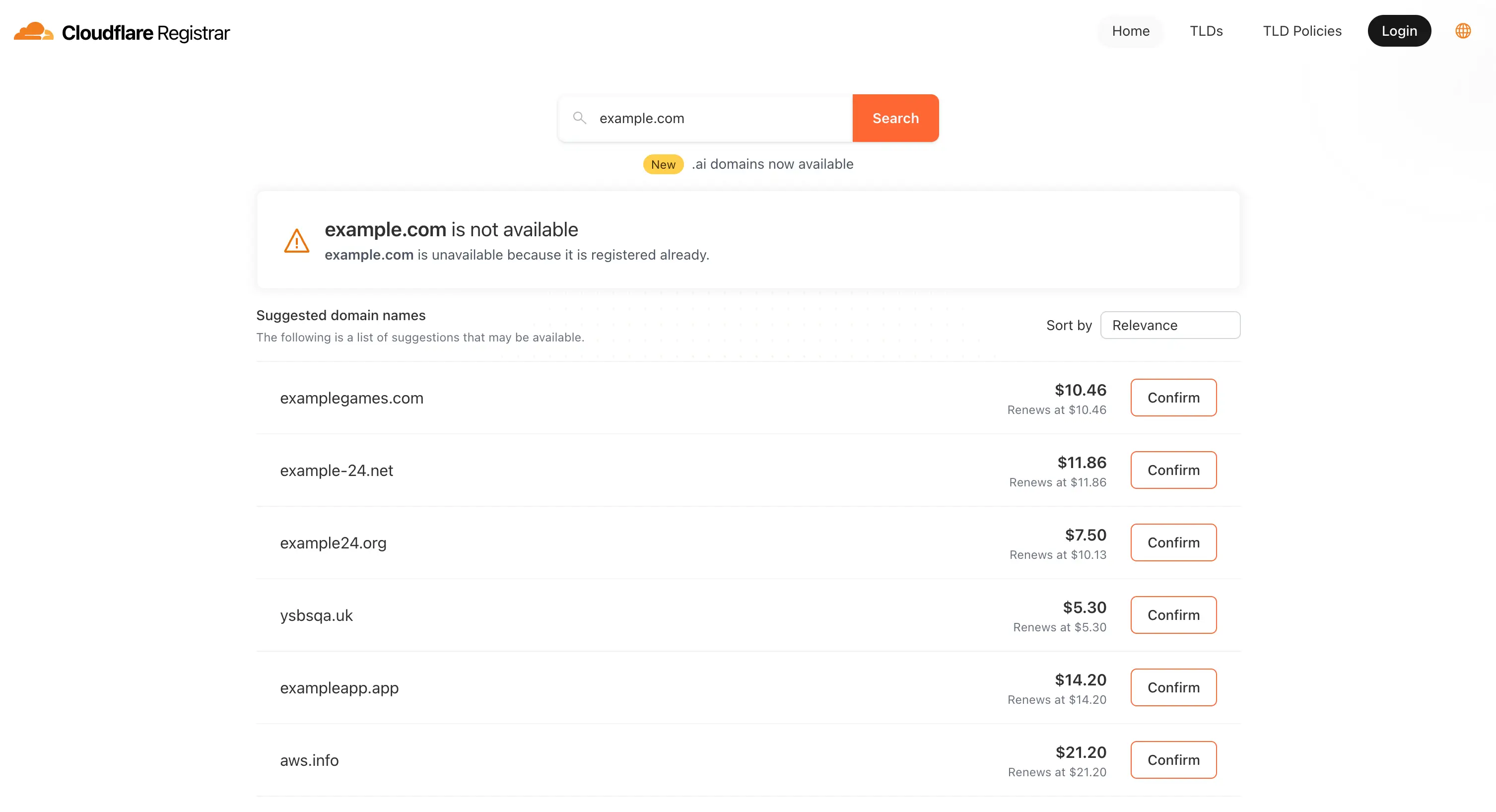
Cloudflare Registrar passes through wholesale registry prices with zero markup. If you’re a developer already using Cloudflare for DNS, CDN, or security, adding domain registration to the same dashboard is seamless. Their pricing model is genuinely impressive — you pay exactly what Cloudflare pays the registry, plus the ICANN fee.
Key features:
- At-cost pricing (wholesale price passed through, no markup on registration or renewal)
- Integrated with Cloudflare’s DNS, CDN, DDoS protection, and Workers platform
- Free WHOIS privacy on all domains
- DNSSEC support
- API access for domain management
- Automatic SSL certificates
Privacy approach: Cloudflare is a registrar. Domain searches on their platform go through their infrastructure.
Limitations: Limited TLD selection (~300 extensions) compared to dedicated search tools. No as-you-type search — you enter a domain and wait for results. No name generation or AI suggestion features. Requires a Cloudflare account. The domain search is a feature within their infrastructure product, not a standalone search tool.
8. Dynadot
Best for: International domain investors and high-volume buyers
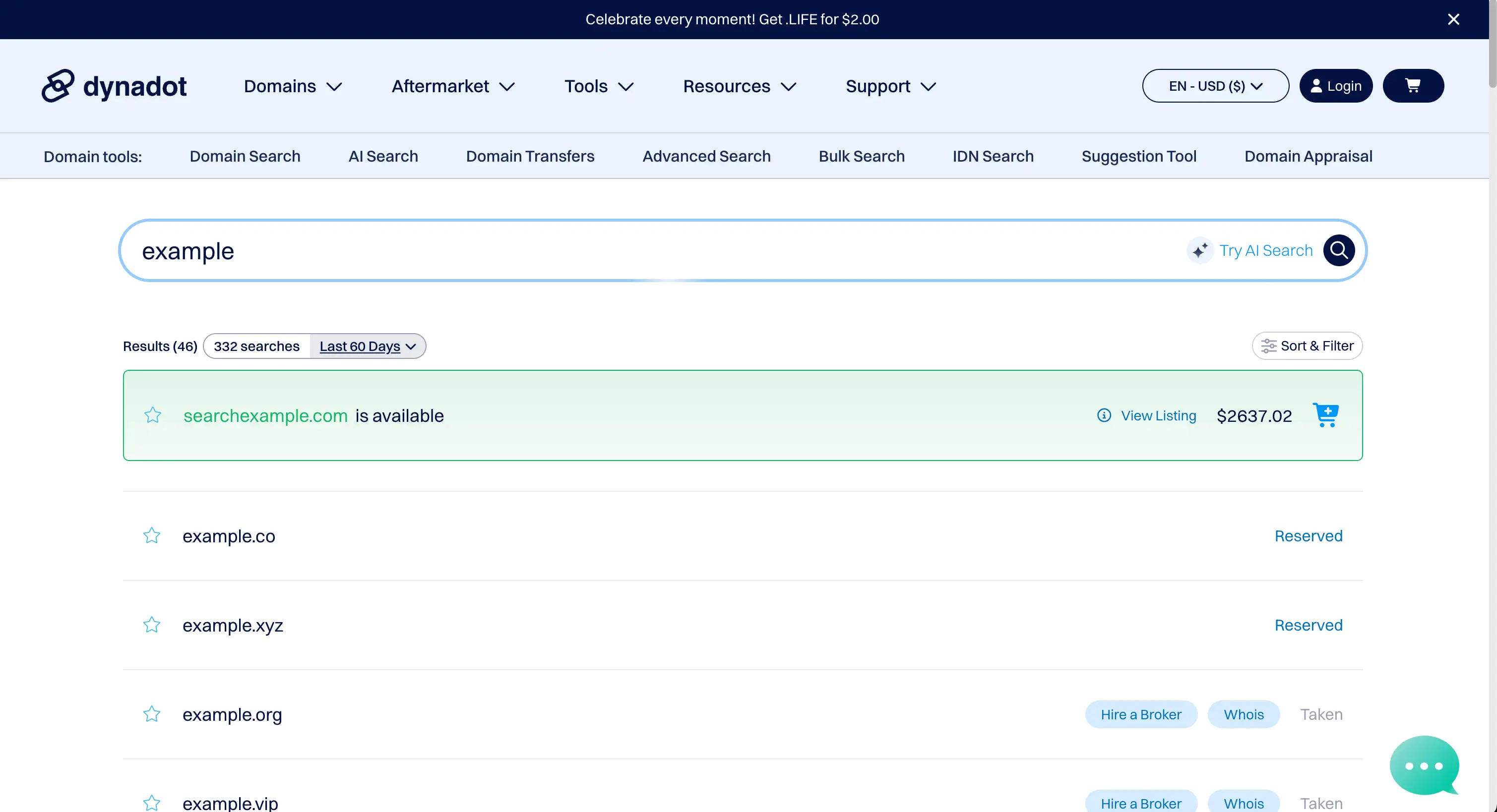
Dynadot has built a strong reputation among domain investors with competitive pricing, full internationalized domain name (IDN) support, and a tiered account system that unlocks better tools as your spending increases. Their aftermarket marketplace adds a buy/sell dimension that pure search tools lack.
Key features:
- 600+ TLDs with full IDN support for international domains
- Bulk search scaling from 1,000 domains (free) to 5,000/day (Super Bulk accounts)
- API access for Bulk and Super Bulk account tiers
- Built-in aftermarket marketplace for buying and selling domains
- Competitive pricing with volume discounts
- WHOIS lookup integration in search results
Privacy approach: Dynadot is a registrar. Searches route through their registrar systems.
Limitations: The best features require significant annual spend — $500+/year for Bulk tier API access, $5,000+/year for Super Bulk. The free tier is functional but limited. The search interface is utilitarian rather than polished.
9. Squarespace Domains (formerly Google Domains)
Best for: Users already in the Squarespace ecosystem
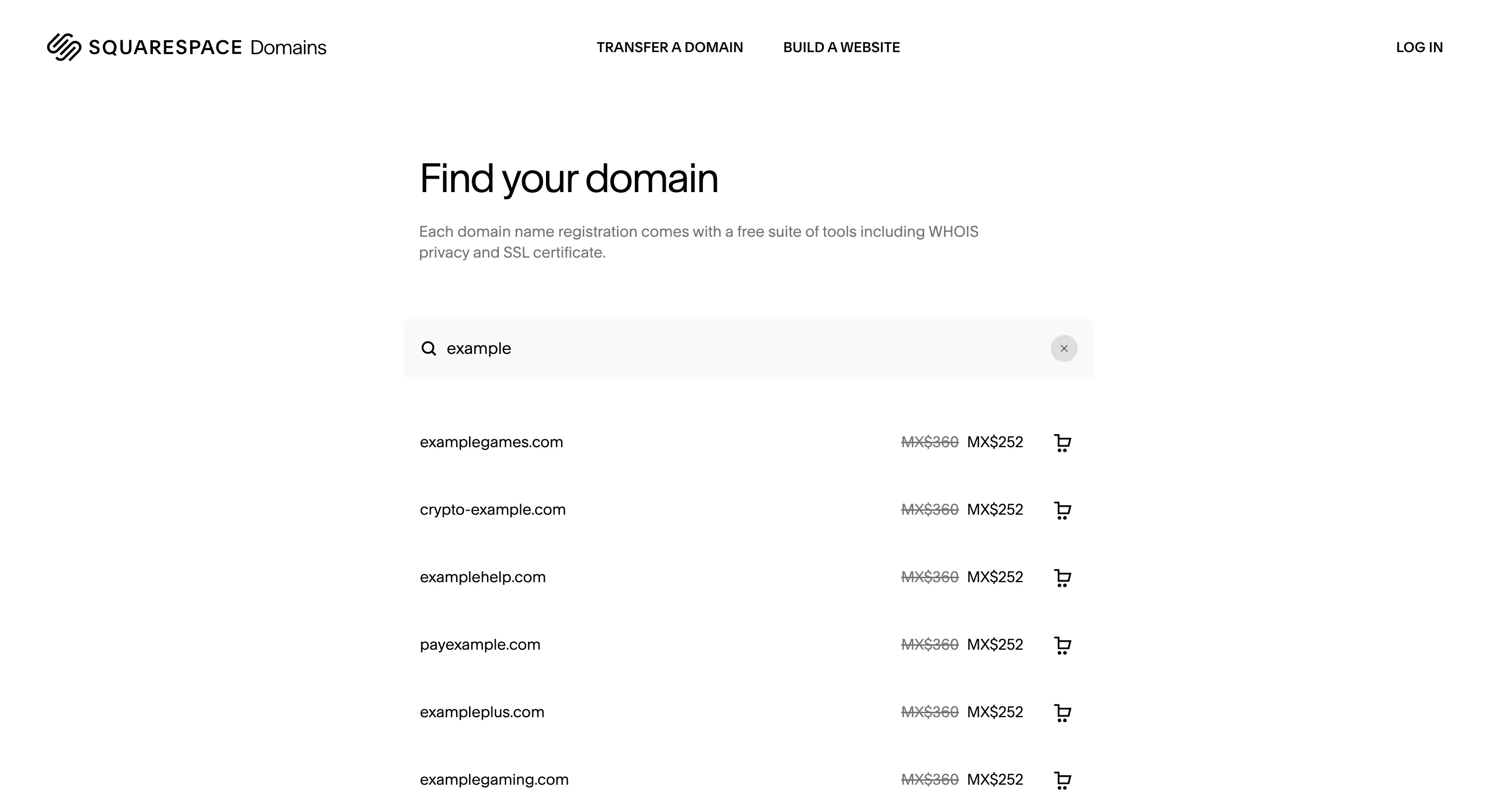
Squarespace acquired Google Domains’ customer base in 2023, inheriting a clean interface and straightforward pricing model that Google built. If you’re already using Squarespace for your website, adding domain registration to the same account keeps everything in one place. The transition from Google Domains has been mostly smooth, though some features are still being integrated.
Key features:
- 300+ TLDs
- Free WHOIS privacy on all domains
- Google Workspace integration for professional email
- Clean interface inherited from Google Domains
- Integrated with Squarespace website builder and hosting
- Simple DNS management
Privacy approach: Squarespace is a registrar (acquired Google Domains’ infrastructure). Standard registrar data practices apply.
Limitations: Still transitioning from the Google Domains acquisition — some features and integrations are in flux. Higher prices than budget registrars. No bulk search capability. No AI features or name generation. No API for domain search. The domain search is secondary to the website builder platform.
Feature comparison table
| Feature | Instant Domain Search | GoDaddy | Namecheap | Porkbun | Hostinger | Domain.com | Cloudflare | Dynadot | Squarespace |
|---|---|---|---|---|---|---|---|---|---|
| Primary purpose | Search tool | Registrar | Registrar | Registrar | Registrar | Registrar | Registrar | Registrar | Registrar |
| Search speed | Sub-25ms | Seconds | Seconds | Seconds | Seconds | Seconds | Seconds | Seconds | Seconds |
| TLDs | 800+ | 518+ | 1,164+ | 500+ | 300+ | 300+ | ~300 | 600+ | 300+ |
| As-you-type results | ✅ | No | No | No | No | No | No | No | No |
| Multi-registrar pricing | ✅ | No | No | No | No | No | No | No | No |
| Privacy (no registrar sees searches) | ✅ | No | No | No | No | No | No | No | No |
| AI name suggestions | ✅ | No | Limited | No | ✅ | No | No | No | No |
| MCP / AI assistant integration | ✅ | No | No | Yes | No | No | No | No | No |
| Bulk search | 5,000 | 500 | 5,000 | 100 | No | No | No | 1,000-5,000 | No |
| Free, no account | ✅ | ✅ | ✅ | ✅ | ✅ | ✅ | No | ✅ | No |
| Domain registration | No (links to registrars) | ✅ | ✅ | ✅ | ✅ | ✅ | ✅ | ✅ | ✅ |
| At-cost pricing | N/A | No | No | No | No | No | ✅ | No | No |
| Free WHOIS privacy | N/A | Paid | ✅ | ✅ | ✅ | ✅ | ✅ | ✅ | ✅ |
Which tool should you use?
The right tool depends on what you’re optimizing for:
If speed matters most: Instant Domain Search returns results in sub-25ms as you type. Every other tool on this list requires you to submit a query and wait. When you’re brainstorming and iterating on name ideas, that instant feedback loop makes a material difference.
If privacy matters (stealth projects, competitive research): Instant Domain Search is the only tool that doesn’t forward your queries to a retail registrar. Every other tool on this list is either operated by a registrar or routes queries through one. If you’re researching domains for a confidential project, this distinction matters.
If you want the cheapest registration price: Cloudflare Registrar passes through wholesale prices with zero markup — it’s hard to beat at-cost pricing. Porkbun and Namecheap offer competitive pricing with the added benefit of no surprise renewal increases (Porkbun) or broad TLD selection (Namecheap). Use Instant Domain Search to compare pricing across registrars before you decide.
If you want AI-powered name brainstorming: Instant Domain Search’s domain generator creates AI-powered name suggestions with real-time availability checking across registrars.
If you want everything in one place (search + hosting + email): GoDaddy, Hostinger, and Squarespace bundle domain search, registration, hosting, email, and website builder into a single platform. The trade-off is less flexibility on pricing, but the convenience of one account is real. Hostinger tends to offer the most competitive pricing of the three.
If you’re a domain investor: Dynadot and Namecheap offer the portfolio management tools and marketplace access that investors need. Use Instant Domain Search for the research phase — its speed, bulk search, and privacy mean you can scout names without tipping off registrars — then register through whichever registrar offers the best pricing.
If you want AI assistant integration: Instant Domain Search’s MCP server lets you check domains directly from Claude, Cursor, or any MCP-compatible AI assistant. Ask your AI to “check if these domain names are available” and get real-time results without switching tools. Porkbun also publishes an official MCP server for managing a Porkbun account.
If you want no-nonsense registration with no upsells: Porkbun and Domain.com both prioritize cleaner purchasing experiences compared to GoDaddy. Porkbun’s transparent pricing model — where registration and renewal prices are nearly the same — makes it easy to know exactly what you’ll pay long-term.
Search-first vs. sell-first: why it matters
There’s a fundamental architectural difference between the tools on this list that’s worth understanding.
Eight of the nine tools listed above are registrars. Their domain search exists to funnel you toward purchasing a domain from them. The search results, suggestions, pricing display, and checkout flow are all optimized for one outcome: you buying a domain through their platform. That’s not a criticism — registrars provide essential services. But it shapes the search experience in ways that matter.
Instant Domain Search is the exception. It’s a search-first tool that exists to help you find the right domain name, then shows you where to buy it at the best price across multiple registrars. The incentive structure is different: instead of optimizing for you to buy from one registrar, it optimizes for you to find the best name at the best price from any registrar.
This difference shows up in small ways. A registrar’s search may emphasize their own premium domains or upsell extensions they profit from. A search-first tool shows you what’s available across the market. A registrar’s pricing reflects their margins. A search-first tool with multi-registrar comparison shows you the actual range.
Neither model is inherently better. If you already know you want to register through Namecheap, searching on Namecheap makes sense. But if you’re in the exploration phase — trying different name ideas, comparing TLDs, checking pricing across registrars — a search-first tool gives you a more complete picture before you commit to a registrar.
The privacy question most people don’t think about
When you use a domain search tool run by a registrar, that registrar sees every domain you check. Search for 50 business name ideas on GoDaddy, and GoDaddy’s systems have logged all 50 queries. The same is true for Namecheap, Dynadot, Porkbun, and every other registrar-operated search.
Does that matter? It depends on what you’re doing.
If you’re checking random name ideas for a personal blog, probably not. But if you’re a startup in stealth mode exploring brand names, a domain investor researching undervalued assets, or a company evaluating competitor brand variations, the registrar knowing your exact search list is a legitimate concern.
This isn’t theoretical. Registrar search data has value. It reveals market demand, competitive intent, and trending name patterns. Some registrars have historically been accused of domain front-running — where searched-but-not-purchased domains get registered by someone else shortly after. While this practice is hard to prove and most reputable registrars deny it, the incentive structure exists.
Instant Domain Search avoids this entirely by running searches against a local zone file index built from direct registry partnerships. Your queries never leave our servers to reach a retail registrar. It’s the same architecture that has protected nearly 50 million domain searches since 2005.
Frequently asked questions
What is the best company to register a domain name?
It depends on what you value. Cloudflare Registrar offers at-cost pricing with zero markup, making it the cheapest option for supported TLDs. Porkbun offers transparent pricing with no surprise renewal increases. Namecheap has the broadest TLD selection (1,164+) with competitive introductory pricing. GoDaddy provides the most comprehensive ecosystem if you want hosting, email, and a website builder in one account. If you’re not sure which registrar to use, start with Instant Domain Search to compare prices across registrars before committing.
Is there anything better than GoDaddy?
GoDaddy’s strength is its all-in-one ecosystem — domain search, registration, hosting, email, and website builder in a single platform. If that bundled experience is what you want, it’s hard to beat. But if you’re optimizing for specific things, other tools excel: Cloudflare for cheapest pricing, Namecheap for TLD selection, Porkbun for transparent renewals, Hostinger for affordable hosting bundles, and Instant Domain Search for the fastest, most private search before you decide where to register.
Does it matter which domain registrar I use?
Yes, more than most people realize. Key differences include pricing (introductory vs. renewal prices can vary by 2-5x between registrars), privacy (some charge extra for WHOIS privacy while others include it free), transfer policies (some make it easy to move domains, others add friction), and upselling (some registrars aggressively push add-ons during checkout). Use Instant Domain Search to compare registration and renewal prices across registrars before choosing. For a deeper look at how to choose a domain name, we’ve published a separate guide.
What is the fastest domain search tool?
Instant Domain Search returns availability results in sub-25ms as you type, making it the fastest domain search tool available. This speed comes from querying a local index of zone files from direct registry partnerships rather than making API calls to registrars for each search. Most registrar-based search tools take 1-3 seconds per query because they check availability through their registrar API in real time.
Are domain search tools free?
Most domain search tools are free to use. Instant Domain Search, GoDaddy, Namecheap, Porkbun, Hostinger, and Domain.com all offer free searches with no account required. Cloudflare and Squarespace require account creation but don’t charge for searching. Dynadot’s free tier allows 1,000 bulk searches, with higher limits on paid tiers. The tools themselves are free because they make money when you register domains through them (registrars) or click through to partner registrars (Instant Domain Search).
Bottom line
For most domain search workflows in 2026, the choice comes down to what you’re optimizing for:
- Fastest search: Instant Domain Search (sub-25ms, as-you-type results)
- Cheapest registration: Cloudflare Registrar (at-cost pricing, zero markup)
- Best for AI workflows: Instant Domain Search (MCP server + domain generator)
- Best for privacy: Instant Domain Search (the only tool that doesn’t forward queries to registrars)
- Best all-in-one platform: GoDaddy or Hostinger (search + hosting + email + website builder)
- Best for domain investors: Dynadot or Namecheap (portfolio tools + marketplace) paired with Instant Domain Search for private research
- Most TLD options: Namecheap (1,164+ extensions)
- Most transparent pricing: Porkbun (no renewal markup, free privacy and SSL)
The domain search space has gotten significantly better over the past few years. Tools are faster, support more TLDs, and are starting to integrate with AI workflows. The biggest differentiator going forward isn’t just which tool finds available domains — it’s how well those searches fit into your actual workflow, whether you can trust the tool with your search intent, and whether you’re seeing prices from one registrar or the whole market.