Picking the right place to register a domain is the part most people rush. The same .com runs about $10 at one registrar and over $21 at another. WHOIS privacy is now free at most places, but a few still charge extra for it. Renewal pricing is where the real money goes: some registrars hold the price steady for the life of the domain, others raise it every year, and the upsell pressure at checkout ranges from “none” to four banners between your shortlist and your invoice.
Instant Domain Search works with 10+ retail registrars so you don’t have to bounce between them. When you search a name on our site, smart partner routing checks which of our partners support that TLD, then surfaces the best available price across them. You search 800+ extensions in one place, see prices side by side, and click straight through to whichever registrar is the right fit for the specific domain you picked. The list below is the same set we route to, plus a few alternates worth knowing about.
This guide ranks them on what actually matters once you’ve found a name: total cost of ownership (first year plus renewal plus the privacy and SSL add-ons that aren’t optional), TLD coverage, transfer policy, security, and how aggressive the checkout flow is.
What to look for in a domain registrar
A few things separate a registrar you forget about from a registrar you regret:
- Registration price vs. renewal price. This is where most buyers lose money. A $1.99 first-year promo that renews at $21.99 is a $20 markup compounded every year you own the domain. Always look up renewal pricing before you register.
- Total cost of ownership. Add the renewal price, WHOIS privacy if it’s not free, DNSSEC if it’s billed separately, and any “domain protection” add-ons. Two registrars with identical headline pricing can differ by $30 or more per year on what you actually pay.
- TLD coverage. Most registrars support somewhere between 300 and 800 TLDs. Coverage of newer extensions like .ai, .io, .dev, .gay, .ngo, and country codes varies a lot. If you’re committed to a specific extension, confirm support before you start. Our most popular domain extensions in 2026 post tracks which ones are actually growing.
- Free WHOIS privacy. In 2026 this should be free. Every registrar below includes it on most TLDs. If a registrar still charges for it, count that as part of their real price. A WHOIS lookup on any domain shows what a redacted record looks like versus one that exposes the owner’s name and email.
- Transfer policy. A good registrar makes it easy to move your domain out. The bad ones add friction: long unlock waits, slow transfer auth codes, “protection” toggles that block transfers, or fees on outbound moves.
- DNS management. You will spend more time editing DNS records than searching for the domain. Some registrars have clean, fast panels. Others bury the controls or rate-limit propagation.
- Add-on pressure at checkout. GoDaddy and Hostinger optimize the funnel for upsells. Cloudflare and Porkbun don’t. The difference adds up if you register multiple domains a year.
- API access. If you’re an investor, an agency, or a developer registering domains programmatically, the API is the product. Dynadot, Cloudflare, Namecheap, NameSilo, and Porkbun all publish real ones.
- Security. High-value domains need registry lock (a manual unlock step before any transfer) and mandatory two-factor authentication on the account. Not every registrar offers both.
- Reputation and transparency. Does the registrar publish renewal pricing on its main page, answer support emails, and avoid the domain front-running controversies that follow some retailers around? These signals matter more than feature lists.
The 9 best domain registrars in 2026
1. Cloudflare Registrar
Best for: At-cost registration with no markup
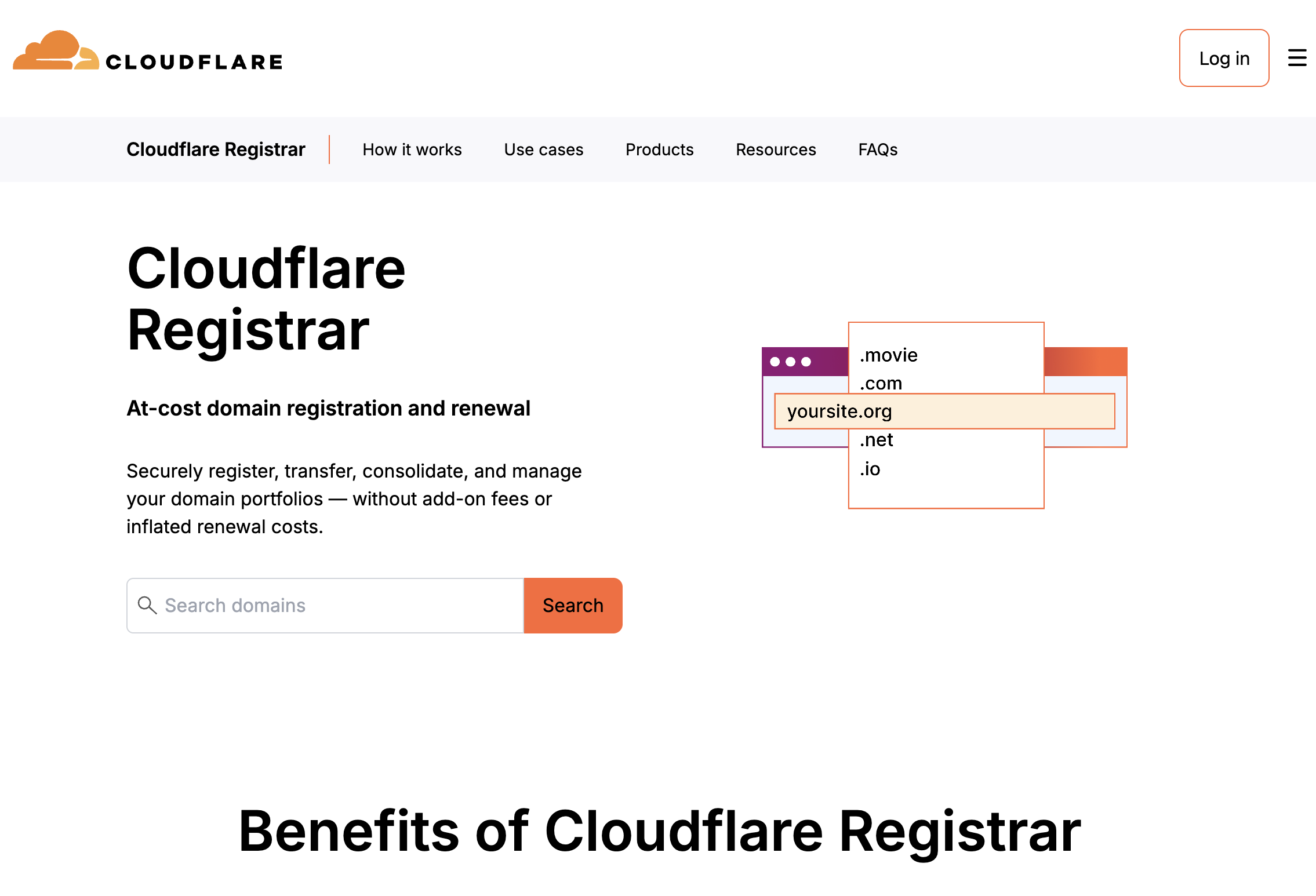
Cloudflare Registrar passes wholesale registry pricing straight through to you with zero markup on registration or renewal. A .com is $10.46 total: $10.26 (VeriSign’s wholesale price) plus the $0.20 ICANN fee. No introductory discount, no renewal hike, no upsell. The price you see is the price for the life of the domain. If you’re already using Cloudflare for DNS, CDN, or Workers, adding domains to the same dashboard is the lowest-friction path in the industry.
Key features:
- At-cost pricing on roughly 390 TLDs, registration and renewal at wholesale plus ICANN fees
- Free WHOIS redaction, free DNSSEC, and free SSL via Cloudflare’s edge
- Tight integration with DNS, CDN, DDoS protection, Workers, and R2
- Solid API for programmatic domain management
- Two-factor authentication required, security keys supported
Privacy approach: Cloudflare is a registrar. Searches on their registration page go through their systems. They publish a strong privacy posture, but any retail registrar that wide sees what you check.
Limitations: No new-customer discounts (which is the point, but it can feel surprising on a $10.46 .com when others advertise $1.99). The TLD selection is narrower than Namecheap or Dynadot, and most ccTLDs and a handful of new gTLDs aren’t supported. No domain search exploration UI: you type a domain, you wait for one yes-or-no answer. No name generation, no AI suggestions, no bulk search. Requires a Cloudflare account.
On Instant Domain Search you can see how Cloudflare’s at-cost rate stacks up against the introductory pricing other registrars advertise for the same TLD.
2. GoDaddy
Best for: All-in-one ecosystem and household-name reliability
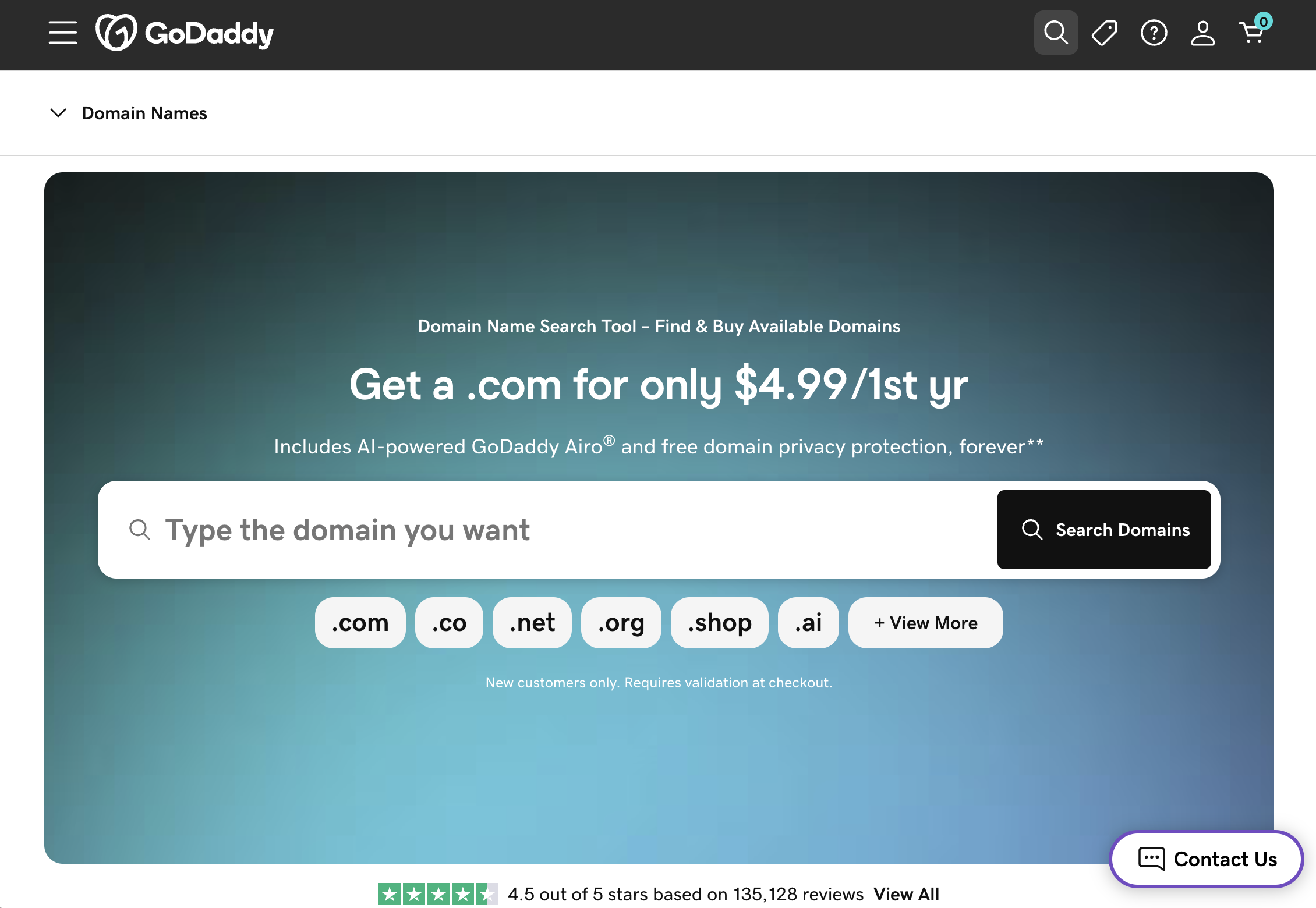
GoDaddy is the largest retail registrar in the world for a reason. The platform bundles domains, hosting, email, website builder, SSL, marketing tools, and 24/7 phone support into a single account. If your priority is “one company to call when something goes wrong,” GoDaddy is the lowest-cognitive-load option. As of recent years, basic domain privacy is now included free with new registrations, a meaningful shift from the historical paid-privacy model.
Key features:
- 545+ TLDs including most newer extensions
- Free WHOIS privacy, email impersonation protection (a default DMARC record), and transfer lock on new registrations
- Aftermarket integration via Afternic (a GoDaddy company)
- Domain appraisal tool, domain investor accounts
- 24/7 phone support, rare among registrars
- Bulk search up to 500 domains
- Full-spectrum hosting and email products
Privacy approach: GoDaddy is the world’s largest registrar. All searches run through their infrastructure. Free WHOIS privacy now protects your record from the public, but GoDaddy still sees what you search.
Limitations: Checkout offers add-ons for hosting, business email, a website builder, and SSL, plus a $9.99-a-year “Full Domain Privacy” upgrade on top of the now-free standard privacy that most users can skip. Introductory pricing is often significantly lower than renewal pricing, with .com renewals running around $21.99 versus much lower first-year deals. Aftermarket listings can blur the line between true availability and premium pricing.
GoDaddy is one of the core partners in Instant Domain Search’s smart partner routing. When they’re the right choice for a domain (often because of TLD coverage), we link straight to them.
3. Porkbun
Best for: Flat pricing, no surprises, free WHOIS and SSL on every domain
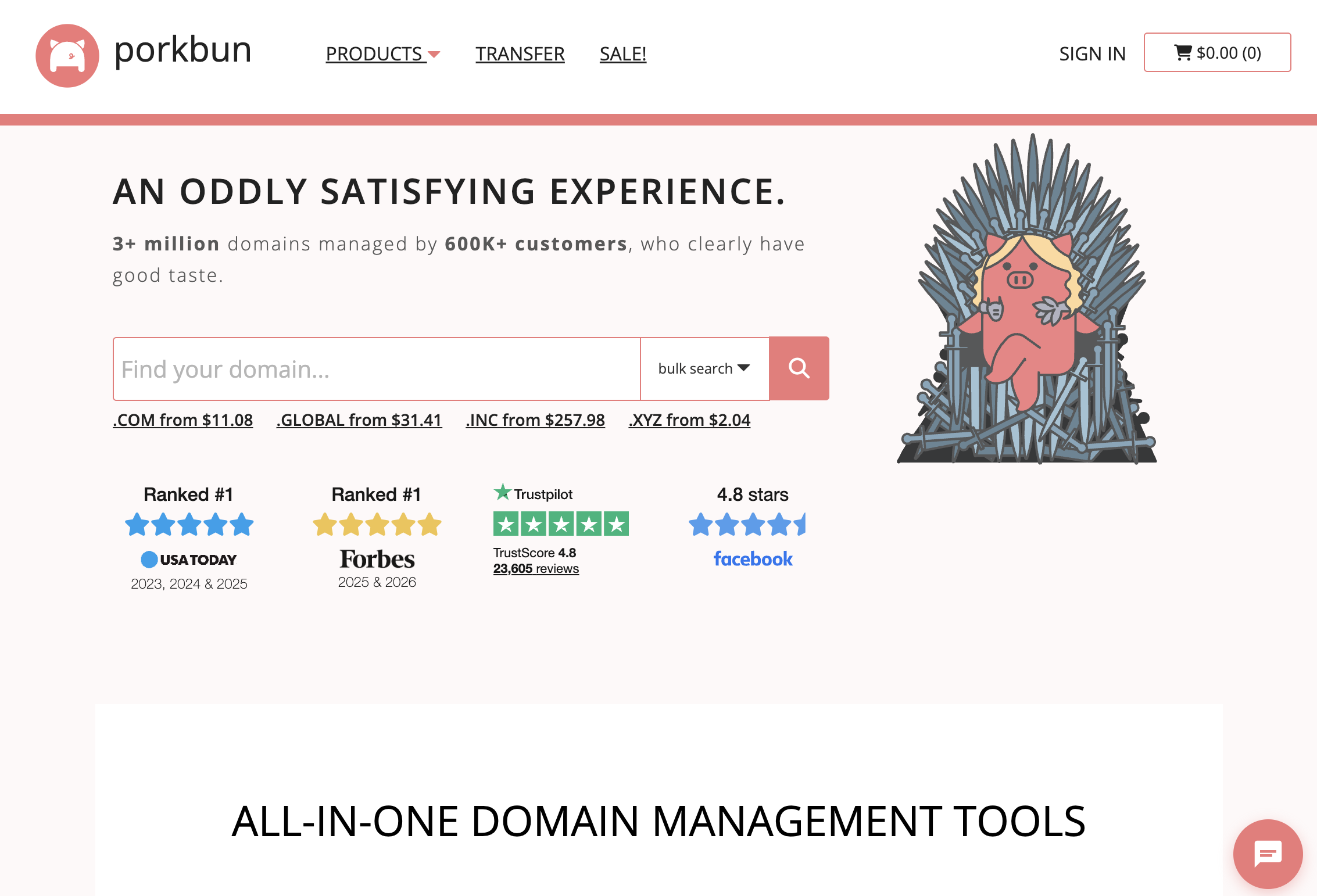
Porkbun has built a small but loyal following by doing the boring things right. A .com is $11.08 and the renewal is $11.08. No bait-and-switch, no “year two” surprise. Every domain comes with free WHOIS privacy, free SSL certificates (Let’s Encrypt with auto-renewal), free URL forwarding, and free email forwarding. The checkout has no upsells. Total cost of ownership is among the lowest in the industry.
Key features:
- About 400 TLDs with transparent registration and renewal pricing
- Free WHOIS privacy, free SSL, free URL and email forwarding on every domain
- Clean modern interface, no clutter, no upsells
- Public API with pricing endpoints
- Solid DNS panel with DNSSEC support
- Friendly support, with a pig mascot if that matters
Privacy approach: Porkbun is a registrar, so searches do go through their systems. They have a clean privacy posture and we’ve never seen credible complaints.
Limitations: Basic search experience, no as-you-type results, no AI suggestions, no creative name generation. Bulk search is capped at 100 domains at a time, which is fine for most buyers but limiting for investors. Domain management is utilitarian if you have a large portfolio. Support is email-only with limited hours.
Porkbun pricing is integrated into Instant Domain Search results, so you can spot when they’re the cheapest option for a given TLD before you click through.
4. Spaceship
Best for: A modern checkout experience at near-wholesale pricing
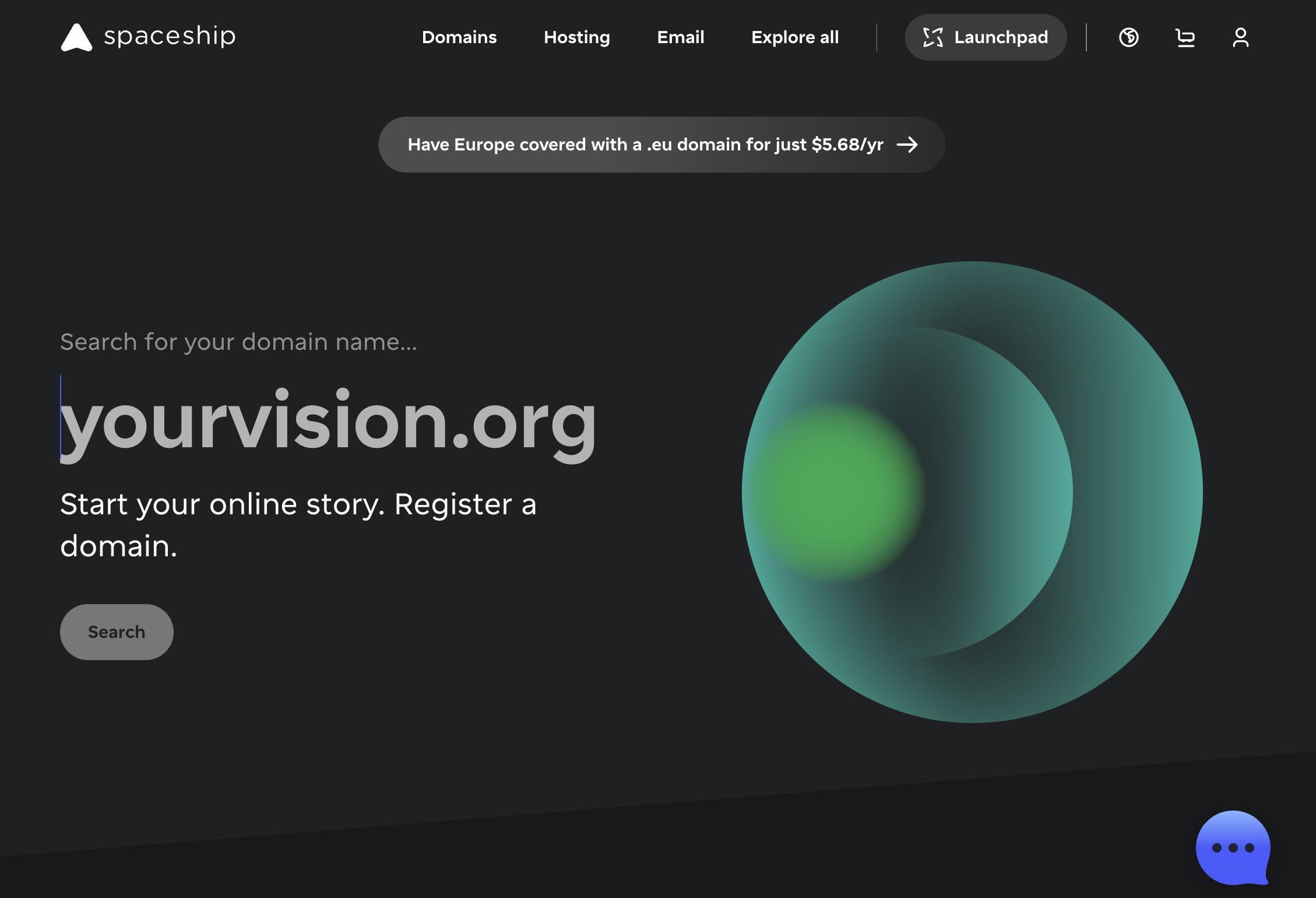
Spaceship is a newer brand launched by Namecheap in 2023 as a ground-up rebuild of the domain-registration experience. The pricing is sharper than the parent brand (.com runs around $9.98), the interface is the cleanest of any major registrar, and the company is already managing more than 5 million domains. If Namecheap is the warehouse, Spaceship is the showroom.
Key features:
- Modern interface that doesn’t feel like it was designed in 2007
- Near-wholesale pricing on .com and most major TLDs
- Free WHOIS privacy, free DNS, two-factor authentication
- Domain forwarding, basic email forwarding, simple SSL setup
- Same registry access as Namecheap (sibling brands share infrastructure)
Privacy approach: Spaceship is a registrar, and shares infrastructure with Namecheap. Searches run through their systems.
Limitations: Younger product, smaller TLD catalog than Namecheap (still expanding). Some advanced features available on Namecheap aren’t yet on Spaceship. No bulk search and no API as mature as Cloudflare’s or Dynadot’s. The upside of being new is also the downside: not every workflow is fully polished.
Instant Domain Search routes to Spaceship whenever they have the best price for a TLD via smart partner routing.
5. NameSilo
Best for: Long-term portfolio holders who want flat pricing and free everything
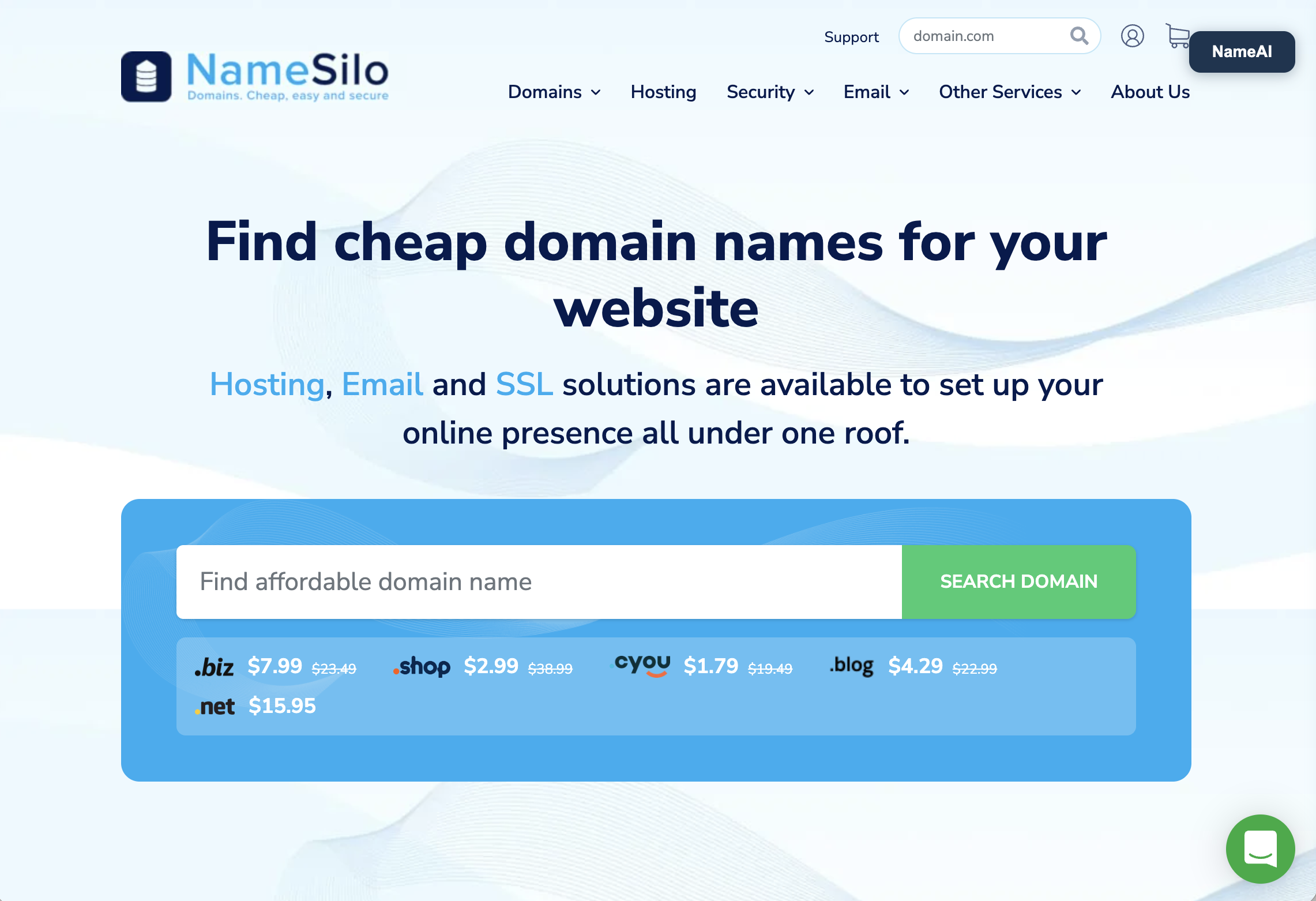
NameSilo manages more than 6 million domains and has earned a reputation among domainers and long-term portfolio holders for boring, transparent pricing. Retail .com sits around $17.29, but the NameSilo Discount Program drops .com to about $11.05 once you have a $50 account balance, with bigger portfolios paying as little as $7.75. Renewal pricing matches registration. WHOIS privacy is free forever on every eligible domain.
Key features:
- 400+ TLDs with consistent registration and renewal pricing
- Free WHOIS privacy forever on every eligible domain
- NameSilo Discount Program lowers .com pricing for accounts with balance
- API access for programmatic domain management
- Domain Defender service with two-factor authentication
- Built-in domain marketplace for buying and selling
- No upsells at checkout
Privacy approach: NameSilo is a registrar, so they see your searches. WHOIS privacy is free and applied by default to every supported TLD.
Limitations: Interface is plain and slow to load in places. No bulk search at the scale of Dynadot or Namecheap Beast Mode. Customer support is ticket-based with no live chat. The Discount Program is genuinely a discount, but you have to keep a positive account balance to unlock it.
For domain investors who run a real portfolio, NameSilo and Dynadot tend to be the two registrars worth knowing well.
6. Dynadot
Best for: Domain investors, international domains, and API-driven workflows
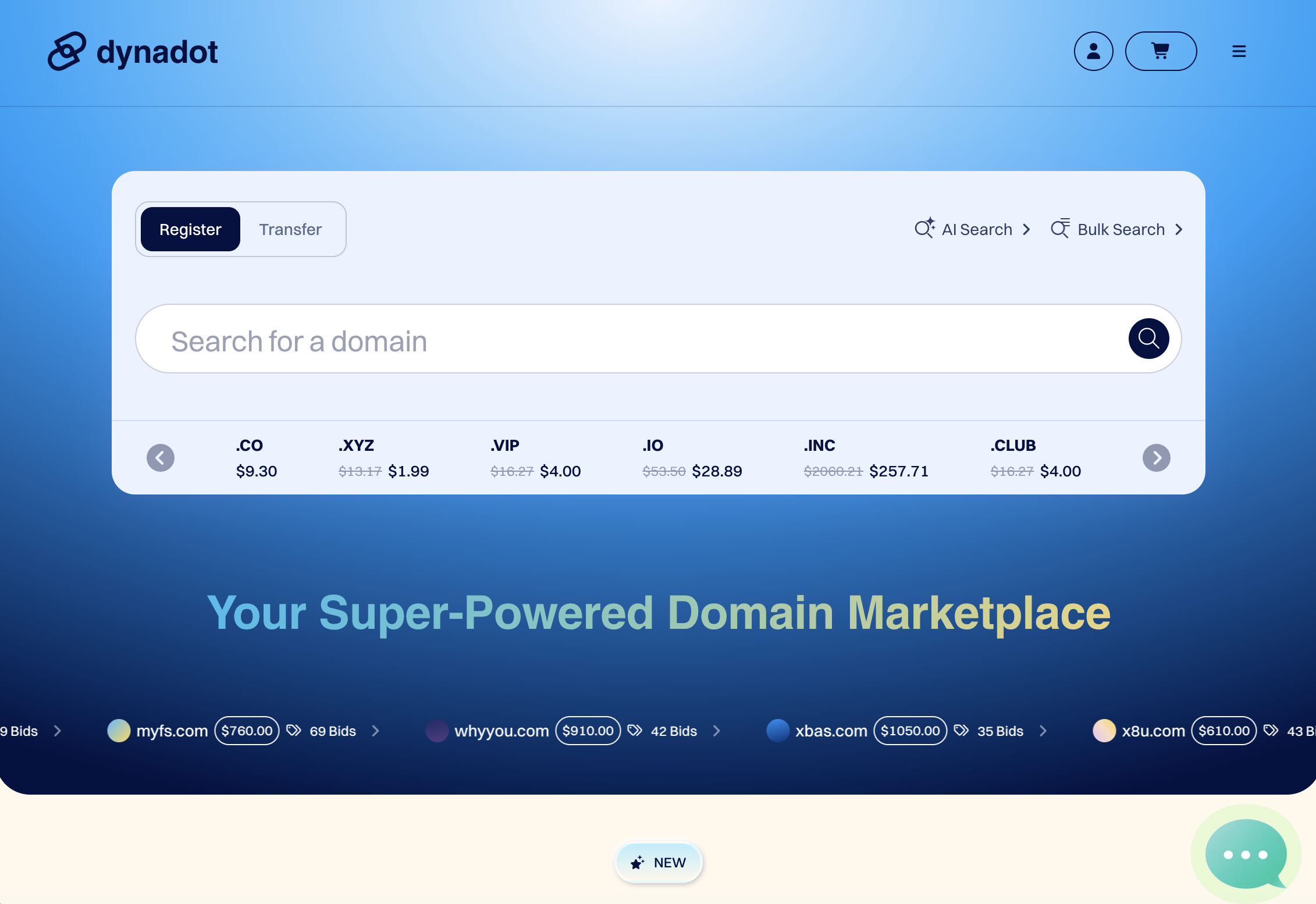
Dynadot has a strong reputation among domain investors. They support roughly 805 TLDs (the widest catalog on this list), they support internationalized domain names across most major scripts, they run a built-in aftermarket marketplace, and their API is the most actionable in the comparison set. .com pricing is competitive at about $10.88 flat with no introductory gimmicks. The platform is utilitarian, but at scale it gets out of your way.
Key features:
- Around 805 TLDs including extensive ccTLD and IDN coverage
- Built-in aftermarket marketplace for buying and selling domains
- Bulk domain search up to 1,000 free or 5,000 per day on Super Bulk accounts
- Mature API with 50+ commands, supporting bulk registration and management
- Competitive flat pricing on most TLDs
- Free WHOIS privacy on supported TLDs
Privacy approach: Dynadot is a registrar. Searches route through their systems.
Limitations: The best account tiers (Bulk, Super Bulk) require meaningful annual spend, which is fine if you’re a real investor and overkill if you register one domain a year. The interface prioritizes function over polish. Support is responsive but not always immediate.
If you’re researching investment-grade domains, run the search phase on Instant Domain Search (private, sub-25ms, no registrar sees the list) and register the winners through Dynadot for the portfolio and marketplace tools.
7. Namecheap
Best for: Broad TLD selection with consistent intro pricing
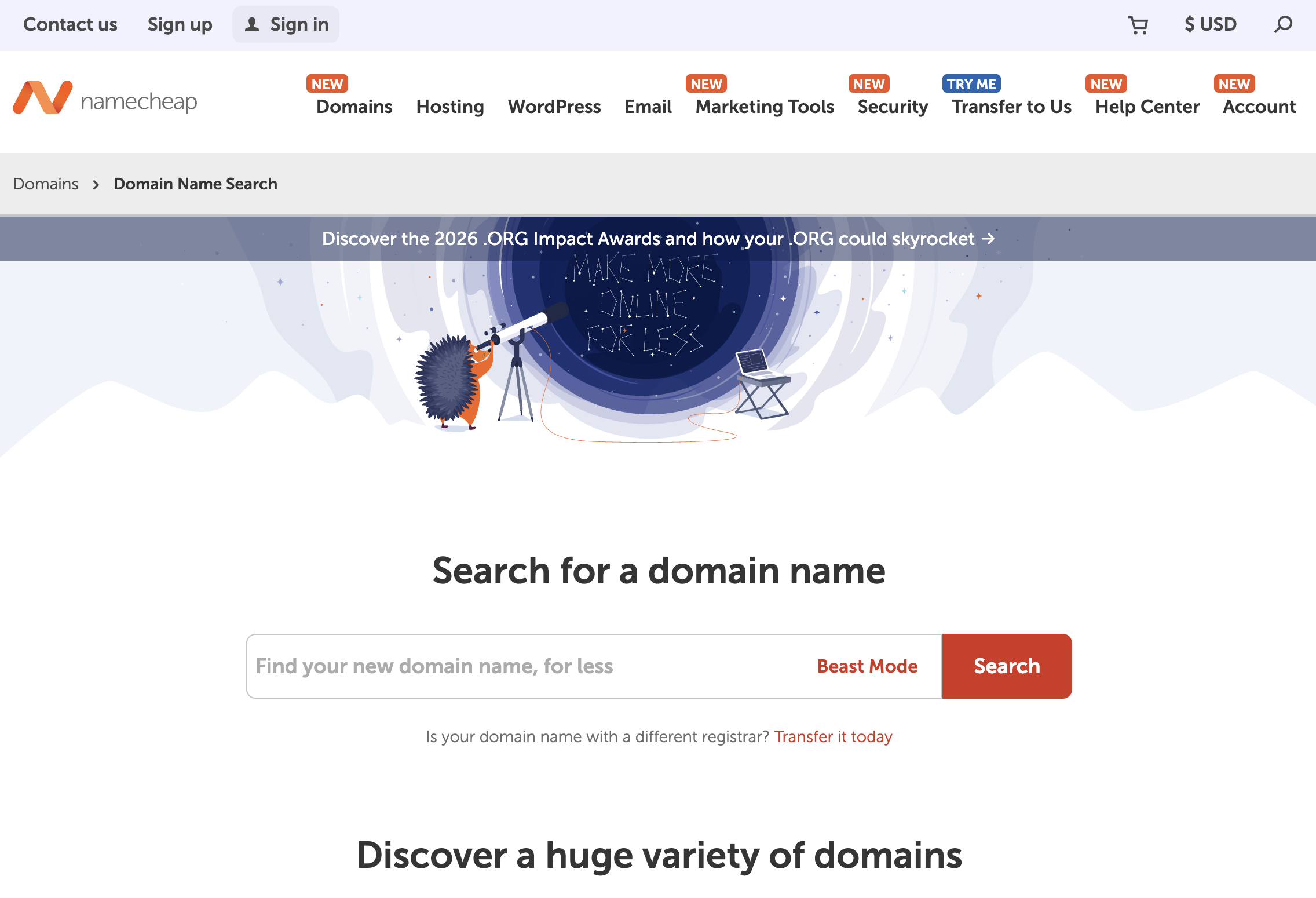
Namecheap is the volume player among independent registrars. They manage roughly 17 million domains, support 560+ TLDs (one of the largest catalogs on this list), include free WhoisGuard with most registrations, and run the highest density of introductory promotions in the industry. Their Beast Mode bulk search is one of the better registrar-native tools for brainstorming domain hacks and prefix or suffix variations.
Key features:
- 560+ TLDs, one of the broadest selections
- Free WhoisGuard included with almost all registrations
- Aggressive introductory pricing on many TLDs, with strong promo cycles
- Beast Mode bulk search with up to 5,000 domains per query and creative transforms
- Marketplace for aftermarket domains
- Solid DNS panel and Premium DNS option
- 24/7 live chat support
Privacy approach: Namecheap is a retail registrar. Every search and Beast Mode query runs through their backend, so they see exactly which domains you check. WhoisGuard protects your record from the public, not from Namecheap itself.
Limitations: Renewal pricing is typically higher than registration pricing. A .com often runs around $10.98 in year one and $18.48 from year two onward. Beast Mode generates a lot of noise alongside useful suggestions. No MCP or AI assistant integration. Upsells at checkout for hosting, email, and SSL.
Namecheap pricing shows up in Instant Domain Search results, so you can compare their introductory rate against the renewal price (and against other registrars) before you commit.
8. Hostinger
Best for: Bundling a domain with affordable hosting
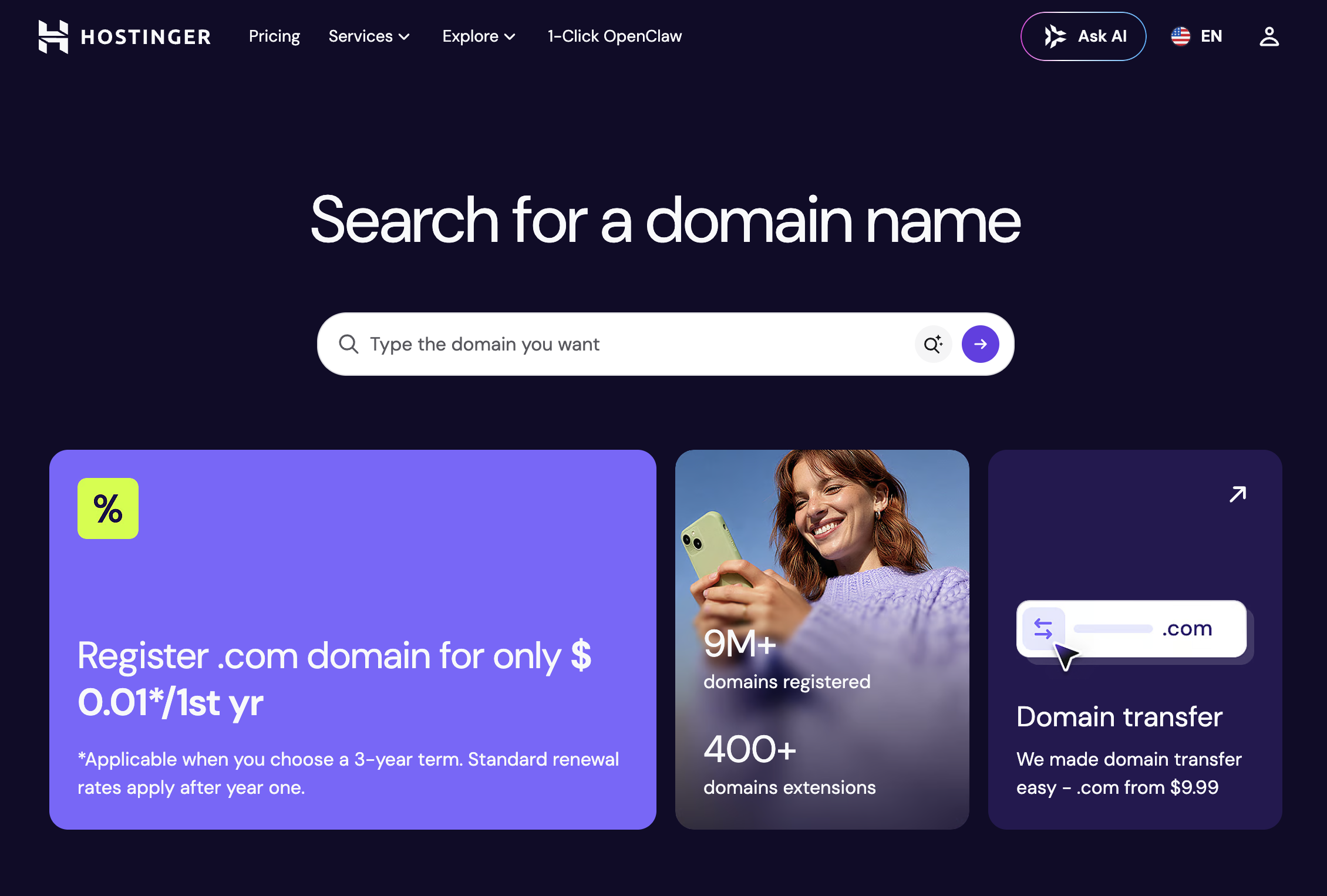
Hostinger has grown fast by combining cheap hosting plans with domain registration and a polished onboarding flow. Their domain search is tightly integrated with the hosting product, and most plans include a free domain for the first year across the popular TLDs. For users who want a domain plus a live site without piecing things together, Hostinger is the cleanest path.
Key features:
- 300+ TLDs with competitive introductory pricing
- Free domain included with most annual hosting plans (first year)
- Free WHOIS privacy on supported TLDs
- AI website builder and WordPress hosting integration
- Intuitive control panel (hPanel)
- 24/7 live chat support
Privacy approach: Hostinger is a registrar. Domain searches go through their infrastructure. Their privacy policy is standard.
Limitations: The advertised low prices typically require multi-year prepayments, so a “$1.99/year” .com usually means a four-year commitment. Domain-only registration without hosting is available but isn’t where the product nudges you. TLD selection is narrower than Namecheap or Dynadot. WHOIS privacy isn’t available on certain TLDs (notably .ai, .ru, several country codes).
Instant Domain Search surfaces Hostinger pricing whenever they support the TLD you’re searching, so you can decide whether the hosting bundle changes the math.
9. Squarespace Domains
Best for: Squarespace site owners and former Google Domains customers
Squarespace absorbed Google Domains in 2023 and has spent the last two years rebuilding the experience inside their ecosystem. The migration is now complete, and the inherited interface is still one of the cleaner buying flows in the industry. .com pricing sits on the higher end of this list (around $20 and up), but the experience is tight, every eligible domain includes free WHOIS privacy and an SSL certificate, and the integration with Squarespace sites and Google Workspace email is seamless.
Key features:
- 360+ TLDs after the post-migration expansion
- Free WHOIS privacy on every eligible domain
- Free SSL via Let’s Encrypt
- Tight integration with Squarespace builder, hosting, and Google Workspace email
- Clean DNS management inherited from Google Domains
- Two-factor authentication
Privacy approach: Squarespace is a registrar. Domain searches go through their systems, and standard retail registrar data practices apply.
Limitations: Renewal pricing is higher than budget registrars, closer to $20 on .com versus $10 to $11 at Cloudflare or Porkbun. No bulk search, no AI features, no public API for domain registration. The domain search is a feature inside the website builder product rather than a standalone tool.
You can see Squarespace pricing alongside other registrars in Instant Domain Search results for any TLD they support.
How Instant Domain Search fits into the picture
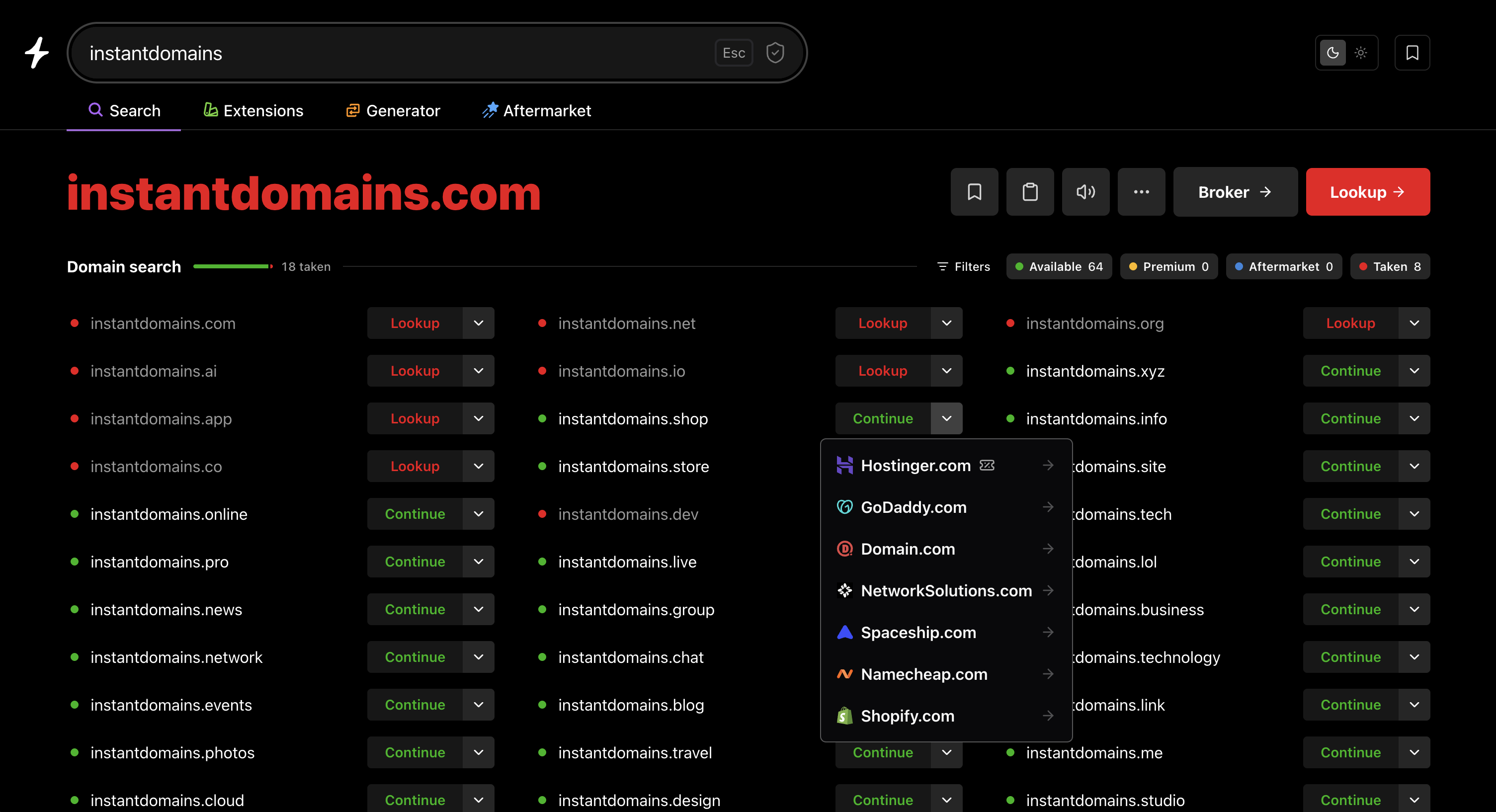
The list above is the same set we route buyers to. Instant Domain Search isn’t an alternative to these registrars, it’s the layer that lets you compare and search across all of them at once.
Here’s how that works in practice:
- One search, every registrar. When you find a domain on our site, smart partner routing checks every registrar in our network (GoDaddy, Spaceship, Namecheap, Porkbun, Hostinger, Network Solutions, Dynadot, and others) for the TLD you’re looking at and shows you which ones support it and at what price. When you click “Register,” you go straight to the partner who has the best fit for that specific domain, not the one that paid the loudest for placement.
- Aftermarket and expired domains in the same view. Alongside live registry availability, we surface aftermarket listings from Afternic, Sedo, Atom, Sav, DomainAgents, and other marketplaces, plus expired and expiring domains that are about to drop back into the pool. You don’t have to bounce between five tabs to compare what a name actually costs across the market.
- Search runs against direct registry data. Most retail registrars check availability by calling another registrar’s API. We don’t. We pull data directly from registries like VeriSign, Google Registry, Radix, and Identity Digital and run searches against our own zone-file index. That’s how we serve results in under 25 milliseconds across 800+ TLDs while you’re still typing.
- Searches stay private. Because the search runs against our own index, your queries never go to a retail registrar. A registrar only learns about your interest when you actually click “Register” and complete a purchase. If you’re researching brand names for a stealth project, scouting undervalued aftermarket assets, or comparing competitor brand variations, this matters.
- No commitment, no account. You can compare a hundred name ideas across .com, .ai, .io, .dev, and 800+ other extensions without ever creating an account, joining a mailing list, or picking a registrar. The “save for later” sidebar lives in your browser; the registrar only comes into the picture when you decide to buy.
- Browse curated lists instead of starting from scratch. If you don’t have a name yet, our curated domain lists refresh daily against live registry data: brandable two-word names, four-letter .com domains, AI and tech buzzword names, dictionary words, and easy-to-pronounce brands that are still available right now.
- AI-assistant integration. Our MCP server lets Claude, Cursor, or any MCP-compatible assistant check domains in real time, which means the same search and registrar-comparison pipeline runs from inside your AI workflow.
The product is free because partner registrars pay us a small referral commission when a search ends in a purchase. The commission is paid by the partner, not added to your price. Your search data isn’t sold or used to target ads. The same architecture has now served close to 50 million domain searches since 2005.
Feature comparison table
| Feature | Cloudflare | GoDaddy | Porkbun | Spaceship | NameSilo | Dynadot | Namecheap | Hostinger | Squarespace |
|---|---|---|---|---|---|---|---|---|---|
| .com year-1 price | $10.46 (incl. ICANN) | varies | $11.08 | ~$9.98 | ~$11.05 (discount) | $10.88 | $10.98 | $1.99 (multi-yr) | $20+ |
| .com renewal price | $10.46 (incl. ICANN) | ~$21.99 | $11.08 | ~$10.18 | ~$11.05 (discount) | $10.88 | $18.48 | $13.99 | $20+ |
| TLDs supported | 390+ | 545+ | 400+ | Growing | 400+ | 805 | 560+ | 300+ | 360+ |
| Free WHOIS privacy | Yes | Yes (basic) | Yes | Yes | Yes | Yes | Yes | Yes | Yes |
| Free SSL | Yes | Paid | Yes | Yes | Paid | Paid | Paid | With hosting | Yes |
| DNSSEC | Yes | Yes | Yes | Yes | Yes | Yes | Yes | Yes | Yes |
| Bulk search | No | 500 | 100 | No | Yes | 1,000 to 5,000 | 5,000 | No | No |
| API | Yes | Limited | Yes | Limited | Yes | Yes (mature) | Yes | Limited | No |
| Marketplace | No | Yes (Afternic) | No | No | Yes | Yes | Yes | No | No |
| Renewal pricing transparency | Wholesale-flat | Marked up | Flat | Near-flat | Flat | Flat | Marked up | Marked up | Flat (high) |
| Add-on pressure at checkout | Low | High | Low | Low | Low | Low | Medium | Medium | Low |
Which registrar should you use?
The right answer depends on what you’re optimizing for.
For the lowest total cost over 10 years, Cloudflare for any TLD they support, Porkbun for everything else, and NameSilo if you’ll register more than a handful and want the Discount Program. All three have flat renewal pricing, so none will surprise you in year two. Avoid registrars where the first-year price is dramatically lower than the renewal: that’s a $10 to $20 markup compounded every year.
For one company that handles domain plus hosting plus email, Hostinger is the value pick, GoDaddy is the full-service pick, and Squarespace works if you’re building the site there anyway.
For a real domain investor or anyone registering at scale, Dynadot for the marketplace and mature API, NameSilo for the cheapest long-term holding cost. Use Instant Domain Search bulk search for the research phase, our aftermarket aggregator for resale inventory across Afternic, Sedo, Atom, and Sav, and our expired domains feed for names dropping back to availability. Your shortlist never touches a registrar until you click to buy.
For the broadest TLD selection, Dynadot (around 805) or Namecheap (560+). If you need a niche TLD, check coverage before you commit.
For a modern, minimal interface, Spaceship is the cleanest checkout in the industry right now. Porkbun is a close second.
For Cloudflare users, add domains to the same dashboard. The integration is the best on this list and the pricing is wholesale flat.
For former Google Domains customers, you’re already at Squarespace post-migration. The experience is similar and renewal pricing is the main thing to keep an eye on.
For brand familiarity and phone support, GoDaddy. Skip the checkout add-ons you don’t need, including “Full Domain Privacy,” an upgrade to the standard privacy that’s now free.
For the search phase, regardless of where you eventually register, use Instant Domain Search. It runs in sub-25 milliseconds across 800+ TLDs, the search never goes through a retail registrar, and we compare pricing across our partner network so you can spot when one registrar is meaningfully cheaper for the specific extension you want.
The introductory vs. renewal price trap
This is the most expensive mistake we see domain buyers make.
A .com at GoDaddy might be on offer for $9.99 in year one and renew at $21.99. A .online at Namecheap might be $0.98 in year one and renew closer to $40. A multi-year Hostinger bundle might advertise $1.99 a year up front and re-anchor at $13.99 in year two. None of these are scams. They’re standard pricing models. But if you only look at the first-year price, you’ve underpriced the real cost by 2 to 5 times.
The fix is mechanical: before you register, open a second tab and look up the renewal price. Every registrar publishes it, some more prominently than others. Multiply the renewal by the number of years you plausibly expect to own the domain. For a serious business, that’s at least 10 years. A $12 renewal beats a $22 renewal by $100 over a decade on a single domain. Across a portfolio, the difference is real money.
This is also why flat-priced registrars matter. Cloudflare’s at-cost model, Porkbun, NameSilo, Spaceship, and Dynadot all publish renewal pricing that equals or nearly equals registration pricing. There is no surprise. With these, the headline number is the real number.
When you search on Instant Domain Search, the pricing we show is registration pricing. Knowing the registrar landscape lets you read between the lines. If the cheapest .com in our results is at GoDaddy for the first year, but Cloudflare is showing at a higher first-year number that is actually their flat renewal price, Cloudflare is the better long-term deal nine times out of ten.
The privacy question most people don’t think about
When you search on a registrar’s domain page, that registrar logs every domain you check. Type 50 startup name ideas into GoDaddy and GoDaddy’s systems have logged all 50. Same on Namecheap, Porkbun, Dynadot, and every other registrar-operated search box. WHOIS privacy protects your record from the public, not from the registrar itself.
Whether that matters depends on what you’re doing. Checking random names for a personal blog? Probably not. Researching brand names for a stealth-mode startup, scouting undervalued aftermarket or expired domain assets, or evaluating competitor brand variations? Worth thinking about.
Domain search data has real commercial value. It reveals market demand, competitive intent, and trending name patterns. Some registrars have historically been accused of domain front-running, where searched-but-not-purchased domains get registered by someone else shortly after. The practice is hard to prove and the major registrars deny it. But the incentive exists, and the data definitely does.
The reason we built Instant Domain Search the way we did, with a local zone-file index and direct registry partnerships, is to take that question off the table. Your searches never reach a retail registrar. The only moment a registrar learns about your interest is when you click “Register” and complete a purchase.
Frequently asked questions
What is the best domain registrar in 2026?
It depends on what you value. Cloudflare offers at-cost pricing with no markup, making it the cheapest long-term option for the TLDs it supports. GoDaddy is the most full-service, with the widest product bundle and 24/7 phone support. Porkbun and Spaceship offer flat near-wholesale pricing with cleaner interfaces. Namecheap has the broadest TLD selection with strong introductory deals. NameSilo is the most consistent flat pricing for long-term portfolio holders. Dynadot is the investor-grade pick. Use Instant Domain Search to compare prices across all of them before you pick.
Is Cloudflare really cheaper than GoDaddy?
In most cases yes, especially over the life of the domain. Cloudflare passes wholesale registry pricing through with no markup, so a .com sits at $10.46 (the $10.26 wholesale price plus the $0.20 ICANN fee), and renews at the same price. GoDaddy’s .com renewal runs around $21.99. Over 10 years that’s more than $100 of difference on a single domain. GoDaddy’s advantage is the ecosystem (phone support, bundled email, hosting, website builder), not the per-domain price.
Does it matter where I register my domain for SEO?
No. Google does not factor your registrar choice into search rankings. What matters is the domain name itself, the TLD’s trust profile, and the technical setup (HTTPS, redirect rules, site quality). Your registrar handles registration and DNS, neither of which is a ranking signal on its own. If you’re still picking a name, our guide to how to choose a domain name covers the parts that actually do affect long-term performance.
Should I transfer my domain to a cheaper registrar?
Often yes, especially if you registered with a registrar that has a steep renewal jump. Transfers typically cost one year of registration at the new registrar (which extends your expiry by a year), and most modern registrars include WHOIS privacy and SSL for free. Watch for: domain lock status, transfer auth codes, the 60-day post-registration transfer block on new domains, and any “domain protection” toggles that block transfers at the source registrar.
What’s the difference between a registry and a registrar?
A registry operates a TLD (VeriSign runs .com, Google Registry runs .dev, Identity Digital runs hundreds of others). A registrar is a retail seller, accredited to register domains on behalf of customers (GoDaddy, Namecheap, Cloudflare, and so on). Registries provide the wholesale infrastructure; registrars sell the domains. Instant Domain Search partners with registries directly for accurate availability data, then routes buyers to registrar partners on the purchase side. For more on how this plays out across 800+ extensions, see our popular domain extensions in 2026 post.
Can I register a domain straight from Instant Domain Search?
You search, compare, and shortlist on our site, then complete the purchase at one of our partner registrars. The handoff is one click: when you find the domain you want, “Register” takes you to whichever partner is the right fit for that specific extension at the best price. You can compare pricing across the partner network before you click, so you never have to pick a registrar in advance.
Which registrars does Instant Domain Search partner with?
Our core retail partners are GoDaddy, Spaceship, Namecheap, Porkbun, Hostinger, Network Solutions, and Dynadot. Smart partner routing checks every TLD in your search against this network and shows you which partners support it, so the “Register” button always takes you somewhere that can actually complete the purchase.
Bottom line
For most buyers in 2026, the choice comes down to a few patterns.
- Lowest total cost: Cloudflare where supported, Porkbun or NameSilo everywhere else
- Domain investor at scale: Dynadot or NameSilo
- Broadest TLD selection: Namecheap or Dynadot
- All-in-one (domain plus hosting plus email): Hostinger for value, GoDaddy for full service
- Former Google Domains: Squarespace (you’re already there)
- Modern interface: Spaceship or Porkbun
For the search phase, regardless of which registrar wins, use Instant Domain Search. Sub-25-millisecond results across 800+ TLDs, queries that never reach a retail registrar, and prices compared across our partner network so you can spot which registrar is actually cheapest for the specific domain you want. If you haven’t picked a name yet, start with our curated lists, the domain generator, or our companion guides on the best domain search tools and the best bulk domain search tools.
The domain market has gotten meaningfully better for buyers over the last few years. Privacy is now free almost everywhere. Wholesale-flat pricing is no longer exotic. Modern interfaces are catching up to the rest of the web. The remaining gaps (renewal-price gotchas, upsell pressure at checkout, search data quietly accumulating at every retail registrar) are exactly the gaps a search layer like ours is built to close.