Finding a good domain name is the hardest part of starting anything. Everything else (registering it, building the site, paying for the domain) takes minutes. The name itself can take weeks. The single-word .com you want is registered. The branded compound you came up with is taken. The clever portmanteau you stayed up writing turns out to be a registered trademark in a tangentially related category.
This is the gap domain name generators exist to close. Type in a keyword or a one-line pitch, and get a list of options that are actually available. The best ones combine creative variations you would not have come up with on your own (think Lyft, Stripe, Spotify, the entire family of invented words that defines modern brands) with live availability checking so the names you see are actually open to register.
2026 raised the bar on what a “generator” is supposed to do. Pre-AI generators ran your keyword through a list of prefixes and suffixes. Post-AI generators can read your business description, suggest invented words tuned to your industry, check availability across hundreds of TLDs, and (in the best cases) route you directly to register. Some have absorbed AI thoughtfully. Some bolted “AI” onto the same prefix-suffix output they were producing in 2018. A few are now indistinguishable from a custom GPT.
We tested the major ones. Below is what each does well, what to watch for, and how to pick the right tool for what you’re actually trying to do.
What to look for in a domain name generator
The differences between generators are bigger than the marketing suggests. The criteria that actually matter:
- Creative range. Does it suggest only “yourkeyword-online.com” style padding, or does it produce brandable invented words (Spotify, Twilio, Stripe), portmanteaus (Pinterest, Microsoft), abstract metaphors (Apple, Oracle), domain hacks (instagr.am, del.icio.us), and compounds that sound like real companies? The depth of the creative library is what separates a brainstorming tool from a glorified suffix machine.
- Live availability checking. A name suggestion is worthless if it turns out to be already registered. The best generators check availability against authoritative registry data in real time as they suggest. The worst ones surface names that have been taken for years.
- TLD coverage. Most generators only check .com. A few extend to .io, .ai, .co, and .app. The serious ones cover 800+ extensions including ccTLDs and newer gTLDs. If you’re naming an AI company, .ai coverage is non-negotiable. If you’re naming a dev tool, .dev coverage matters.
- Multi-registrar pricing. Even when a name is available, the price varies meaningfully across registrars. A generator that shows live prices across multiple registrars saves you the trip of checking five different sites once you’ve shortlisted.
- Brand-fit controls. Can you steer the generator toward a particular industry, audience, or style? Naming a SaaS for developers and a wellness brand for retirees should not produce the same suggestions, but most older generators treat them identically.
- Brand inputs that aren’t just keywords. AI-native generators let you describe the business in a sentence and pick a tone. Pre-AI ones only accept keywords. The difference shows up in the relevance of the output.
- Save and shortlist. Generators that produce hundreds of names but no way to save your favorites are exhausting. Good ones let you flag, sort, and export a shortlist.
- Logo and brand previews. Some generators preview how the name would look as a wordmark or logo. This is downstream of naming, but it’s useful for narrowing a shortlist quickly.
- Privacy of your queries. If a generator is operated by a registrar, that registrar logs every name you ask it to suggest. For stealth-mode projects or competitive research, this matters more than people realize. We wrote a full piece on how we keep domain searches private when we built our own search architecture around this.
- AI assistant integration. In 2026, an increasing share of naming workflows starts inside Claude, ChatGPT, or Cursor. Generators with MCP (Model Context Protocol) integration plug directly into those workflows. Most don’t yet.
The 9 best domain name generators in 2026
1. Instant Domain Search Domain Generator
Best for: AI suggestions with live availability and multi-registrar pricing on every result
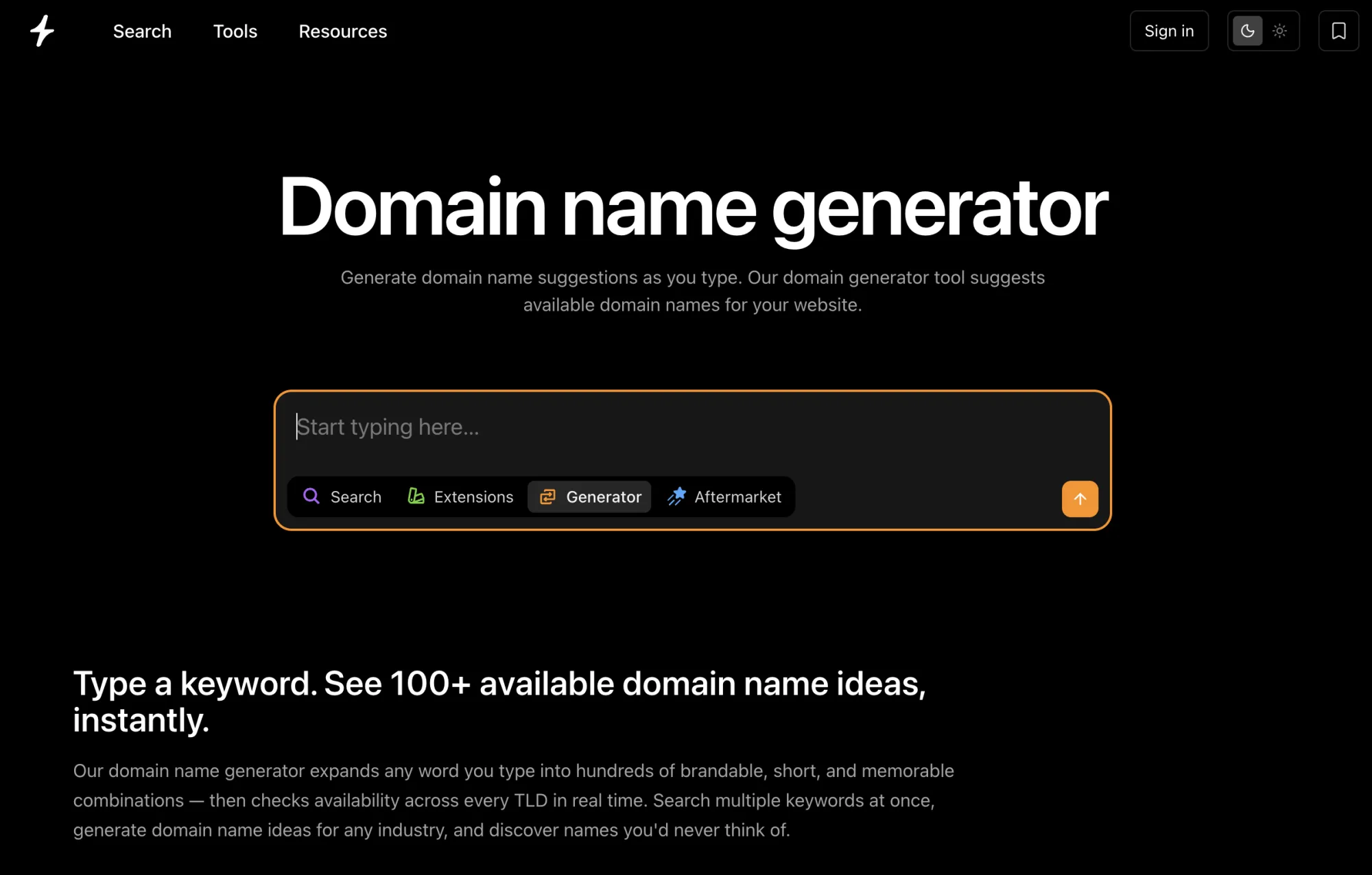
Our own Domain Name Generator is built around a simple bet: the most useful suggestion is one you can buy immediately. Every name surfaced is checked against our local zone-file index for live availability across 800+ TLDs, shown next to the price from each of our partner registrars, with a one-click path to register. There’s no separate “now go check elsewhere” step.
The generator combines multiple strategies in one search. Brand modifiers (get + stripe, my + stripe), letter tweaks (str + ipe, stripe + z), alternate TLDs (stripe.dev, stripe.co), action and verb-like patterns (stripify, stripely), and keyword permutations when you enter multiple words. Behind that, AI suggestions tuned to brandable, descriptive, compound, portmanteau, and abstract styles. You can pick the naming style and the industry, and the suggestions adjust.
Key features:
- Sub-25ms live availability across 800+ TLDs from direct registry partnerships
- Multi-registrar price comparison (GoDaddy, Spaceship, Namecheap, Porkbun, Hostinger, Network Solutions, Dynadot) via smart partner routing on every result
- Multiple generation strategies in a single search (brand modifiers, letter tweaks, alternate TLDs, action-verb patterns, keyword permutations)
- Naming style picker (brandable, descriptive, compound, portmanteau, abstract)
- Industry fit picker for steering suggestions
- Curated lists of available names refreshed daily against live registry data
- Save your shortlist without an account (lives in your browser)
- MCP server so Claude, Cursor, and any MCP-compatible assistant can use the generator directly
- Sibling tool at
/business-name-generatorfor full-business-name conversations
Privacy approach: Queries never reach a retail registrar. Searches run against our local zone-file index built from direct partnerships with VeriSign, Google Registry, Radix, Identity Digital, and others. A registrar only learns about your interest when you click “Register.”
Limitations: We’re not a logo maker. If you want full brand identity previews on every name (mockups, business card visualizations, color palettes), Namelix and Wix do that. Our take is that logo previews are downstream of naming, but if you want them tightly bundled, we don’t compete on that axis.
2. Namelix
Best for: Brandable invented words with logo previews on every suggestion
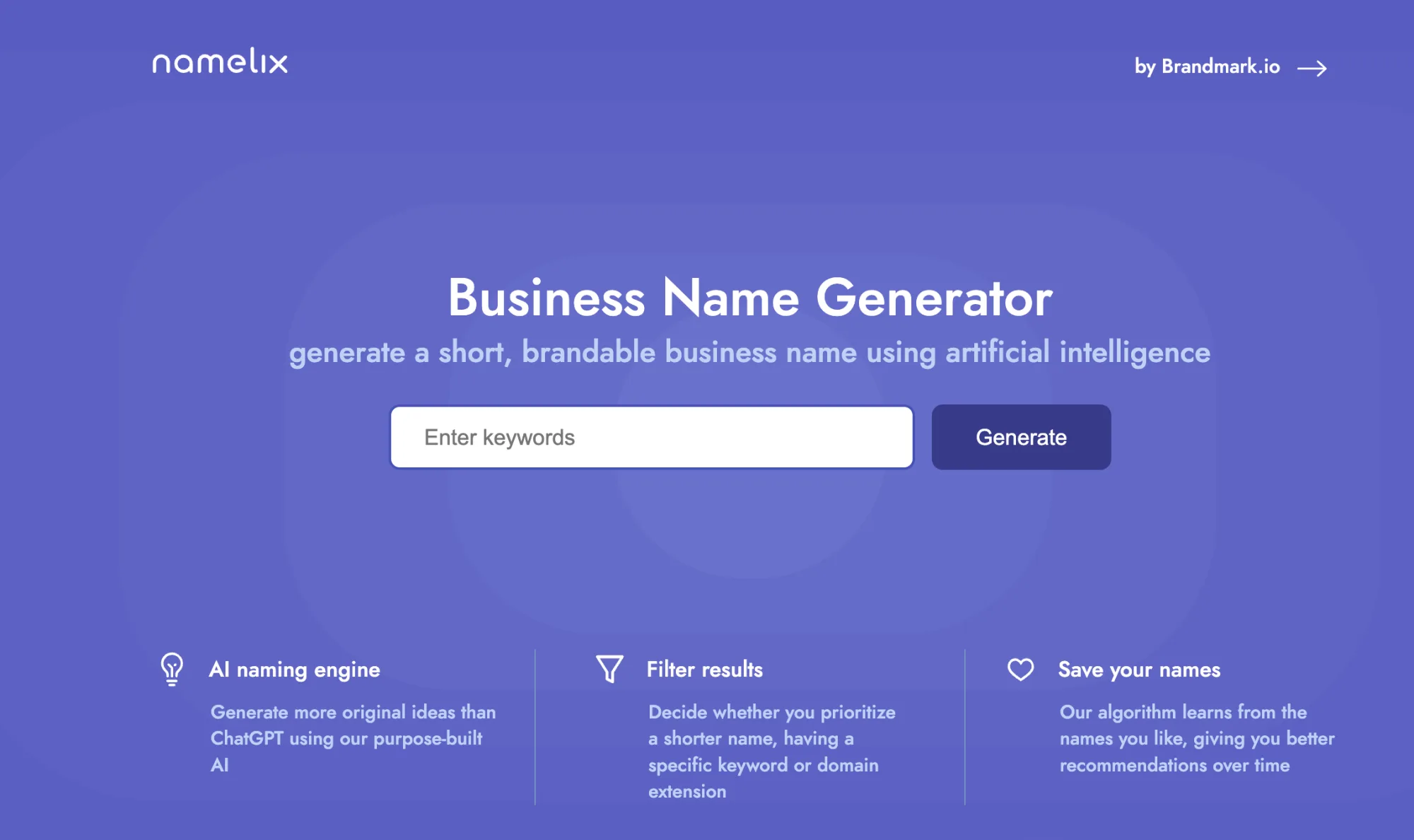
Namelix has earned a strong reputation as the brandable-name generator of choice. The tool is built by the team behind Brandmark, so every generated name comes with an instant logo mockup, business card preview, and brand identity concept. For founders who think visually, this is a meaningful workflow shortcut: you see what the name looks like as a brand before you commit to it.
It offers eight naming styles (brandable, compound, real words, misspelled words like Lyft and Flickr, non-English words, rhyming words, and a few more). An adaptive learning algorithm tracks the names you save and biases subsequent suggestions toward what you’ve shown a preference for. The longer you use it in a single session, the more its output starts to feel tuned to your taste.
Key features:
- Eight distinct naming styles
- Adaptive AI that learns from the names you “heart”
- Instant logo mockups via Brandmark integration
- Domain availability checking on suggestions
- Free to use; paid plans for full logo and brand kit downloads ($25 / $65 / $175 one-time)
Privacy approach: Namelix is operated by a third-party company. Standard query logging applies.
Limitations: Domain availability is checked, but there is no multi-registrar price comparison. If you want logo previews, the workflow is excellent; if you want to register right now at the cheapest price, you’ll still need to check elsewhere. The free version surfaces some names that are already registered trademarks, so additional trademark checking is on you.
3. NameMesh
Best for: Categorized results across multiple styles in one search
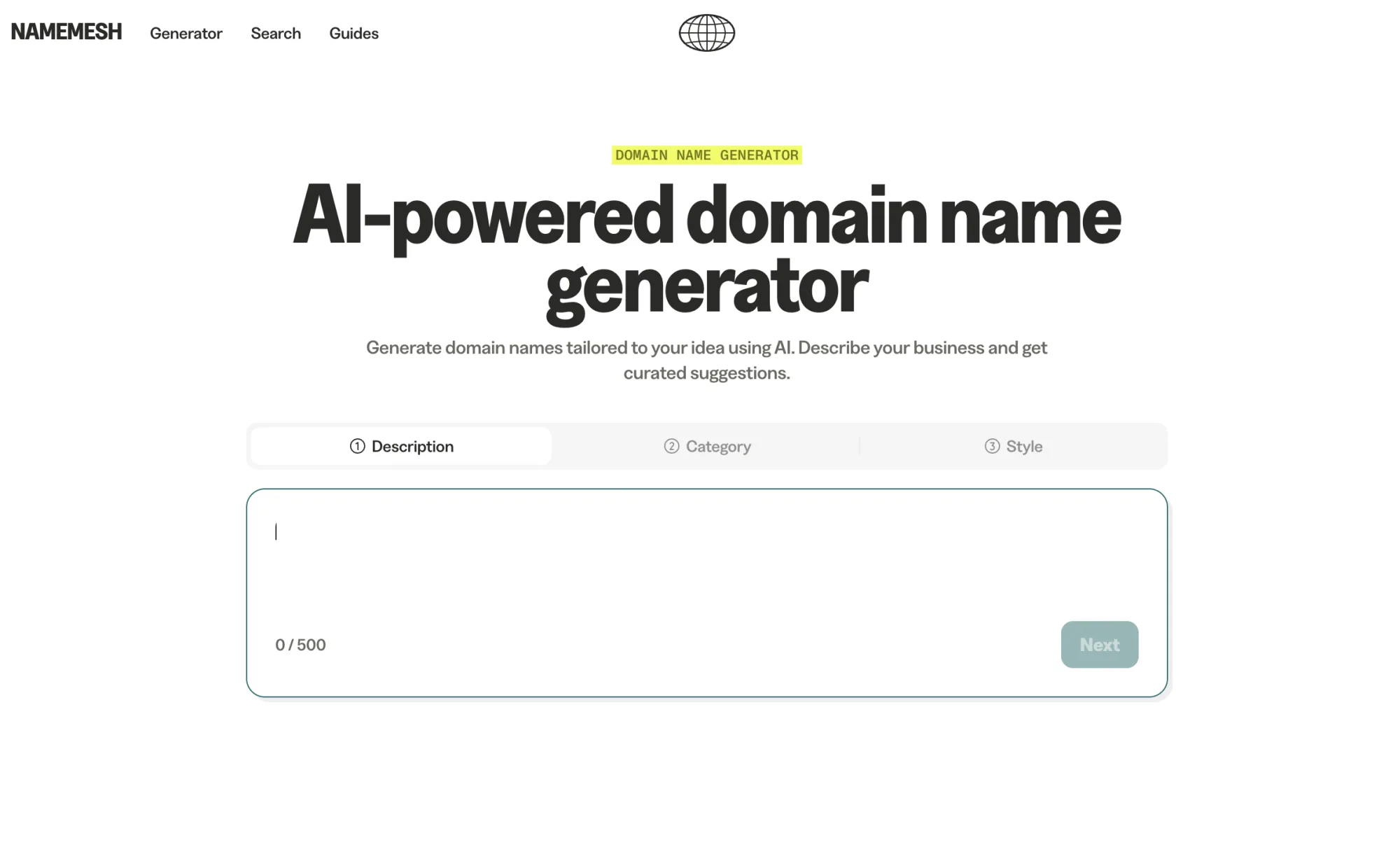
NameMesh has been a favorite among startup founders and developers for over a decade because of one feature: results are organized into clearly labeled categories. You search once and get tabs for Common (standard keyword combinations), New (creative variations), Short (concise options), Fun (playful and creative), Extra (uncommon endings), Similar (close alternatives), and SEO (search-engine-optimized patterns). For people who want to brainstorm across multiple directions without running seven separate searches, the categorization is a real time-saver.
Key features:
- Categorized results across at least 7 styles
- Real-time domain availability checking
- AI-enhanced search for refined suggestions
- SEO-focused search for ranking-friendly patterns
- Clean, no-nonsense interface
Privacy approach: Third-party tool with standard query logging.
Limitations: The interface is dated and ad-supported. Pricing comparison across registrars is absent. AI features are bolted on rather than built in, so the suggestion quality varies. No way to save a shortlist across sessions without an account.
4. Domainr
Best for: Domain hacks and short URL ideas
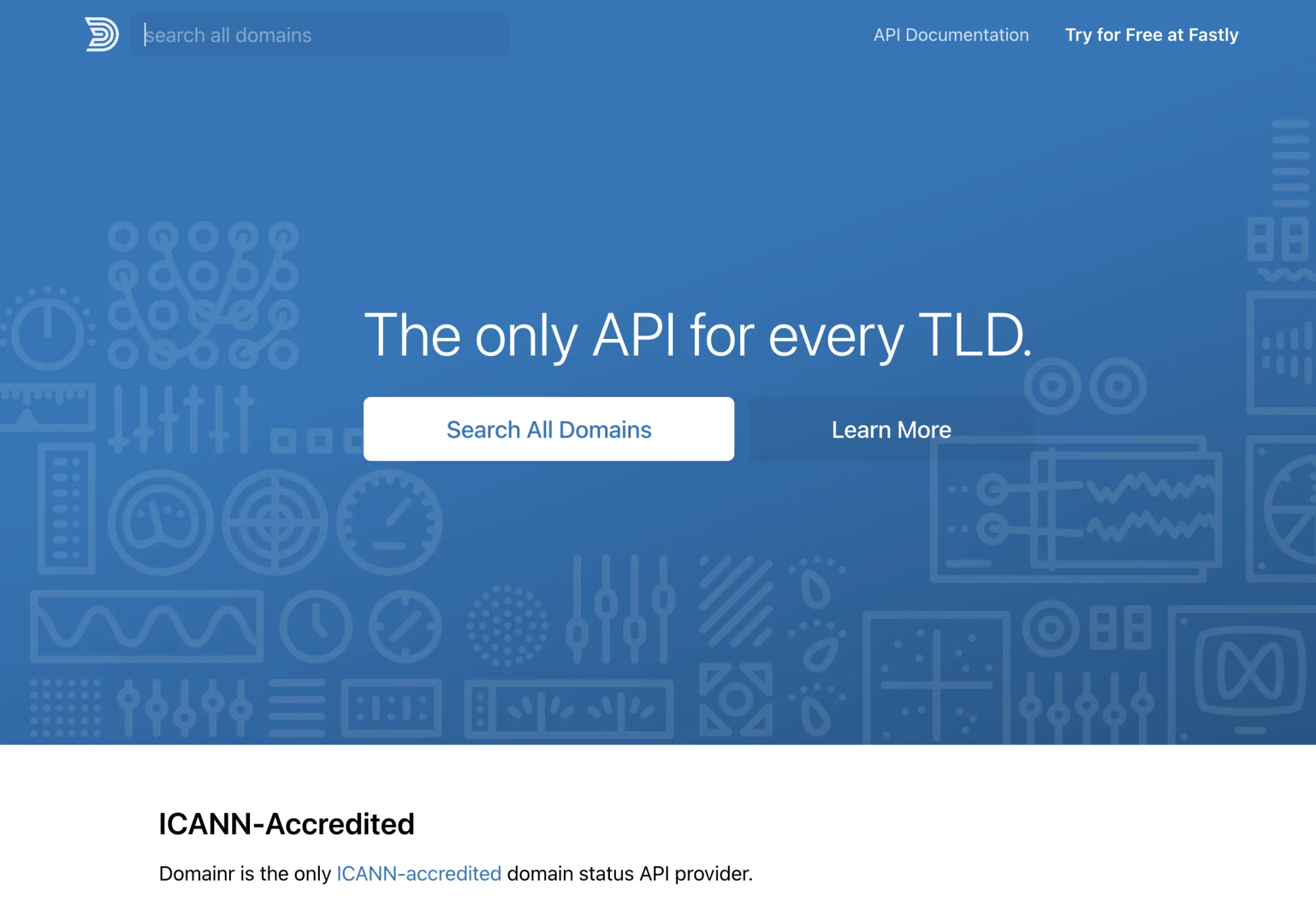
Domainr (now owned by Fastly) is the specialist for one specific use case: finding clever short URLs by using the TLD as part of the word. The classic examples are instagr.am and del.icio.us. Domainr tracks 1,731 top-level domains, including 161 non-Latin internationalized TLDs, and lets you search for ways to slice your keyword across an extension. For URL shorteners, micro-services, dev tools, and brand variations, this is unmatched.
Key features:
- Specialized domain hack discovery across 1,731 TLDs
- Instant search with results as you type
- ICANN-accredited domain status API for developers
- Clean minimalist interface
- Free to use; API pricing varies by volume
Privacy approach: Domainr is API-first and built by Fastly. Privacy posture is standard for an infrastructure tool.
Limitations: Domainr is not a brainstorming tool. It expects you to bring a keyword and shows you ways to fragment it across extensions. If you don’t have a starting keyword, it has nothing to offer. No AI suggestions, no logo previews, no multi-registrar pricing.
5. Shopify Business Name Generator
Best for: Ecommerce store naming in the Shopify ecosystem
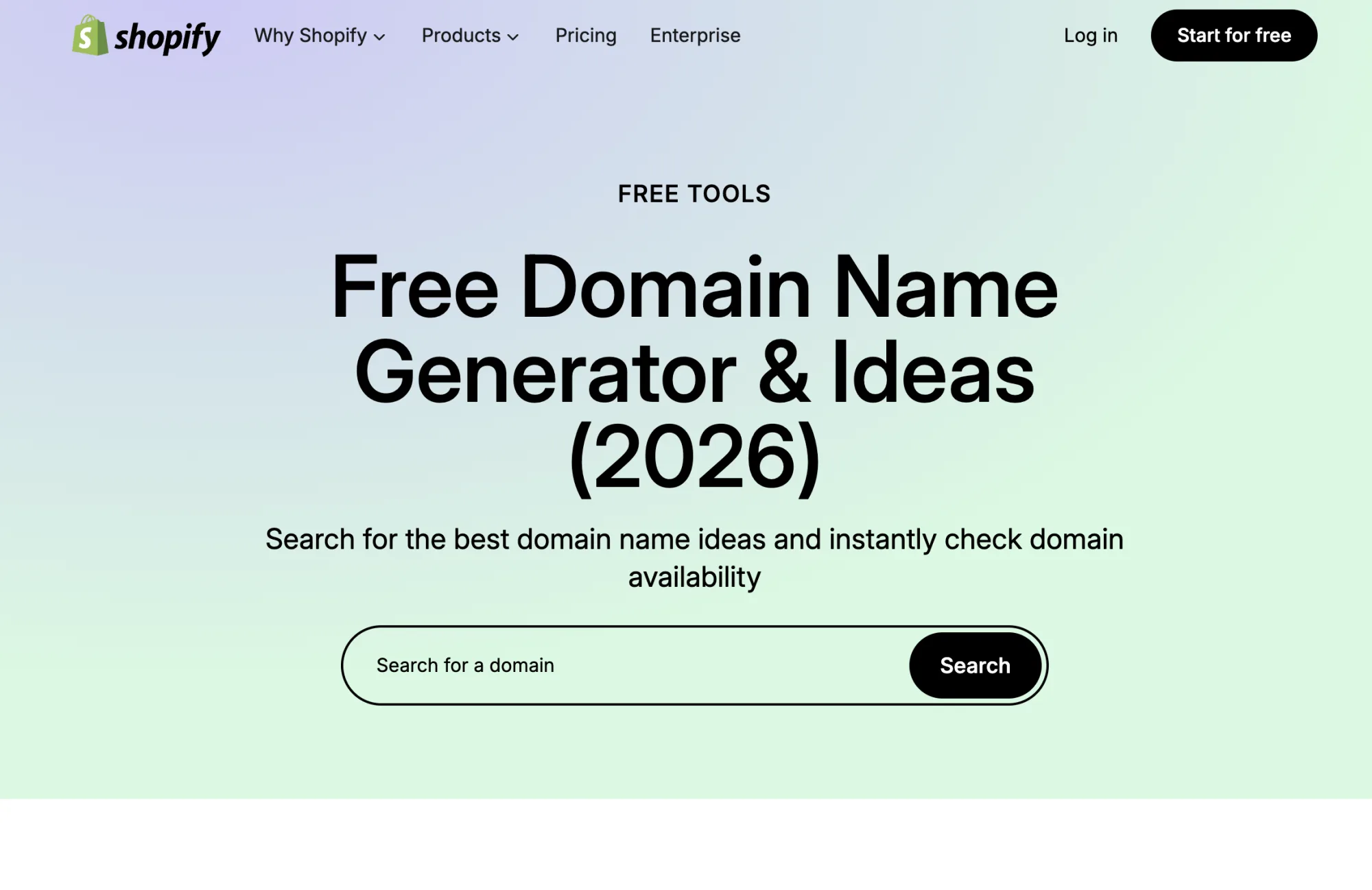
Shopify’s free business name generator is one of the cleaner free tools, with a generous “no signup required” policy and the marketing weight of one of the largest brands in commerce behind it. You describe your business in a short prompt and the AI produces name candidates, each with an annual domain price for purchase. The flow is tightly integrated with Shopify’s store setup, so if you’re building an ecommerce business, the path from idea to live store is short.
Key features:
- AI-powered naming from a one-line business prompt
- Instant domain availability check with annual pricing
- Multiple style variants (Simple, Cool, and other dedicated sub-tools)
- No account required
- Tight integration with Shopify store builder
Privacy approach: Operated by Shopify. Queries are logged under Shopify’s standard privacy practices.
Limitations: Suggestions skew commercial and ecommerce-flavored. Good for stores; less useful for a developer tool, a SaaS, or a personal brand. Single-registrar pricing (Shopify-only). No MCP integration, no API for naming workflows.
6. Wix Business Name Generator
Best for: Full-stack brand kit (name + logo + website) in one place
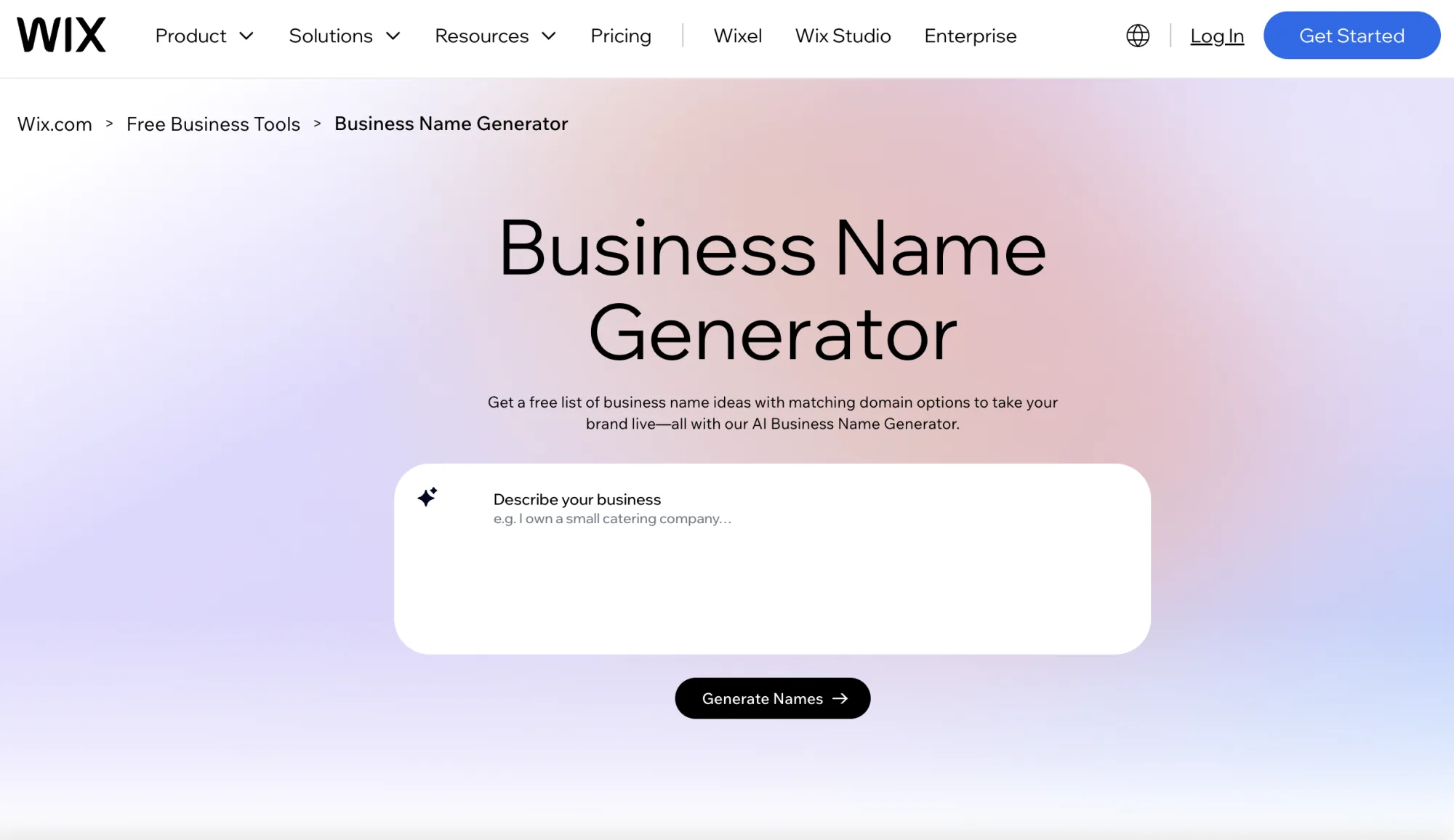
Wix offers a free AI business name generator with 21 industry categories, a customizable name-length slider (1 to 20+ characters), and instant checks on both domain and social media handle availability. The differentiator is integration with the rest of Wix’s brand stack: you can go from name to logo (via the Wix Logo Maker) to live website (via the Wix Website Builder) in a single flow without switching tools. For founders who want one platform from naming through launch, the workflow is genuinely seamless.
Key features:
- AI-powered naming with industry context (21 categories)
- Name length slider (1 to 20+ characters)
- Instant domain and social media handle availability
- Logo Maker, Website Builder, Business Card Maker, QR Code Generator integration
- Free to use; downstream tools require Wix plans
Privacy approach: Operated by Wix. Standard query logging.
Limitations: The free tier funnels toward Wix’s paid plans for anything beyond the name itself. Single-registrar pricing. No MCP or API. The naming output skews toward small-business and personal-brand patterns; if you’re naming a high-growth tech startup, the suggestions can feel generic.
7. Atom.com (formerly Squadhelp)
Best for: Buying a curated brandable name off-the-shelf instead of generating one from scratch
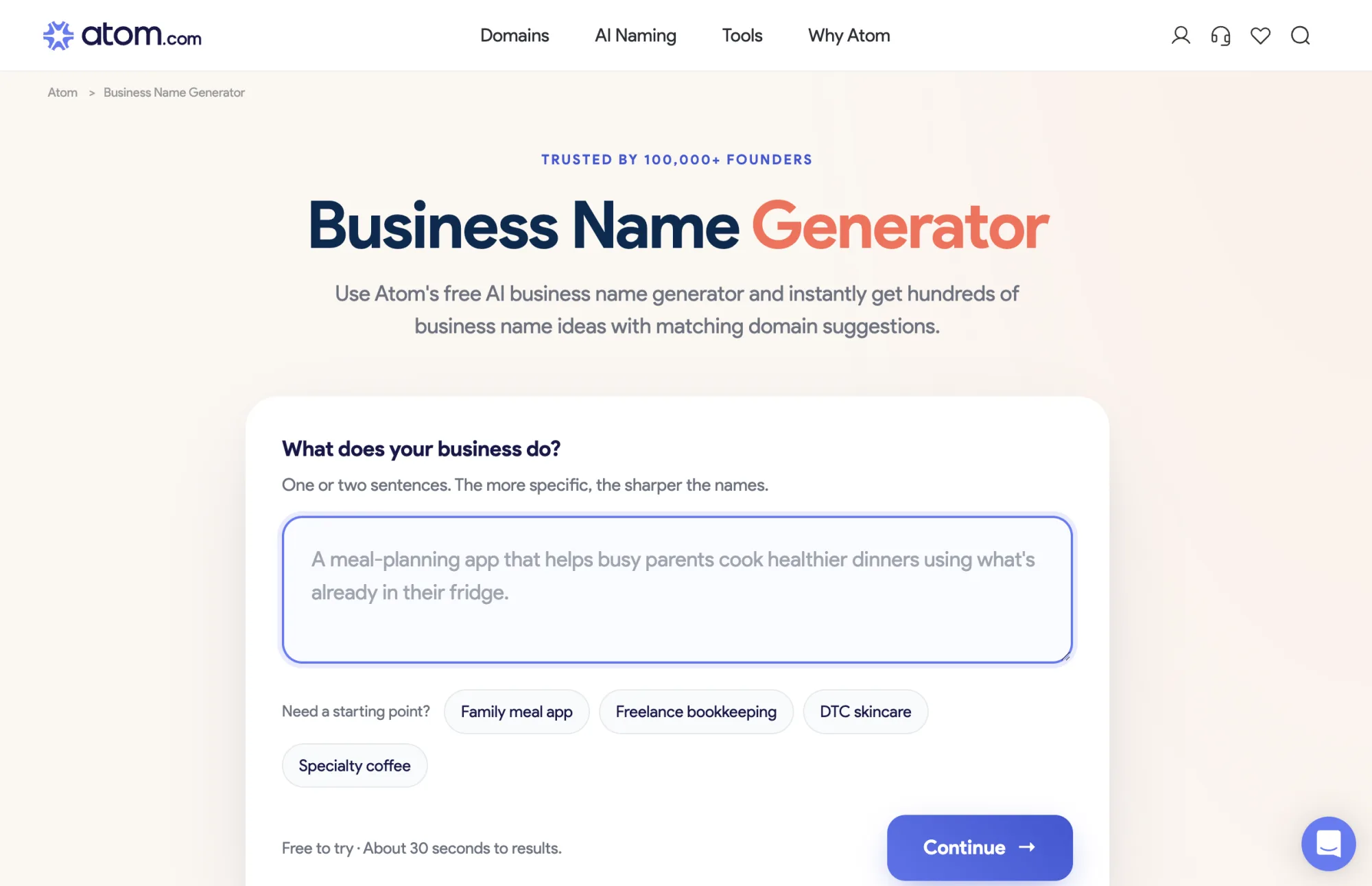
Atom (rebranded from Squadhelp in 2024) is a different model than the others on this list. Rather than generate names from your keywords, it sells access to 300,000+ pre-curated brandable domains, each one already vetted for memorability, marketability, and (usually) trademark cleanliness. You browse and search the inventory by industry, style, length, or price. When you find one, you buy the domain directly from the marketplace.
It also runs AI-powered naming contests where you describe your business and a community of namers (humans, augmented by AI) submits candidates over a few days, with an AI Appraisal tool providing data-backed valuations. The tool is more business-development than brainstorming.
Key features:
- 300,000+ curated brandable domains (mostly .com, .ai, and other premium TLDs)
- AI-powered naming contests for custom names
- AI Appraisal tool for valuations
- Trademark filters
- Marketplace tiers (Premium, Ultra Premium, Sapphire)
Privacy approach: Atom is a marketplace operator. Queries on the marketplace are logged.
Limitations: Names are premium-priced (usually low four to five figures and up). Atom typically takes 15-35% commission on sales, and some users have reported friction with forced registrar transfers and two-year renewal fees. For solo founders who want a $9 hand-registered .ai, Atom is overkill. For funded startups who want a name with a logo and a trademark report already attached, it’s hard to beat. Note that the inventory overlaps with our aftermarket aggregator, which surfaces Atom listings alongside Sedo, Afternic, Sav, DomainAgents, and others in one search.
8. Lean Domain Search
Best for: Simple prefix/suffix brainstorming with no AI overhead
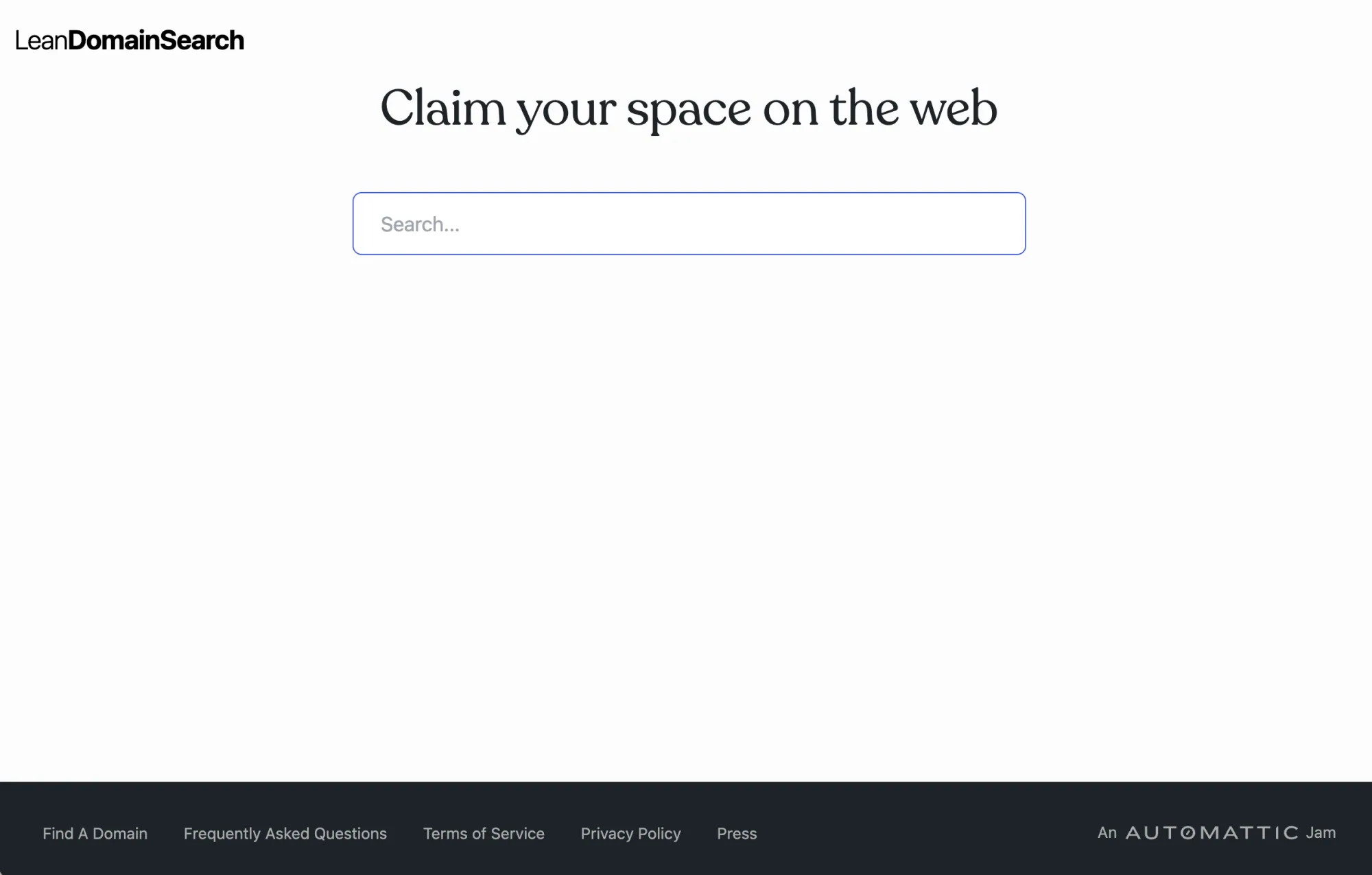
Lean Domain Search was launched in 2012 by Matt Mazur and is now operated by Automattic (the parent of WordPress.com). The tool does one thing: pairs your keyword with a curated list of prefixes and suffixes to produce hundreds of available .com combinations. Results are filterable by position (prefix, suffix, or anywhere) and sortable by length, popularity, or alphabetical order. It’s a throwback to a pre-AI era of generators, and that’s the appeal for some users.
Key features:
- Prefix/suffix pairing for .com domain ideas
- Filtering by position
- Sorting by length, popularity, or alphabetical
- Free, no account required
- Clean utilitarian interface
Privacy approach: Operated by Automattic. Standard query logging.
Limitations: Limited updates in recent years. Only checks .com availability, no broader TLD coverage. No AI suggestions, no logo previews, no multi-registrar pricing, no industry context. The tool’s strength is also its weakness: it does exactly one thing, and that thing has been improved on by every modern generator on this list. Still useful for fast brainstorming if you want raw prefix/suffix output without ceremony.
9. ChatGPT, Claude, and Custom GPTs
Best for: Open-ended naming conversations and unusual constraints

The newest entry on this list is also the most flexible. Rather than visit a generator, you can ask Claude or ChatGPT to brainstorm 200 names for your business, then narrow with follow-up prompts (“more brandable,” “shorter,” “no Greek roots,” “must end in a hard consonant”). Both have purpose-built naming GPTs and skills available. The output quality is comparable to (and sometimes better than) traditional generators because the model holds your full business context across multiple turns.
The gap, until recently, was that AI assistants would happily generate names without any awareness of whether they were available as domains. You’d end up with a polished shortlist of names you couldn’t actually register.
That’s solved by MCP. Instant Domain Search’s MCP server gives Claude, Cursor, and any MCP-compatible assistant the ability to check domain availability across 800+ TLDs in the middle of a conversation, with multi-registrar pricing attached. The flow becomes: “Brainstorm 50 names for an AI agent platform, then check availability and price for the top 10.” All in one chat.
Key features:
- Open-ended naming with full business context
- Iterative refinement across multiple turns
- Custom GPTs and Claude skills for specialized naming workflows
- MCP integration with our generator for live availability and pricing
- Free to use with most AI assistants
Privacy approach: Depends on the AI assistant’s data policy. Anthropic, OpenAI, and others have published privacy positions on chat data retention. Most allow you to disable training on your inputs.
Limitations: Without an MCP integration, no built-in domain availability check. The assistant will happily suggest names that are already registered. You also need to bring your own structure: the quality of the output is directly tied to the quality of your prompt. New users tend to ask too vaguely and get generic results.
How Instant Domain Search fits into the picture
The list above is what we built our own generator around. We are not above the other tools, we are competing with them on merit. The architecture choices that make our generator different:
- Live availability on every suggestion, sub-25 milliseconds. Most generators show suggestions first and check availability later (or, worse, suggest names that are already registered). Ours runs every suggestion against a local index of zone files built from direct registry partnerships with VeriSign, Google Registry, Radix, Identity Digital, and others. The names you see are the names you can register, right now.
- Multi-registrar pricing on every result. When a name is available, we show pricing across GoDaddy, Spaceship, Namecheap, Porkbun, Hostinger, Network Solutions, and Dynadot via smart partner routing. You can spot the cheapest place to register before you click. No other generator does this.
- Five generation strategies, not one. Brand modifiers, letter tweaks, alternate TLDs, action-verb patterns, and keyword permutations all run in parallel on a single search. You don’t have to pick which mode you’re in. The output is broader than any single-strategy generator.
- 800+ TLDs. Most generators check .com or a handful of major TLDs. Ours covers everything from .ai and .io to .gay, .ngo, .museum, and 800+ others. If you’re naming an AI startup and want every possible variation across .com, .ai, .app, .dev, .so, .co, and .io in one search, we’re built for that.
- Privacy by architecture. Because our searches run against our own zone-file index, no retail registrar is ever queried. Your shortlist never leaves our infrastructure until you click “Register.” For stealth-mode projects, this is genuinely different from every other tool on this list.
- MCP for AI workflows. Our MCP server lets Claude, Cursor, and any MCP-compatible assistant generate names and check availability inside the same conversation. The “ChatGPT brainstorm, then go check elsewhere” workflow becomes a single flow.
- Free, no account. Unlimited generation, unlimited availability checks, full multi-registrar pricing comparison, and a saved domains sidebar that lives in your browser. We make money when you register through a partner registrar, not from your queries.
The product is built on a single bet: the highest-leverage moment in naming is the gap between “this name sounds good” and “this name is registered.” Closing that gap with live data, in real time, across the whole market, is the thing we optimize for.
Feature comparison table
| Feature | IDS Generator | Namelix | NameMesh | Domainr | Shopify | Wix | Atom.com | Lean Domain Search | AI Assistants |
|---|---|---|---|---|---|---|---|---|---|
| Live availability | Yes (sub-25ms) | Yes | Yes | Yes (instant) | Yes | Yes | N/A (pre-curated) | Yes (.com only) | Only with MCP |
| TLD coverage | 800+ | Major TLDs | Major TLDs | 1,731 | Major TLDs | Major TLDs | Curated inventory | .com only | Depends on integration |
| Multi-registrar pricing | Yes | No | No | No | No (Shopify) | No (Wix) | No (Atom-only) | No | Only with MCP |
| AI suggestions | Yes | Yes (adaptive) | Yes | No | Yes | Yes | Yes (contests + appraisal) | No | Yes (native) |
| Multiple generation strategies | Yes (5+) | Yes (8 styles) | Yes (7 categories) | Domain hacks only | Yes | Yes | Marketplace browse | Prefix/suffix only | Yes (open-ended) |
| Logo / brand previews | No | Yes | No | No | Limited | Yes | Yes (paid) | No | No (without plugin) |
| MCP / AI assistant integration | Yes | No | No | No (API only) | No | No | No | No | Yes (native) |
| Save shortlist | Yes (no account) | Yes (account) | No | No | Limited | Yes (account) | Yes (account) | No | Yes (chat history) |
| Account required | No | Optional | No | No | No | Optional | Yes (to buy) | No | Yes (for AI assistant) |
| Privacy of searches | Queries never reach registrars | Standard | Standard | Standard | Standard | Standard | Standard | Standard | Depends on assistant |
Which generator should you use?
The right choice depends on what you’re actually trying to do.
For most workflows (naming a startup, a side project, an app, a SaaS, a personal brand) where you want fast, live data and immediate registration paths, use Instant Domain Search’s generator. The combination of sub-25ms availability checking across 800+ TLDs, multi-registrar pricing on every result, and multiple generation strategies in a single search is the closest to a one-stop-shop the market has.
For brand-first naming where you want to see the logo before you commit to the word, Namelix is the right tool. The Brandmark integration is genuinely useful for narrowing a shortlist, even if you end up buying the name elsewhere.
For ecommerce specifically, where you’re building a Shopify or Wix store anyway, use the matching native tool. The integration with the rest of the store-building flow is worth the narrower naming output.
For domain hacks (short URLs, dev tools, micro-services where the TLD is part of the word), Domainr. It’s the only tool that takes this use case seriously.
For a categorized brainstorm across multiple styles in one search, NameMesh. The tab structure is a real time-saver if you want to compare Common vs. Short vs. Fun outputs side by side.
For premium brandable .coms you can buy off-the-shelf with trademark vetting attached, Atom.com. Expensive but real inventory. Worth scanning the aftermarket aggregator on Instant Domain Search first to see Atom’s listings alongside Sedo, Afternic, Sav, and others.
For simple prefix/suffix brainstorming without any AI overhead, Lean Domain Search. Still works, still useful, especially for non-technical users who find AI suggestions overwhelming.
For open-ended naming conversations and unusual constraints, ChatGPT or Claude (with our MCP server configured so the assistant can check availability in the same conversation). The “brainstorm freely, then validate” flow is the most flexible naming workflow available right now.
Frequently asked questions
What is the best domain name generator in 2026?
For most naming workflows, Instant Domain Search’s domain name generator is the strongest single tool because it combines AI-powered suggestions, multiple generation strategies, live availability across 800+ TLDs, multi-registrar pricing, and MCP integration in one free product. Namelix is a strong alternative if you want logo previews bundled with naming. NameMesh and Lean Domain Search are useful for simple categorized brainstorming. Shopify and Wix are best if you’re already building inside their ecosystems. Atom.com is the right move if you want a pre-curated brandable .com and have budget for premium inventory.
Are domain name generators free?
Most are free for the core generation feature. Instant Domain Search, Namelix, NameMesh, Domainr, Shopify’s tool, Wix’s tool, and Lean Domain Search all offer free generation with no account required. Namelix charges for logo and brand kit downloads ($25-$175 one-time). Wix’s downstream tools (logo, website) require paid Wix plans. Atom.com is free to browse but charges for the actual domain purchase (typically four to five figures and up). AI assistants like Claude and ChatGPT are free or low-cost for the naming use case.
What’s the difference between a domain name generator and an AI business name generator?
In 2026 the line is mostly cosmetic. Both types now use AI for some part of the suggestion pipeline. The historical distinction was that pre-AI domain generators ran keywords through hardcoded prefix/suffix lists, while AI business name generators used language models to produce brandable invented words. Today, most serious generators (including ours) blend both approaches. The “AI” label is no longer a meaningful differentiator; what matters is the quality of the suggestions, the depth of the live availability checking, and the registration workflow.
Do domain name generators check trademark availability?
A few do, partially. Most do not. Even the ones that surface trademark information rely on USPTO and similar public databases, which means they cover registered trademarks but not common-law trademarks or trademarks in pending jurisdictions. If you’re naming a serious business, treat the trademark check as a separate step (start with a free trademark search of USPTO records, plus a quick consultation with a trademark attorney for high-stakes names). Domain availability and trademark availability are not the same thing.
Can I use ChatGPT or Claude as a domain name generator?
Yes. Both work well for open-ended naming, especially when you give them rich business context and specific constraints. The gap is that the AI assistant itself doesn’t know which generated names are actually available as domains. Our MCP server fixes that: Claude or any MCP-compatible assistant can check availability and pricing in the same conversation, so you can brainstorm and validate without leaving the chat.
How many domain name generators should I use when naming a company?
For most naming exercises, two is plenty. Instant Domain Search covers fast AI-assisted generation with live availability checking across 800+ TLDs. Pair it with either Namelix (if you want visual brand previews) or your preferred AI assistant (if you want open-ended conversational naming). Adding more generators tends to produce diminishing returns and decision paralysis. The bigger gains come from spending more time on shortlist evaluation, not on generating more options.
What’s the most important factor in picking a domain name generator?
Live availability checking, by a wide margin. A generator that produces a beautiful list of brandable names you can’t actually register is worse than useless. The second most important factor is TLD coverage: if you only check .com, you miss the .ai, .io, .app, and 800+ other TLDs where many serious modern startups live. Everything else (logo previews, industry filters, naming styles, social handle checks) is downstream.
Is it safe to search domain names on these tools?
It depends on the tool’s architecture. Tools operated by retail registrars (anything that funnels you toward registering on their own platform) log every name you search and have commercial incentive to know what you’re looking at. Instant Domain Search runs searches against our own zone-file index, so your queries never reach a retail registrar. For stealth-mode projects, competitive research, or investor scouting, this matters more than people realize. We wrote a full piece on how we built the privacy architecture.
Bottom line
The domain name generator space has gotten meaningfully more useful in 2026. AI-native suggestions, broader TLD coverage, live availability checking, and (for the first time) genuine integration with AI assistants are all standard for the better tools. The trade-offs left are mostly about workflow fit:
- For most users: Instant Domain Search. Sub-25ms live availability, multi-registrar pricing, 800+ TLDs, MCP integration. Free, no account, no registrar sees your queries.
- For visual brand previews: Namelix
- For ecommerce store naming: Shopify or Wix
- For domain hacks: Domainr
- For premium pre-curated .coms: Atom.com
- For categorized brainstorming: NameMesh
- For simple prefix/suffix output: Lean Domain Search
- For open-ended AI conversations: ChatGPT or Claude (ideally with our MCP server configured)
If you’re still in early exploration and you don’t know what you want yet, start with our generator and the curated lists of available names. The generator covers the “I have a keyword, what’s possible” workflow. The lists cover the “I don’t have a keyword, what’s available right now” workflow. Together they’re the same architecture that has powered close to 50 million domain searches on our platform since 2005.
The right name is somewhere on the other side of a hundred wrong ones. The job of a good generator is to make the hundred wrong ones cheap to discover so the right one is faster to find.