mercury.com traffic, backlinks, authority, and more
Mercury.com is a financial technology company that provides online business banking, cash management, payments, and developer-friendly APIs aimed primarily at startups, tech companies, and small to medium-sized enterprises. The site is well-known within the startup and fintech communities and has growing recognition among entrepreneurs and investors with estimated daily visits in the thousands.
Score assigned based on the strength of the domain online
Estimated monthly organic traffic from search engines
Total number of links from other websites pointing to this domain
Traffic Analysis
The site's traffic has grown by 9% year-over-year with over 168,057 monthly visits driven primarily by product and finance-oriented informational queries, comparative research and practical business templates that attract founders, accountants and prospective customers. Traffic is heavily concentrated in North America (74.0%) with meaningful follow-on audiences across Europe and MENA (12.5%) and the Asia‑Pacific region (8.1%), underscoring a core US market presence while signaling growing international interest that aligns with the domain’s focus on business banking, financial tools and small‑business education.
Domain Preview & WHOIS Information
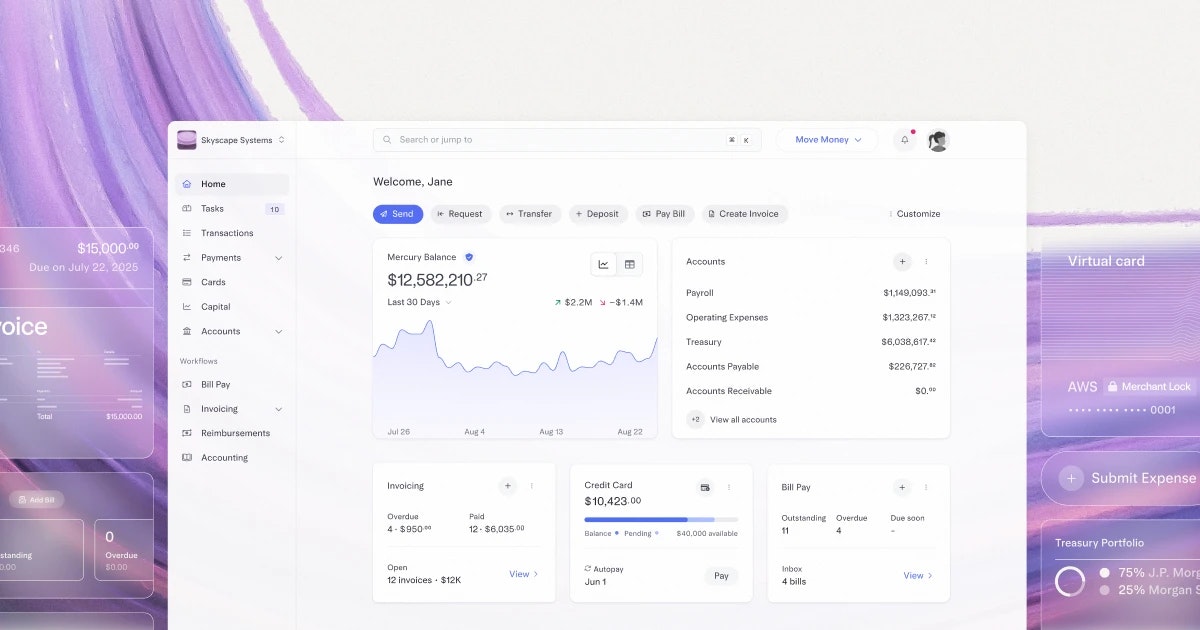
Online Business Banking For Startups, Small Businesses & Scaling Companies
Everything you do with money. All in one place. Apply in 10 minutes for business banking that transforms how you operate.
The domain mercury.com was registered on November 30, 1990, through amazon registrar, inc. and uses Cloudflare for DNS and security. At 35 years old, this longevity signals established credibility, a mature online presence, a proven track record, and significant accumulated authority that benefit search visibility, trust signals, and long-term SEO strength.
Backlink Profile and Referring Domains
Referring Domains
The backlink profile for Mercury is dominated by medium-authority (DA 40-69) referring sites (overall Domain Authority in the data sits in the mid-range) with no clear DA 70+ heavyweights among the top links; notable placements come from recognizable technology publications, developer resources and industry leaders such as the Microsoft for Startups Blog, Medium and Hacker News which lend topical credibility. This broad base — nearly 9,432 referring domains and a high total backlink count — provides solid organic search support and contributes meaningful topical relevance and crawl signals that strengthen Mercury’s overall SEO profile and organic visibility.
Counting the top links provided yields a dofollow-to-nofollow distribution of approximately 40:60 (dofollow:nofollow), a mix that is somewhat skewed toward nofollow but still includes several dofollow mentions from reputable outlets that can pass useful link equity. Anchor text is heavily weighted toward naked URLs at 70%, with branded anchors (company/name variants) at 20% and keyword-rich anchors (e.g., “Mercury Bank”) at 10% — a generally natural profile due to the prevalence of naked URLs and branded mentions, though increasing diverse, context-rich keyword anchors could improve targeted relevance.
Keyword Rankings
Top Ranking Keywords
The domain mercury.com demonstrates a concentrated keyword portfolio focused on banking and account access (brand + login intent) with high-volume anchors and a mix of low-competition navigational terms and commercially valuable branded searches, signaling a strong product-led SEO positioning and clear fintech audience targeting. The top keyword 'mercury bank' attracts daily searches in the hundreds with a $16.08 CPC, indicating strong commercial value. The other keywords—'mercury bank login' (4,400 SV, 6% competition low), 'mercury banking' (2,400 SV, 68% competition high), 'mercury login' (6,600 SV, 4% competition low), and 'mercury.com' (1,900 SV, 28% competition low‑moderate)—show a mix of navigational dominance and one high-competition commercial term, revealing a market position that is brand-strong but facing competitive bids for broader commercial intent. The domain's strengths are its strong organic visibility, healthy keyword portfolio, and competitive SEO performance.
Technology Stack
 AmazonAmazon CloudFront
Mercury.com is built on a modern frontend mix that includes React, legacy Angular JS, and jQuery for incremental functionality alongside Next.js to enable server-side rendering and faster initial loads; this combination gives engineers a balance of component-driven development, progressive enhancement, and optimal SEO and developer experience. On the backend and delivery side the site leverages Amazon EC2 infrastructure with nginx as the web server and edge/distribution services like Cloudflare and Amazon CloudFront, providing reliability, horizontal scalability, and global distribution for static and dynamic assets through CDN and edge optimizations.
The security and DNS layer uses certificates from LetsEncrypt and DigiCert SSL together with HSTS policies to enforce encryption and strict HTTPS, while Cloudflare and edge CDNs contribute to DNS management, DDoS mitigation and fast load times across regions. For observability and product insights the site integrates analytics and UX tooling such as Google Analytics, Mixpanel, Segment, and Hotjar, which together enhance monitoring, experimentation, and user insights to improve the development workflow and user experience.
Competitive Landscape
mercury.com competes in the modern startup banking and fintech business banking space against established players like Brex, Ramp, Stripe Treasury and newer alternatives such as mercurycards.com and mrcy.com. Compared to the more established players, mercury.com shows comparable traffic patterns (roughly 168k monthly visits versus Brex’s ~174k) and a concentrated market presence focused on startups and SMBs, with an API-first, developer-friendly positioning and heavy backlink volume that have enabled niche growth through integrations and partnerships.
With a Domain Authority score of 50, mercury.com sits on par with direct competitors in the business banking / fintech industry rather than above or below them, indicating competitive SEO strength but not a clear authority lead. The site targets startup founders and tech-first finance teams, offers virtual cards, integrated banking APIs, and streamlined account workflows, and that focus has driven organic visibility and steady market penetration through word-of-mouth and platform integrations.
FAQ on mercury.com
Everything you need to know about mercury.com.
What is mercury.com's primary business model?
Mercury.com operates as a financial technology company providing business banking services tailored primarily to startups and SMBs, offering FDIC-insured checking and savings accounts, corporate cards, and cash-management tools. It generates revenue through interchange fees on cards, interest income from deposits, and paid add-on services for treasury and compliance features. The platform emphasizes digital-first banking with integrations to accounting and payment systems to simplify financial operations for founders.
Is mercury.com considered a market leader, a challenger, or a niche player?
Mercury.com is best categorized as a challenger in the business banking fintech space. It competes with larger incumbents and well-funded fintech rivals by targeting startups and technology companies with a modern, developer-friendly product set rather than competing as a broad-market incumbent. While influential within its target segment, it does not have the scale of major consumer banks or some larger fintechs that serve wider enterprise markets.
What makes mercury.com unique compared to its competitors?
Mercury.com differentiates itself through a startup-focused product design that emphasizes developer-friendly APIs, easy integrations with accounting and payment tools, and streamlined digital onboarding tailored to founders. It combines business banking with features like virtual cards, multiple user roles and permissions, and cash-management tools aimed at venture-backed companies. The platform’s focus on simplicity, technology integrations, and founder-centric workflows distinguishes it from more traditional banks and broader fintech offerings.
What are the most recent major updates or strategic shifts seen on mercury.com?
Publicly available information indicates Mercury has continued expanding its product suite and integrations, improving API functionality, and enhancing treasury and compliance features to meet the needs of scaling startups. The company has also emphasized partnerships and platform enhancements that streamline banking, card management, and accounting workflows. If specific headline announcements are not publicly listed, the general strategic direction is toward deeper productization for startups, stronger risk and compliance capabilities, and tighter integrations with the developer and startup ecosystems.