pendo.io traffic, backlinks, authority, and more
Pendo.io is a SaaS company offering product analytics, in-app guidance, and user feedback tools for product managers, UX teams, and customer success professionals to optimize digital products. The platform is well-known within the tech and product management communities and widely used by mid-market and enterprise software teams, with estimated daily visits in the thousands.
Score assigned based on the strength of the domain online
Estimated monthly organic traffic from search engines
Total number of links from other websites pointing to this domain
Traffic Analysis
The site's traffic has grown by 29% year-over-year with over 58,138 monthly visits driven primarily by product analytics and user experience topics, customer feedback and NPS-related measurement, AI-enabled product management tools, certification and adoption resources, and integration/feature discovery. The audience is concentrated in North America (led by the US at 69.7%), with strong follow-on interest from Asia-Pacific (notably India at 8.5%) and Europe (the UK at 5.5%), a distribution that reflects Pendo’s focus on enterprise product teams in major English-speaking markets while also signaling growth opportunities in APAC and broader European product organizations.
Domain Preview & WHOIS Information
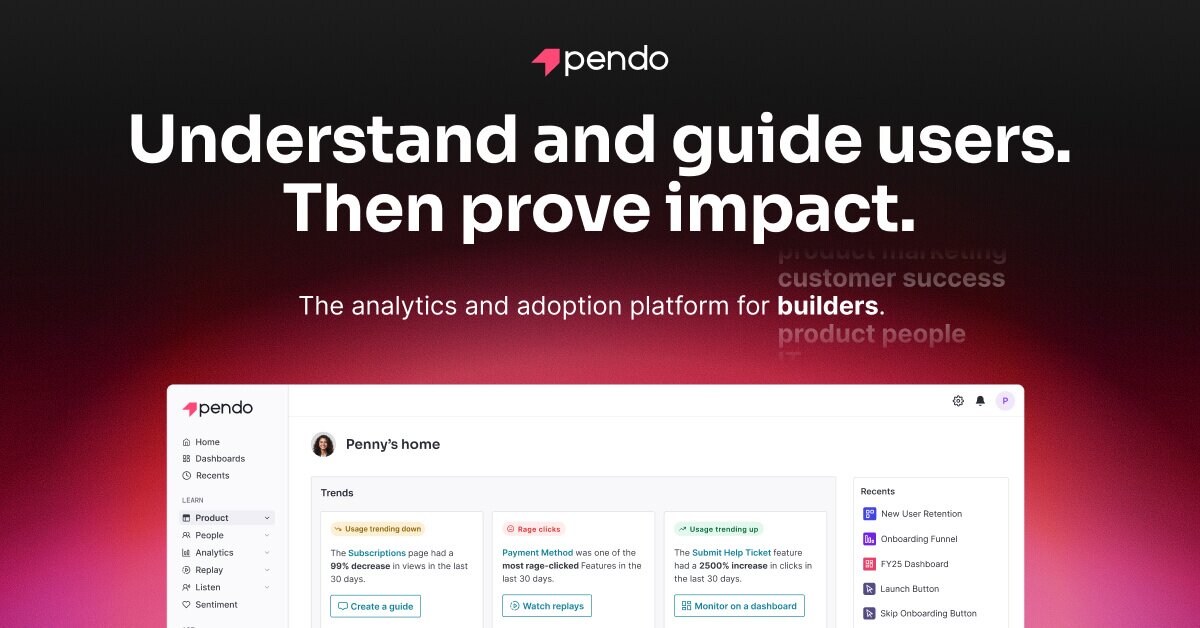
Product Experience & Analytics Platform | Pendo
AI-powered platform that improves how everyone uses software. Product analytics, in-app guides, churn prediction, and agent performance—unified by Pendo AI.
The domain pendo.io was registered on June 17, 2013, through key-systems gmbh and uses Google Cloud for DNS and security. At 12 years old, the domain benefits from established credibility, accumulated authority, and stronger trust signals that support improved SEO performance and a mature online presence with a proven track record.
Backlink Profile and Referring Domains
Referring Domains
Pendo's backlink profile is dominated by medium-authority (DA 40-69) sources with notable placements from near-high pages (a DA 68 listing) and a mix of technology publications, developer resources, and industry leaders such as NC TECH and prominent security lists, while a number of links come from lower-authority sites below DA 40. This breadth of referring domains and a healthy total backlink volume contribute solidly to Pendo's organic search visibility and overall SEO strength, providing topical relevance and referral diversity that supports ranking resilience.
The sampled top links show an approximate dofollow:nofollow ratio of 60:40, indicating a moderately favorable share of link equity with dofollow links from higher-authority sources helping to pass SEO value. Anchor text is heavily concentrated in branded and URL forms—approximately 90% branded/naked URLs, 0% keyword-rich, and 10% other/variant anchors, which reads as a generally natural profile focused on brand signals but with limited keyword-rich anchors that could be increased cautiously for topical relevance.
Keyword Rankings
Top Ranking Keywords
The domain pendo.io shows a concentrated keyword portfolio dominated by branded and navigational queries—high-volume terms like pendo io (1,300) and pendo pricing (1,300) alongside career and login intent, reflecting a product-led SaaS positioning with clear user, commercial, and hiring signals. The top keyword 'pendo io' attracts daily searches in the dozens with a $41.54 CPC, indicating solid brand recognition. The other keywords — pendo pricing (high volume, $32.5 CPC, 60% competition: moderate competition signaling commercial interest), pendo careers, pendo login, and careers at pendo (all high positions with 0% competition: low competition reflecting navigational and employer-brand intent) — reveal a market positioned between paid commercial opportunity and low-competition branded anchors. The domain's strengths lie in dominant SERP ownership for branded queries, clear monetizable pricing intent, and recruitment visibility, underscoring strong organic visibility and a healthy keyword portfolio.
Competitive Landscape
pendo.io competes in the product analytics and digital adoption space against established players like Gainsight and Heap and newer alternatives such as Userpilot and ProductSchool. Compared with the largest incumbents, pendo.io shows stronger organic traffic (58,138) than most listed peers and leverages a focused product-led positioning—combining in-app guidance with analytics—that creates distinct product-led growth and concentrated usage patterns versus broader customer success suites.
The domain carries a Domain Authority score of 46 which is on par with the competitive set in the product analytics and digital adoption industry, indicating similar backlink equity to rivals but room to outpace them through content and partnership strategies. pendo.io targets product teams with integrated in-app feedback, analytics, and onboarding tools—its in-app guidance, user segmentation, and product analytics capabilities drive strong word-of-mouth growth and improved organic visibility, translating into measurable market penetration despite similar DA metrics.
FAQ on pendo.io
Everything you need to know about pendo.io.
What is pendo.io's primary business model?
Pendo.io operates a software-as-a-service (SaaS) business model, selling subscription licenses for its product experience platform to businesses. Its offerings bundle product analytics, in-app guidance, feedback management, and roadmap tools into tiered plans aimed primarily at product and customer-facing teams in mid-market and enterprise customers.
Is pendo.io considered a market leader, a challenger, or a niche player?
Market leader. Pendo is widely recognized as a leading provider in the product experience and product analytics category, competing at scale with established vendors and attracting large enterprise customers and significant VC backing.
What makes pendo.io unique compared to its competitors?
Pendo combines product analytics, no-code in-app guidance, and user feedback tools in a single platform targeted specifically at product teams, which reduces the need to stitch separate point solutions together. Its emphasis on enabling product-led growth, robust segmentation and behavioral analytics, and easy-to-build in-app experiences distinguishes it from competitors that focus more narrowly on either analytics or onboarding.
What are the most recent major updates or strategic shifts seen on pendo.io?
In recent years Pendo has doubled down on expanding its product-led growth capabilities, enhancing analytics and in-app guidance features and improving integrations with third-party systems to better serve enterprise workflows. The company has also invested in product suites around feedback and roadmap management and signaled continued focus on AI-enabled insights, deeper platform integrations, and scaling for larger enterprise customers.
Related Domains
Explore other domains similar to pendo.io.